
Billing and revenue recognition processes have traditionally been viewed as financial and operational functions rather than regulatory control areas. Across many organizations in the GCC, invoicing structures, fee allocation, and revenue timing are primarily managed through finance workflows with limited integration into broader compliance oversight.
Supervisory attention is beginning to change this perspective.
Regulators across the region are increasingly examining whether billing activity reflects underlying governance, conduct, and control practices within regulated firms. Irregular invoicing patterns, inconsistent fee structures, and delayed recognition of revenue are no longer treated solely as accounting issues. They are increasingly being assessed as indicators of broader operational and compliance risk.
In several GCC supervisory environments, billing behaviour is now being reviewed alongside client onboarding, transaction activity, and operational decision making to assess whether firms maintain consistent and defensible control frameworks.
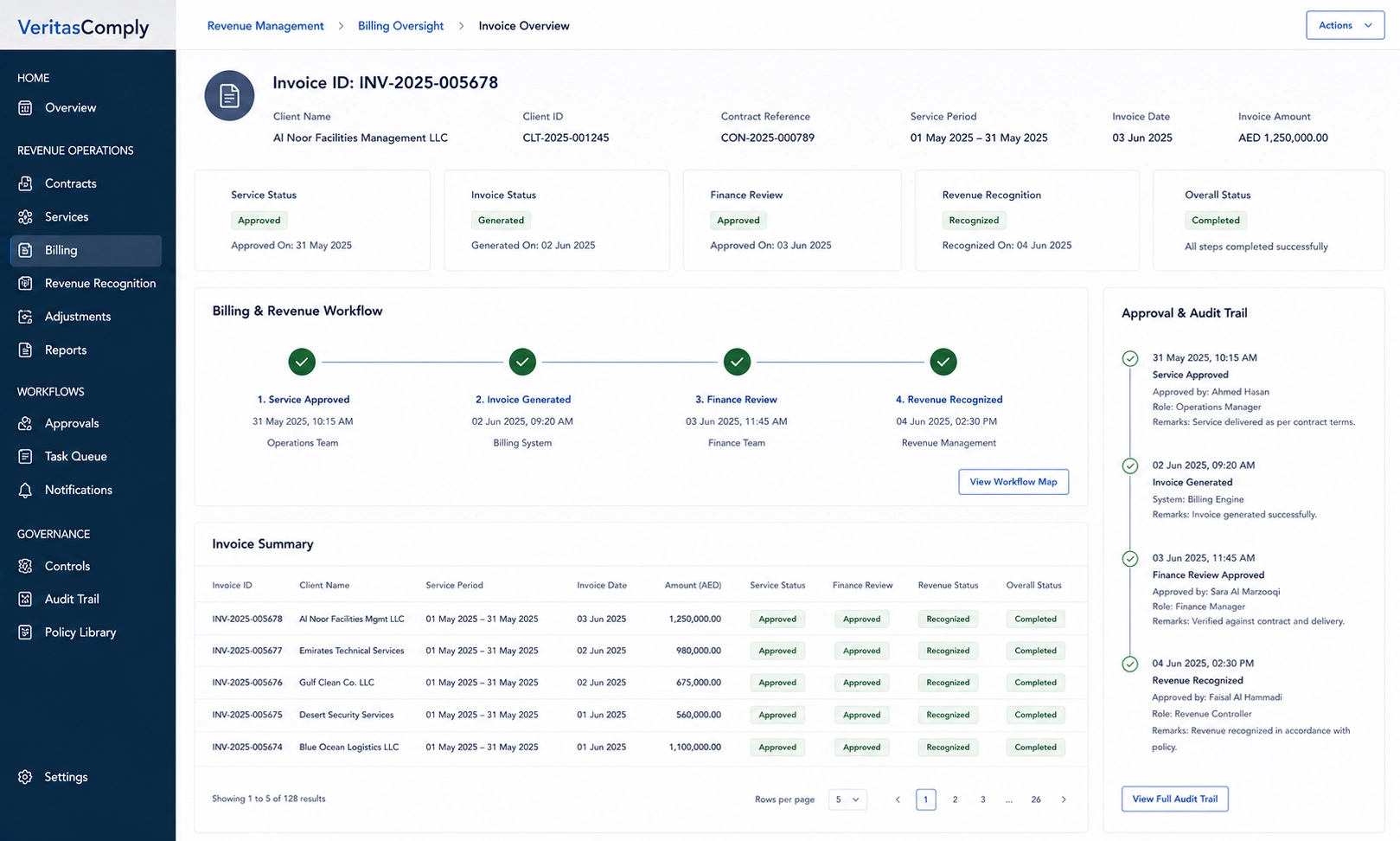
Authorities operating under supervisory frameworks such as the Central Bank of the UAE and expectations associated with the Saudi Central Bank (SAMA) are placing greater emphasis on whether financial activity aligns with documented operational processes and client arrangements.
This shift reflects a broader supervisory concern around transparency and control consistency. Billing activity often provides regulators with a practical view into how firms operate beyond formal policy documentation. Revenue timing, fee application, and invoice patterns can reveal whether controls are functioning consistently across departments and processes.
As a result, supervisory reviews increasingly examine:
Whether invoicing practices align with approved client arrangements
Whether revenue recognition timing reflects actual service delivery or operational activity
Whether fee structures are applied consistently across comparable clients or transactions
Whether changes to billing terms are properly authorized and documented
In UAE based inspections, firms have been asked to explain inconsistencies between operational records and invoicing timelines. In Saudi supervisory reviews, regulators have examined whether irregular billing practices indicate weaknesses in approval governance or client management controls.
The focus is no longer limited to financial accuracy alone.
It is increasingly connected to conduct, governance, and operational integrity.
Billing activity sits close to several operational and regulatory processes. Client onboarding, service approvals, contract management, and financial reporting often intersect within the revenue lifecycle. Because of this, irregularities in billing behaviour can expose weaknesses that extend beyond finance functions.
Delayed invoicing may indicate breakdowns in operational approval processes. Inconsistent fee structures may suggest poor control over client agreements. Revenue recognized outside expected timelines may raise questions around internal governance and oversight.
From a supervisory perspective, these issues are significant because they may reveal that operational processes are not functioning consistently or transparently.
The concern is not necessarily the billing discrepancy itself. It is what the discrepancy suggests about the reliability of the surrounding control environment.
These risks frequently become visible during supervisory inspections or targeted reviews.
A regulator may begin by reviewing a sample of client engagements, invoices, or revenue records alongside supporting operational documentation. Firms provide contracts, billing schedules, approval records, and financial data.
The pressure point emerges when supervisors compare these records against operational activity.
Invoices may be issued significantly later than the associated services. Fee structures may differ between similar client arrangements without a clear explanation. Revenue recognition timing may not align with operational milestones or approvals.
In several UAE inspections, firms have been asked to reconcile invoicing timelines with documented client activity and service delivery records. In Saudi supervisory reviews, regulators have questioned whether fee adjustments and billing exceptions were subject to appropriate authorization controls.
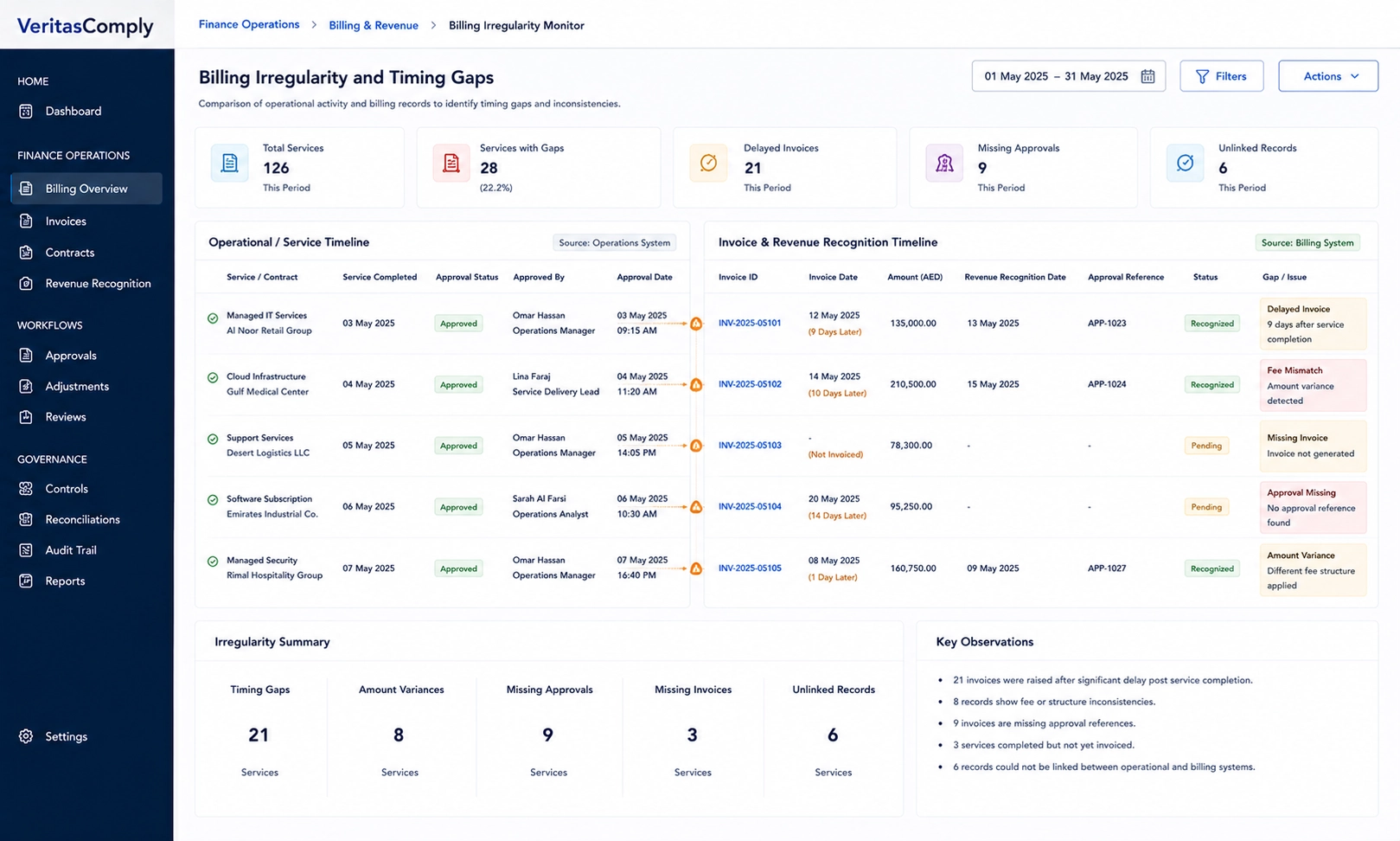
Where these inconsistencies cannot be clearly explained, the issue moves beyond finance operations.
It becomes a question of governance reliability and control effectiveness.
Once irregular billing patterns are identified, supervisory interpretation typically broadens beyond the individual transactions under review.
Regulators assess whether the issue reflects isolated operational gaps or a wider weakness in governance frameworks and management oversight. Repeated inconsistencies in revenue recognition or billing practices may suggest that approval structures, authorization processes, and operational controls are not functioning consistently.
Where firms are unable to demonstrate clear linkage between operational activity, contractual arrangements, and billing outcomes, supervisors may conclude that:
Control processes are fragmented or inconsistently applied
Approval and authorization frameworks are ineffective
Financial and operational governance are insufficiently aligned
In GCC supervisory contexts, findings related to billing irregularities have increasingly triggered broader examination of operational governance, client management controls, and oversight structures.
What initially appears as a finance issue is often interpreted as a wider conduct and governance concern.
Supervisory expectations across the GCC increasingly require organizations to demonstrate that billing activity operates within structured and controlled frameworks.
This includes ensuring that invoicing, fee allocation, and revenue recognition processes are aligned with approved operational activity and supported by clear authorization records.
Effective governance frameworks typically ensure that:
Billing activity is linked directly to approved services or operational events
Fee structures are applied consistently and transparently
Changes to billing arrangements are validated and traceable
Revenue recognition follows clearly defined approval and timing controls
Where these controls are weak or inconsistently applied, supervisors may question whether firms maintain effective oversight over financial conduct and operational governance.
In many organizations, operational activity, contractual records, and billing processes are managed across separate systems. Client engagement details may exist within CRM platforms, operational approvals within workflow systems, and invoicing within finance environments.
Over time, this separation creates fragmentation.
Data may not remain synchronized across systems. Billing timelines may not align with operational records. Approval evidence may exist in disconnected environments.
During supervisory inspections, firms are often required to demonstrate a consistent and traceable relationship between operational activity and financial outcomes. This can become difficult where information is fragmented or maintained independently.
In the UAE inspections, firms have been challenged where billing records could not be directly linked to approved operational activity. In Saudi supervisory contexts, regulators have questioned whether fragmented systems weaken oversight of fee structures and revenue controls.
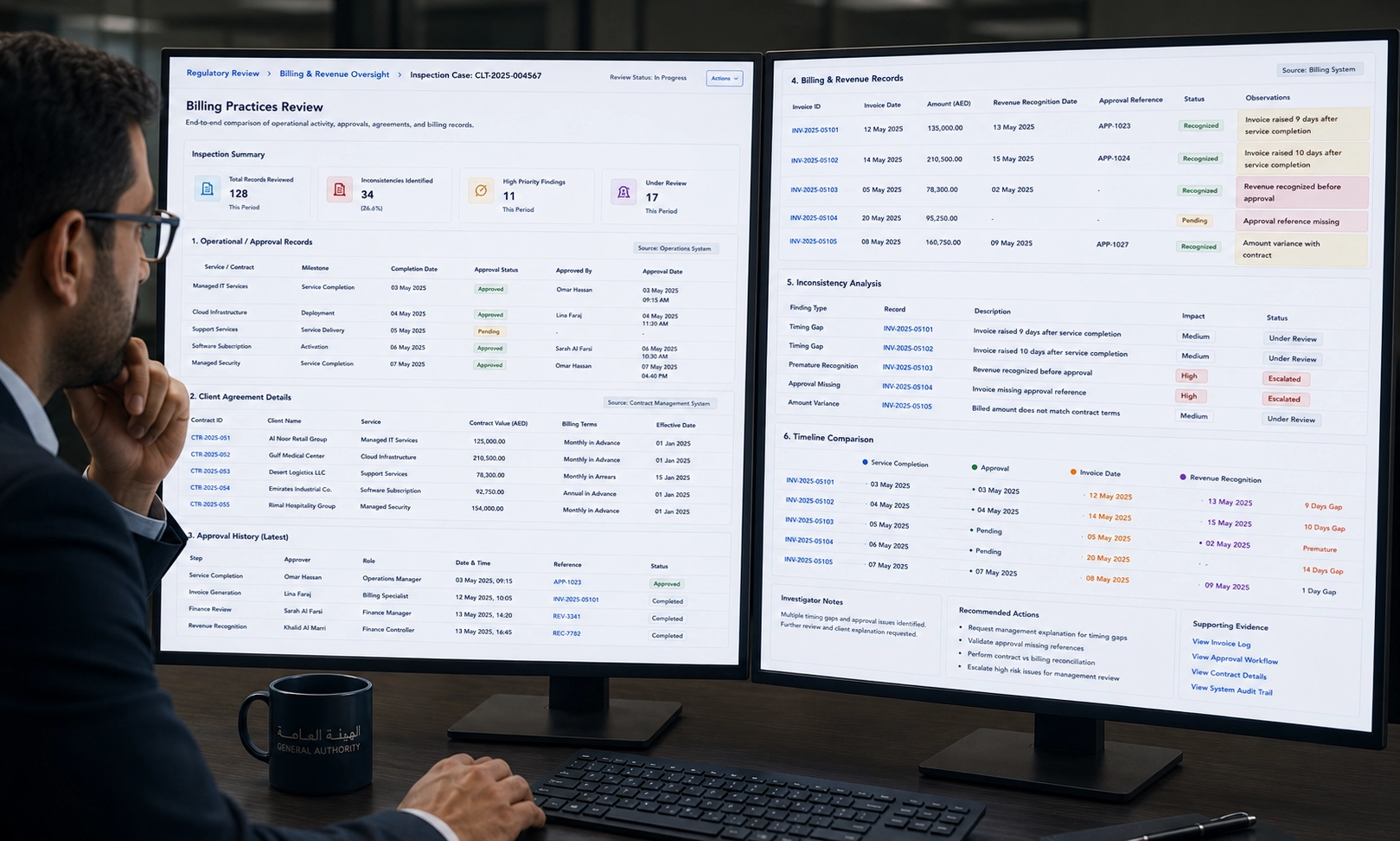
Where firms cannot clearly evidence consistency between operations and billing activity, supervisors may question the reliability of the broader governance environment.
To address these risks, firms are increasingly focusing on ensuring that billing activity operates within structured environments where operational actions, approvals, and financial outcomes remain connected and traceable.
This requires treating billing governance as part of the wider control framework rather than solely as a finance function.
In practice, this means:
Operational approvals and billing actions remain linked across workflows
Revenue recognition follows structured and traceable timelines
Changes to fee arrangements are validated and recorded consistently
Financial and operational data remain aligned across systems
When these conditions are met, firms are better positioned to demonstrate that billing practices operate within controlled and transparent governance frameworks.
Provide us with a bit of information about your business needs and we will be in touch to arrange a no commitment demonstration.


"*" indicates required fields