
It wasn’t fraud.
It wasn’t negligence.
It wasn’t even considered a policy breach.
A critical client deliverable needed to be completed before the end of the week. One approval stage would have delayed the project, so the team agreed to bypass it. The missing approval would be documented afterwards.
Everyone understood it was a one-time exception.
The client received the deliverable on schedule, leadership praised the team’s responsiveness, and business continued as usual.
A month later, another project followed the same approach.
Then another.
Before long, the exception had quietly become part of the operating model.
Nobody had formally approved the change.
Nobody had intentionally redesigned the process.
The organization had simply become accustomed to working around its own controls.
This is how many governance blind spots begin.
Not with major failures, but with practical decisions made under pressure that slowly become accepted business practice.
Across Europe, regulators are paying increasing attention to how organizations govern operational exceptions. They recognize that flexibility is often necessary, but they also expect organizations to demonstrate that every exception is documented, justified, approved, monitored, and eventually resolved.
The greatest governance risk is rarely the first exception.
It is the hundredth one that no longer feels like an exception at all.
Every organization encounters situations where established procedures cannot be followed exactly as designed.
A supplier misses a delivery. A client deadline changes unexpectedly. A key employee becomes unavailable. A technology outage disrupts a critical workflow. Leadership must often make pragmatic decisions to keep operations moving.
These decisions are rarely inappropriate.
In fact, many are necessary.
The problem begins when temporary workarounds remain undocumented, unreviewed, and unchallenged.
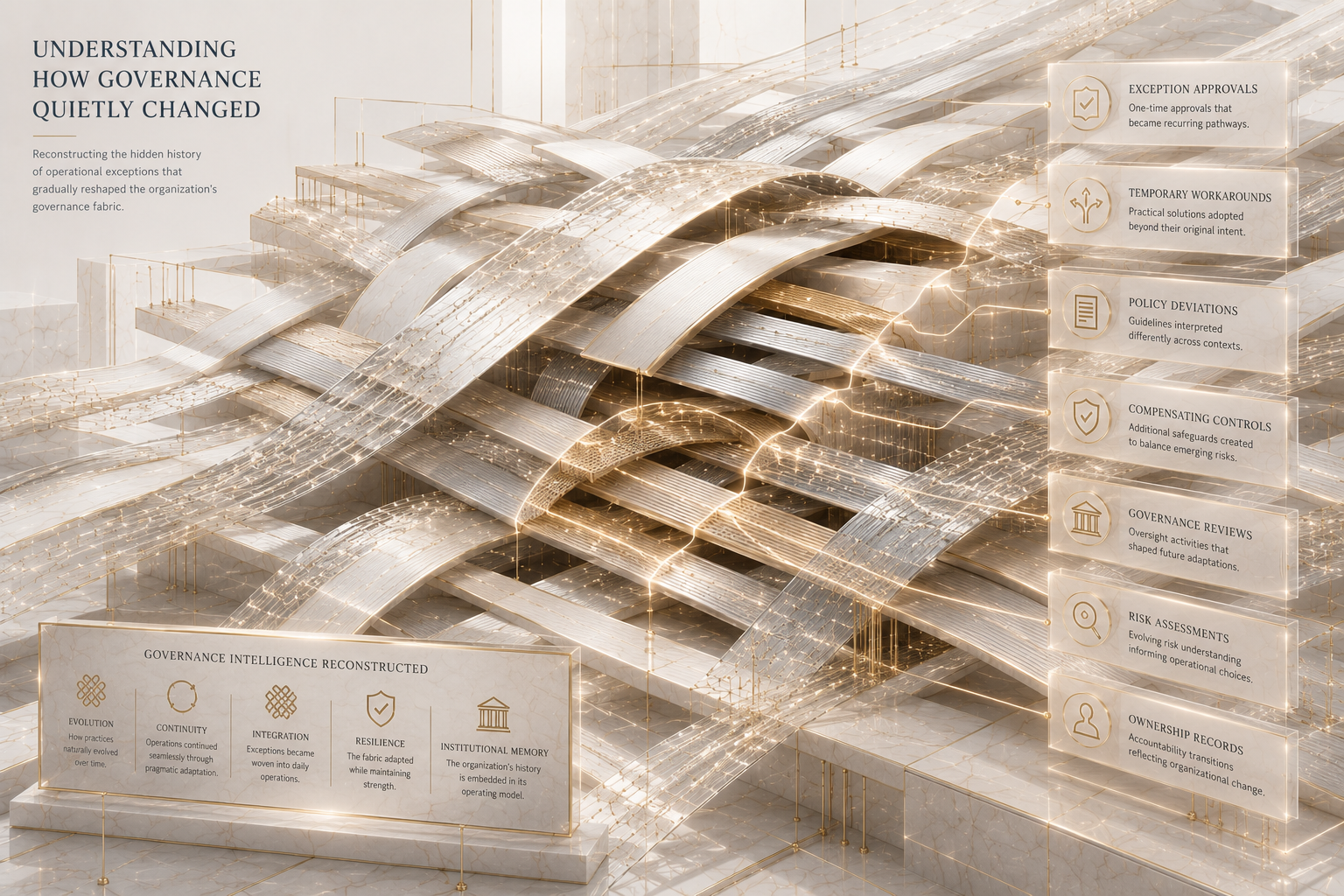
An approval bypassed today becomes an accepted shortcut tomorrow. Manual processes replace automated controls. Informal communications substitute documented workflows. Teams gradually adapt to working around established governance because the workaround appears faster than the formal process.
Eventually, the organization operates according to exceptions rather than policies.
What was once an operational adjustment quietly becomes the new standard.

Organizations often treat operational exceptions as isolated events.
Regulators increasingly do not.
Every exception represents a governance decision.
Someone decided that a process could be modified.
Someone accepted the associated risk.
Someone determined that business priorities justified departing from the standard operating procedure.
The question is whether those decisions remain visible after the immediate pressure has passed.
Without structured exception management, organizations frequently lose sight of why exceptions were introduced, who authorized them, whether the associated risks were assessed, and when normal operating procedures were restored.
Over time, temporary decisions accumulate into permanent operational behaviours.
The governance framework gradually evolves without anyone formally approving the change.
European governance expectations increasingly recognize that operational flexibility must coexist with strong oversight.
The European Banking Authority (EBA) emphasizes governance arrangements that support effective internal controls, clear accountability, and transparent decision-making across operational activities. Likewise, the European Securities and Markets Authority (ESMA) continues to reinforce expectations around governance, operational resilience, and risk management, encouraging organizations to maintain demonstrable oversight over deviations from established processes.
The message is becoming increasingly clear.
Organizations are not expected to eliminate operational exceptions.
They are expected to govern them.
A large European manufacturing organization introduced a temporary manual approval process after upgrading one of its production planning systems.
The workaround was expected to remain in place for four weeks while technical adjustments were completed.
The transition appeared successful.
Production continued without interruption, customer deliveries remained on schedule, and operational teams adapted quickly to the temporary arrangement.
Eighteen months later, internal audit discovered that the manual approval process was still being used across multiple facilities.
Because it had worked effectively during the initial transition, teams had continued relying on it long after the original justification no longer existed.
No formal review had assessed whether the exception should remain in place.
No governance committee had approved the revised operating model.
The organization had unintentionally replaced a controlled workflow with an undocumented operational practice.
Following the review, the company implemented centralized exception management supported by workflow automation, documented approvals, risk assessments, and periodic governance reviews.
Operational flexibility remained.
The difference was that every exception now had visible ownership, justification, review dates, and formal closure.
Reviewers increasingly distinguish between controlled exceptions and uncontrolled operating practices.
Organizations that can clearly demonstrate why an exception was introduced, who approved it, how associated risks were assessed, and when the exception was reviewed are generally viewed very differently from organizations where temporary workarounds evolve without governance oversight.
Exception management is increasingly regarded as an indicator of operational discipline rather than administrative compliance.
Operational exceptions often remain invisible until auditors ask a deceptively simple question.
“Is this your documented process?”
The answer is usually yes.
The follow-up question creates the real challenge.
“Then why are your teams doing something different?”
Reviewers begin tracing how operational practices evolved.
They examine whether exceptions were formally approved, whether associated risks were evaluated, whether compensating controls were introduced, and whether management regularly reviewed the continuing need for those deviations.
Organizations frequently discover that individual exceptions were well understood.
What they cannot demonstrate is how dozens of separate exceptions collectively changed the way the business operated.
At that point, the review moves beyond process compliance.
It becomes an assessment of governance effectiveness.

Temporary workarounds rarely attract regulatory attention on their own.
The concern arises when those workarounds begin replacing established governance.
Repeated exceptions may indicate ineffective operational controls. Persistent deviations can expose weaknesses in workflow governance, risk management, and management oversight. Informal practices often make accountability more difficult to demonstrate, while undocumented process changes weaken organizational resilience.
What initially appears to be operational flexibility can therefore evolve into a broader governance concern.
Leading organizations recognize that exceptions should remain visible throughout their lifecycle.
Not because flexibility is undesirable.
But because flexibility without governance gradually becomes unpredictability.
Every organization needs flexibility.
Markets change. Customers make urgent requests. Systems fail. Regulations evolve. Business realities sometimes require temporary deviations from standard procedures.
Strong governance does not eliminate these situations.
It ensures they remain transparent, accountable, and temporary.
Organizations that mature operationally do not measure success by how few exceptions they have.
They measure success by how effectively those exceptions are governed, reviewed, documented, and resolved before they become permanent operating practices.
Moebius supports this approach through integrated Workflow Management, Compliance Management, Risk Management, and Workflow Automation capabilities that enable organizations to record operational exceptions, assign ownership, automate approvals, monitor review dates, maintain supporting evidence, and preserve complete governance visibility throughout the exception lifecycle.
The most resilient organizations are not those that never deviate from process.
They are the ones that can always explain why they did, who approved it, what controls remained in place, and when normal governance was restored.
Provide us with a bit of information about your business needs and we will be in touch to arrange a no commitment demonstration.


"*" indicates required fields