
Three years ago, the board approved a strategic decision that transformed the organization.
The investment was significant, the implementation was successful, and the commercial results exceeded expectations. Leadership frequently referred to it as one of the company’s defining moments.
No one questioned whether it had been the right decision.
The question arose much later.
During a governance review, external reviewers requested the documentation supporting the board’s decision. They wanted to understand the assumptions that had been considered, the risks that had been evaluated, the alternatives that had been rejected, and the approvals that ultimately led to the final outcome.
The minutes of the meeting were available.
The reasoning behind the decision was not.
Some supporting reports had been archived. Several approvals remained within email correspondence. Risk assessments had been revised multiple times before the meeting, while comments from key stakeholders existed only inside collaboration platforms that were no longer actively used.
The organization could prove what had been decided.
It struggled to explain why the decision had been made.
Across Europe, governance expectations are evolving beyond documenting outcomes. Regulators, auditors, and boards increasingly expect organizations to demonstrate the rationale, evidence, ownership, and approval history behind significant decisions.
Decision-making is no longer assessed solely by its results.
It is increasingly evaluated by its traceability.
Every important decision begins with a conversation.
Ideas are discussed. Risks are evaluated. Financial models are reviewed. Legal opinions are considered. Operational impacts are assessed, and leadership challenges assumptions before reaching a conclusion.
The meeting eventually ends.
The decision, however, continues influencing the organization for years.
Acquisitions reshape business strategy. Compliance decisions affect regulatory relationships. Policy approvals influence operational behaviour. Commercial decisions determine investment priorities, while governance resolutions establish long-term accountability.
Over time, the context surrounding those decisions begins to fade.
Supporting documents are stored in different repositories. Approval records become separated from meeting minutes. Email discussions remain isolated from formal governance records, while revised reports gradually replace earlier versions that originally influenced executive thinking.
The organization preserves the outcome.
The decision-making journey slowly disappears.

Weak decision traceability rarely becomes visible during everyday operations.
Leadership already understands why recent decisions were made because the discussions remain fresh, stakeholders are still involved, and supporting information is readily available. The challenge emerges months or years later.
Leadership teams change. Board members rotate. Regulatory expectations evolve. Internal reviews revisit historical decisions, while auditors seek evidence explaining how significant conclusions were reached.
At that point, organizations often discover that information still exists.
What has been lost is the connection between that information.
Meeting minutes exist separately from risk assessments. Board papers remain disconnected from supporting evidence. Legal advice sits within isolated repositories, while approval histories become fragmented across different communication channels.
Without structured governance over decision records, reconstructing the complete rationale becomes increasingly difficult.
European regulators are placing greater emphasis on decision governance as part of broader expectations around accountability and organizational transparency.
The European Banking Authority (EBA) highlights the importance of effective governance arrangements, reliable information flows, and documented decision-making processes that support management accountability. Likewise, the European Securities and Markets Authority (ESMA) continues to reinforce governance expectations that enable organizations to demonstrate how significant decisions are supported, approved, and evidenced throughout their lifecycle.
These expectations reflect an important shift.
Governance is no longer measured only by the quality of decisions.
It is increasingly measured by the organization’s ability to explain them.
Organizations frequently assume that experienced employees preserve decision history.
Initially, they do.
Executives remember why certain risks were accepted. Legal teams recall the discussions that influenced contractual decisions. Finance leaders understand why specific assumptions were approved, while compliance officers remember the regulatory context that shaped governance outcomes.
Institutional memory, however, is not permanent.
People retire. Leadership changes. Teams restructure. Responsibilities move between departments, while digital collaboration tools continue accumulating fragmented information across multiple environments.
Eventually, organizations become dependent on individual recollection to explain decisions that should already be fully documented.
What begins as an information challenge gradually becomes a governance vulnerability.
A European asset management firm underwent an external governance assessment following a significant acquisition completed several years earlier.
The transaction itself had been successful.
However, reviewers requested evidence demonstrating how the board had evaluated operational risks before approving the acquisition.
The organization quickly assembled board minutes, financial reports, and legal documentation.
What proved significantly harder was reconstructing the complete decision narrative.
Risk assessments existed in different repositories. Earlier financial models had been overwritten by updated versions. Comments from executive committees remained within archived collaboration platforms, while supporting approvals had been exchanged through email correspondence rather than centralized governance records.
Although the acquisition itself was never questioned, the review identified weaknesses in the organization’s ability to evidence executive decision-making.
Following the assessment, the firm introduced centralized governance records, structured approval workflows, integrated document management, and executive decision repositories.
Future decisions became easier to defend because the complete governance history remained connected from initiation through approval.

Governance reviewers are increasingly distinguishing between documented decisions and traceable decisions.
A board resolution, executive approval, or management record may confirm that a decision was made. Increasingly, however, supervisors expect organizations to demonstrate the complete governance journey behind that decision—who contributed, what evidence was considered, how risks were evaluated, what alternatives were discussed, and why the final course of action was approved.
Decision traceability is becoming a reflection of governance maturity rather than administrative discipline.
Decision traceability gaps rarely emerge during routine business operations.
They become visible when an external party asks the organization to revisit a decision long after it was made.
Auditors, regulators, and governance reviewers frequently request information such as:
Producing the final decision itself is rarely the problem.
The difficulty begins when organizations attempt to rebuild the decision-making journey.
Supporting reports may exist in separate repositories. Legal advice may have been exchanged through email. Comments from executive committees may remain inside collaboration platforms, while revised documents gradually replace the versions originally presented to decision-makers.
Each piece of information exists.
The governance story connecting those pieces has quietly disappeared.
When this happens, the review no longer focuses solely on one historical decision.
It becomes an assessment of how effectively the organization governs executive decision-making as a whole.
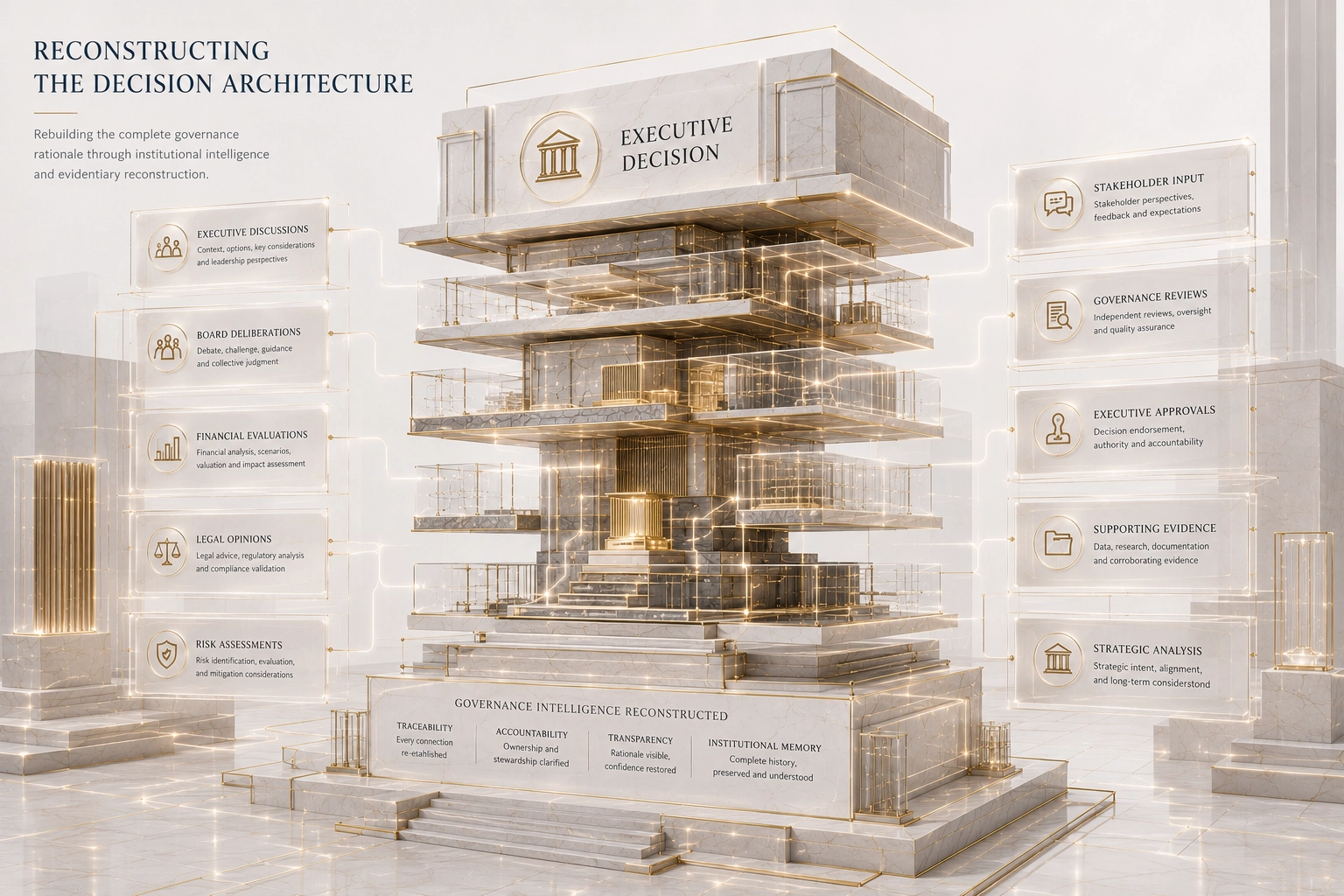
Weak decision traceability rarely exists in isolation.
Reviewers often examine what missing context reveals about the broader governance environment.
Incomplete approval histories may prompt questions regarding delegated authority. Missing supporting evidence may lead to reviews of document governance. Inconsistent decision records can expose weaknesses in executive reporting, board administration, or information governance, while fragmented documentation may raise concerns regarding organizational accountability.
What initially appears to be a historical documentation issue can quickly evolve into a broader evaluation of governance effectiveness.
Across Europe, organizations are increasingly expected to demonstrate not only that governance decisions were appropriate, but that they remain transparent, defensible, and fully traceable years after they were made.
This represents an important shift.
Governance is no longer measured only by the quality of executive judgement.
It is increasingly measured by the organization’s ability to preserve the reasoning behind that judgement.
Organizations invest significant time preparing board papers, executive reports, financial analysis, legal opinions, and risk assessments before major decisions are made.
Yet once the decision is approved, those valuable governance records often become dispersed across document repositories, meeting records, email conversations, and individual departments.
Over time, the decision survives.
The context that justified it gradually fades.
Leading organizations are beginning to recognize that governance requires more than maintaining minutes of meetings.
It requires preserving the complete decision narrative—from the first recommendation and supporting evidence through approvals, discussions, revisions, and final authorization.
This is where Moebius supports organizations.
Through its integrated Document Management, Workflow Automation, Reporting, and governance capabilities, Moebius enables organizations to centralize executive decision records, connect supporting documentation with approval workflows, preserve complete audit trails, and maintain a continuously traceable governance history for every significant decision.
When governance reviews take place, organizations should not have to rebuild the reasoning behind critical decisions.
They should already possess a complete and connected record that explains not only what was approved, but why, how, and by whom.
Because ultimately, decisions shape an organization’s future.
The ability to explain those decisions shapes confidence in its governance.
Provide us with a bit of information about your business needs and we will be in touch to arrange a no commitment demonstration.


"*" indicates required fields