
Regulated firms across Europe depend on accurate and unified client identities to support onboarding, customer due diligence, transaction monitoring, and regulatory reporting. Each of these processes assumes that a single, consistent client profile exists across the organization. In well-controlled environments, this profile forms the foundation for how risk is assessed and managed throughout the client lifecycle.
In practice, this assumption is increasingly being challenged.
Supervisory reviews across European jurisdictions are identifying situations where multiple profiles exist for the same client across different systems. These profiles may contain variations in identity information, contact details, risk classification, or transaction history. What appears internally as a data management issue is increasingly being interpreted as a weakness in control.
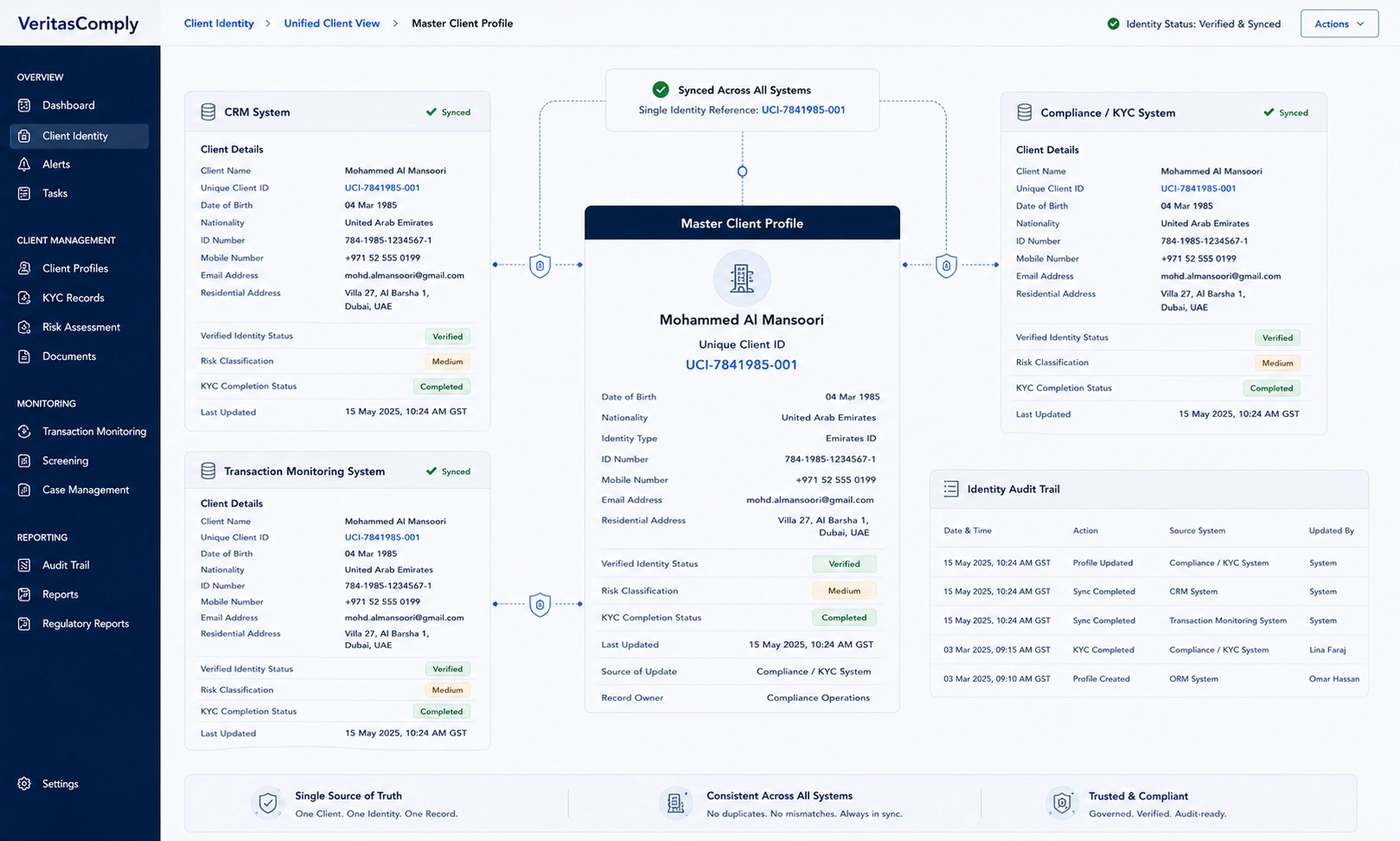
European regulators are placing greater emphasis on whether firms maintain a single, reliable view of each client across their systems and processes. The expectation is not limited to accurate onboarding but extends to ensuring that identity information remains consistent and traceable across all operational and compliance environments.
Authorities influenced by supervisory approaches from the European Banking Authority are increasingly examining how client identities are maintained, updated, and reconciled across systems. Reviews often focus on whether firms can demonstrate that all records associated with a client are aligned and reflect a consistent risk profile.
In supervisory inspections, firms have been asked to explain how duplicate records are identified and resolved, and how inconsistencies between systems are prevented. Where firms cannot provide a clear and controlled approach, identity fragmentation is not treated as a technical issue.
It is treated as a control weakness.
Client identity is not an isolated data point. It underpins a range of compliance activities, including KYC verification, risk classification, transaction monitoring, and suspicious activity reporting. When multiple profiles exist for the same individual or entity, these processes may operate on incomplete or inconsistent information.
In fragmented environments, one system may reflect a higher risk classification while another shows the client as low risk. Transaction monitoring alerts may be generated under one profile but not linked to another. Onboarding checks may be performed on one record while duplicate records remain unverified.
From a supervisory perspective, this creates a critical concern.
If a firm cannot reliably identify a client as a single entity, it cannot demonstrate that its controls are applied consistently or effectively.
This issue typically becomes visible during supervisory inspections, where regulators examine client records across multiple systems rather than in isolation.
A review may begin with a sample of onboarding files or KYC records. Firms provide documentation showing identity verification, risk assessment, and approval processes. On initial review, each record may appear complete.
The pressure point emerges when supervisors compare these records across systems.
They may identify multiple profiles for the same client with differing identifiers, incomplete linkage, or inconsistent updates. In European inspections, firms have been asked to reconcile discrepancies between CRM systems, compliance platforms, and transaction monitoring tools. In some cases, duplicate profiles have resulted in incomplete monitoring coverage or inconsistent risk classification.
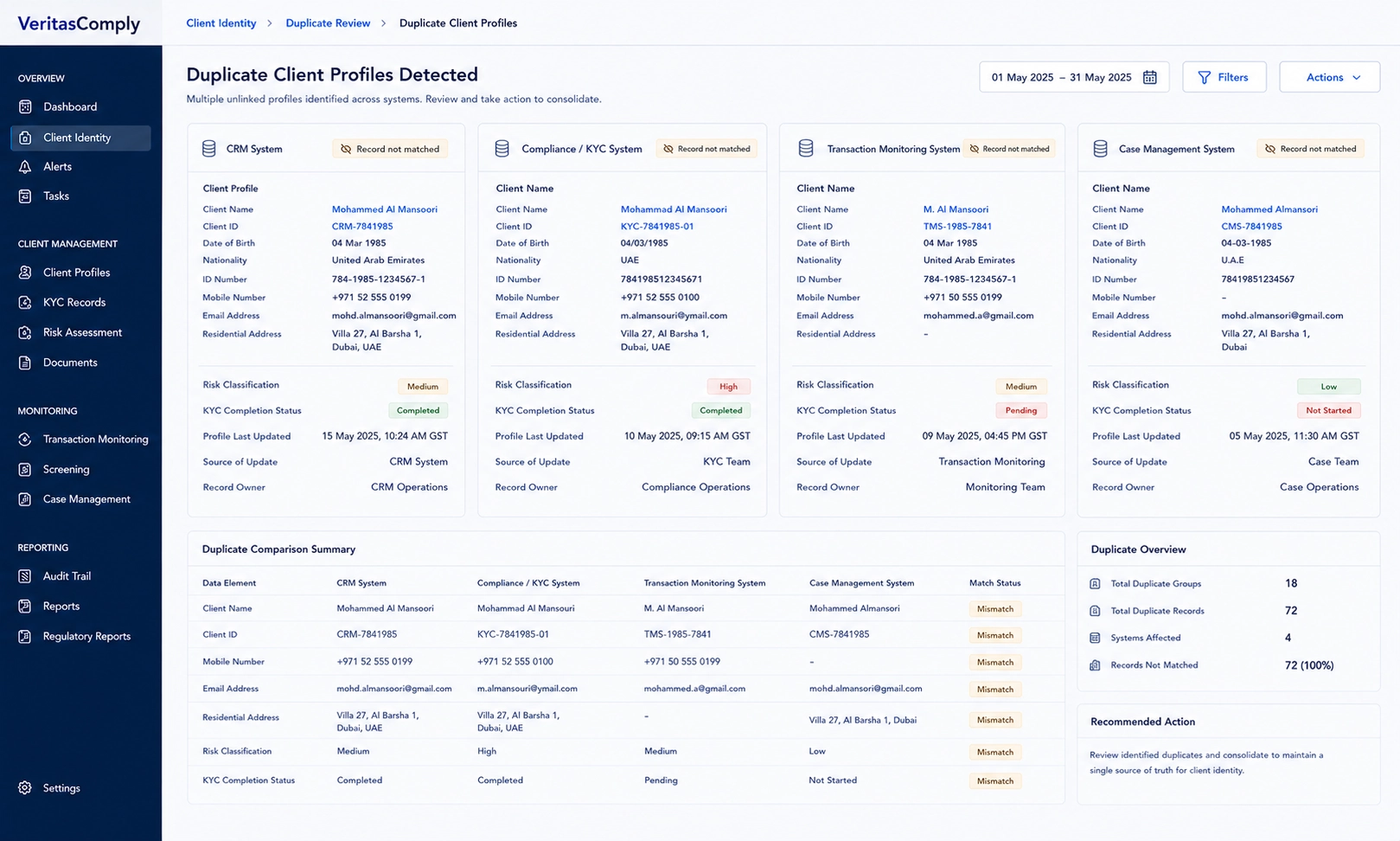
At this stage, the issue is no longer data duplication.
It becomes a question of whether the firm maintains a coherent and controlled view of its clients.
Once identity fragmentation is identified, supervisory interpretation typically broadens beyond the specific records under review. Regulators assess whether the issue reflects isolated data inconsistencies or a structural weakness in how client information is managed across the organization.
Where firms cannot demonstrate a consistent and unified client identity, supervisors may conclude that:
Customer due diligence processes are incomplete or inconsistent
Transaction monitoring coverage may be fragmented
Risk assessments may not reflect the full client profile
Control frameworks are not operating on reliable data
In European supervisory contexts, such findings have led to expanded reviews of onboarding processes, data governance frameworks, and system integration. What initially appears as duplication often escalates into a broader concern about control effectiveness.
Supervisory expectations across Europe increasingly require firms to maintain a single, authoritative view of each client. This involves ensuring that identity data is consistently applied, updated, and reconciled across all systems and processes.
Effective governance frameworks typically ensure that duplicate records are detected and resolved, that changes to client data are validated, and that all systems reflect a synchronized and accurate view of the client. Where discrepancies arise, they are expected to be identified and corrected promptly.
Where firms operate with multiple, unlinked client profiles, supervisors may question whether governance frameworks are sufficiently robust to support regulatory compliance.
In many organizations, client data is maintained across separate systems, including onboarding platforms, CRM tools, compliance systems, and transaction monitoring environments. Each system may capture and update information independently, leading to divergence over time.
This fragmentation creates challenges during supervisory reviews.
Firms may need to demonstrate how a single client identity is represented across multiple systems, how discrepancies are resolved, and how updates are synchronized. Where this process is manual or inconsistent, evidence becomes difficult to produce.
In European inspections, firms have been challenged where identity data could not be reconciled across systems or where duplicate records remained active without clear linkage. Such situations raise concerns about the reliability of the firm’s data environment.
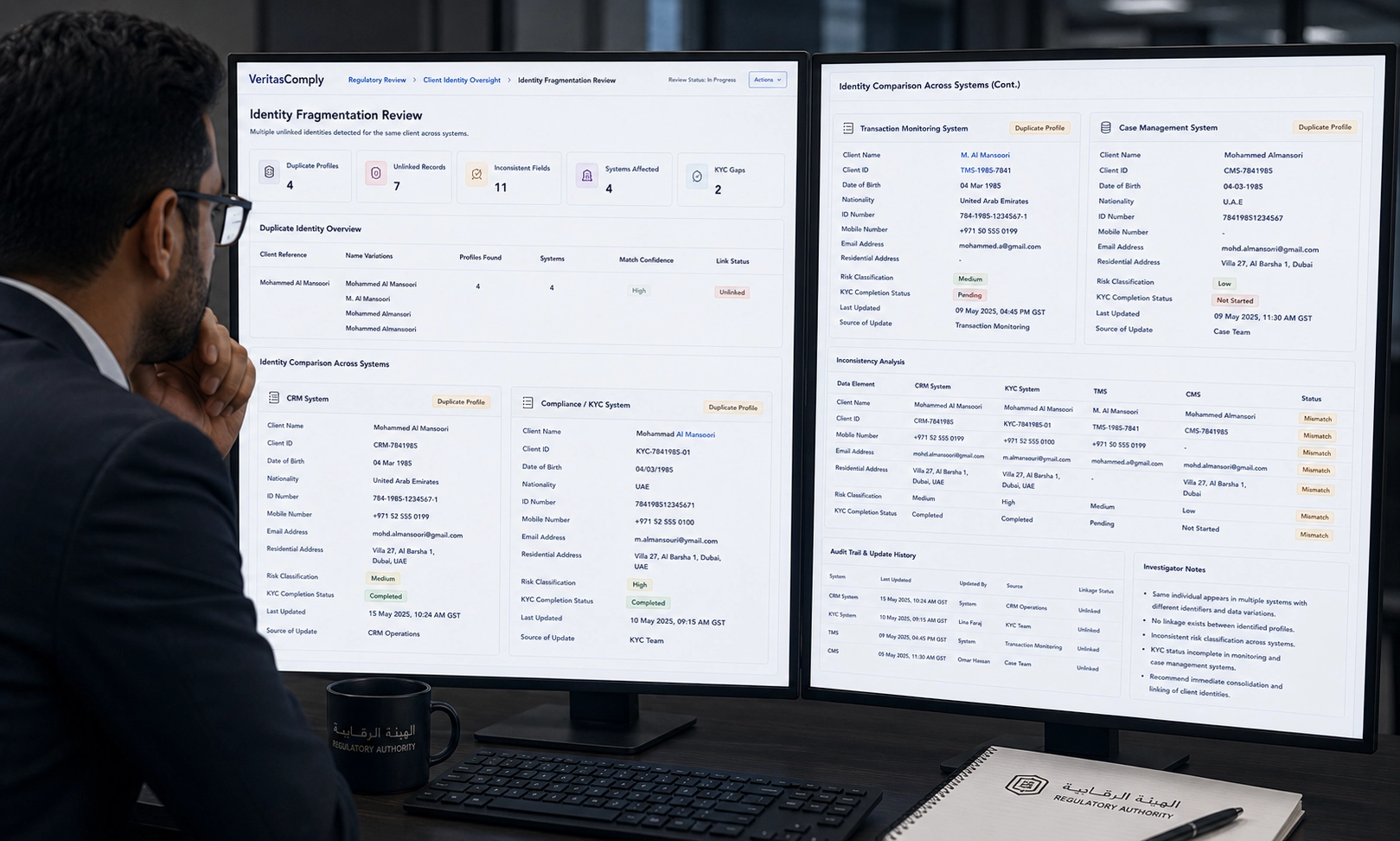
Where identity consistency cannot be demonstrated, supervisors may question whether the firm has effective control over its customer base.
To address these risks, firms are increasingly focusing on ensuring that client identity is managed within structured environments where data remains consistent, traceable, and aligned across systems.
This involves treating identity management as a core component of the control framework rather than a supporting data function.
In practice, this means that client identities are maintained as a single, unified record, that duplicate profiles are prevented or resolved through controlled processes, and that updates are reflected consistently across all relevant systems. It also requires that identity related controls are embedded within onboarding, monitoring, and reporting workflows.
Provide us with a bit of information about your business needs and we will be in touch to arrange a no commitment demonstration.


"*" indicates required fields