
Regulated firms across the GCC increasingly rely on third parties to support operational and compliance functions. These arrangements often include onboarding support, transaction monitoring, and document processing, placing external providers close to the firm’s control environment.
Contracts, service level agreements, and defined scopes of work typically govern these relationships. Responsibilities appear clearly allocated and documented.
From an internal perspective, this creates a sense of structured control.
Supervisory reviews are approaching the issue differently.
The question is not whether outsourcing exists, but whether control remains with the firm once execution moves outside it.
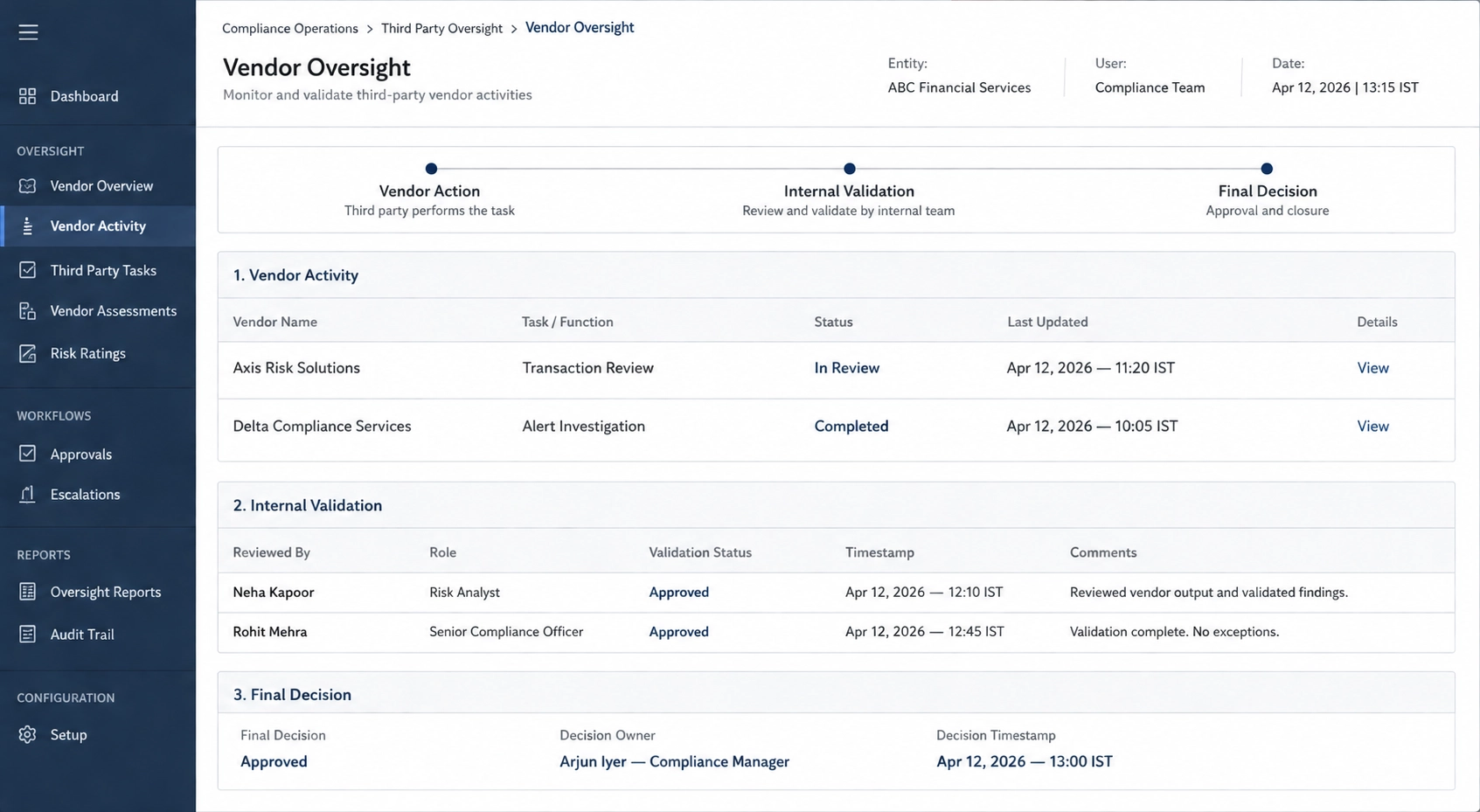
Outsourcing does not alter regulatory responsibility. This position is consistently reflected across GCC supervisory frameworks.
What is evolving is how this principle is tested.
Authorities such as the Central Bank of the UAE and the Saudi Central Bank (SAMA) are placing less emphasis on contractual arrangements and more on how outsourced activities operate in practice.
Supervisory reviews now examine whether third-party execution reflects the same level of control expected within the regulated firm.
This includes assessing:
Whether decisions made by vendors are visible to the firm
Whether those decisions are subject to internal validation
Whether execution aligns with defined control standards
In UAE inspections, firms have been asked to demonstrate how outsourced activities are monitored beyond periodic reporting. In Saudi supervisory reviews, a similar focus has been placed on whether firms retain sufficient oversight over vendor-driven processes.
Where this equivalence cannot be demonstrated, outsourcing is treated as a gap in control.
As vendors become embedded in daily operations, a gradual shift often occurs.
Execution moves outside the firm. Accountability remains within it.
Over time, this distinction can become less visible.
Internal teams may rely on vendor outputs without fully validating how those outcomes were reached. Oversight becomes periodic. Control becomes assumed rather than evidenced.
This creates conditions where:
The origin of decisions is unclear
Internal authorization points are not consistently applied
Escalation mechanisms are not triggered or documented
From a supervisory perspective, these are not isolated issues. They indicate that control is no longer anchored within the firm.
These gaps typically become visible during inspection.
A review may begin with a focused sample, such as transaction monitoring alerts, where initial analysis has been outsourced. Firms provide process descriptions, vendor reports, and summary outputs.
At this stage, the structure appears sound.
The pressure point arises when supervisors test how those outcomes were produced.
They may examine how alerts were assessed, what criteria were applied, and whether internal teams reviewed vendor decisions before action was taken.
In UAE-based inspections, firms have been required to demonstrate how vendor-generated outcomes are validated within internal workflows. In Saudi Arabia, supervisors have examined whether firms can explain the rationale behind vendor decisions rather than relying on final outputs alone.
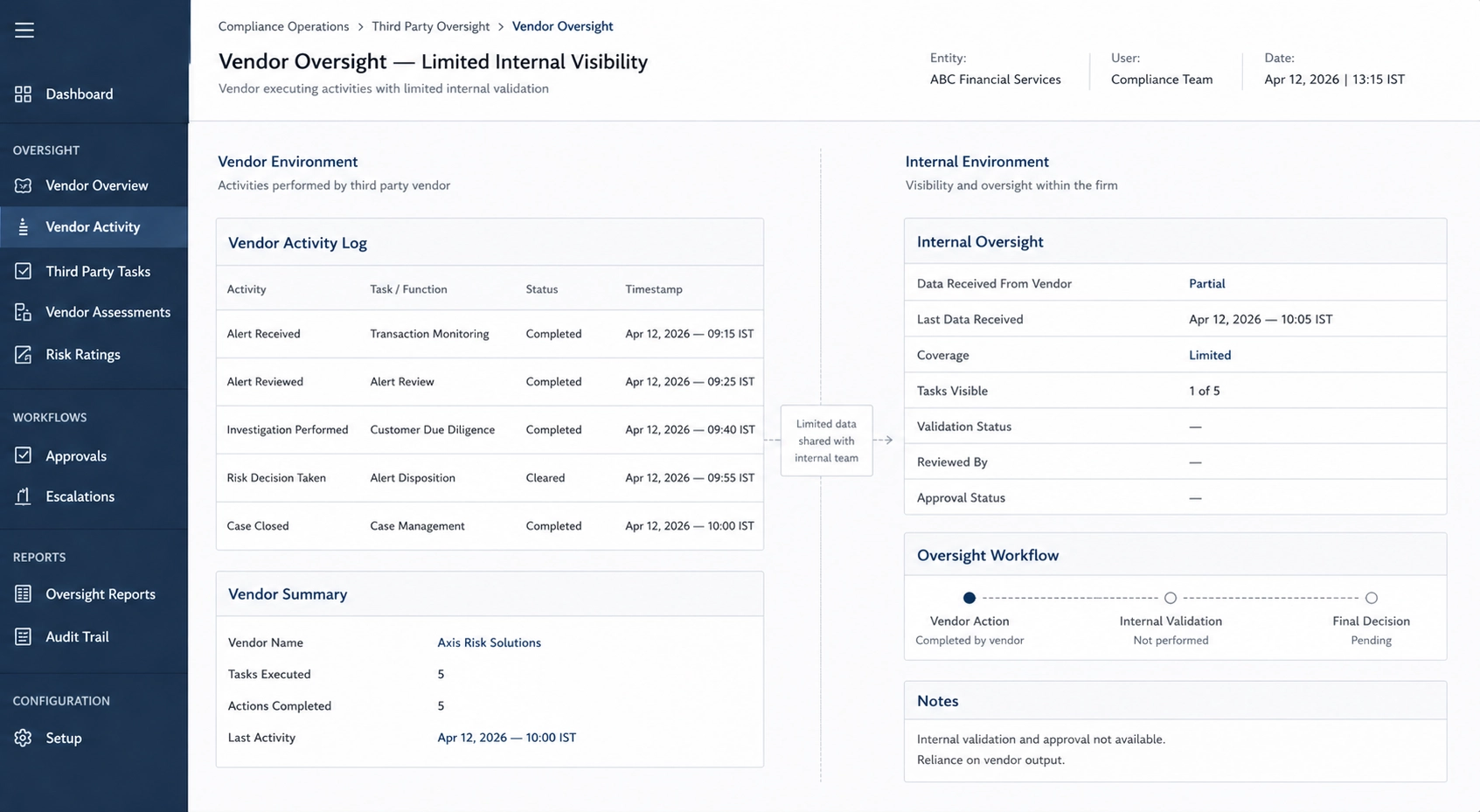
Where this visibility is limited, the issue is no longer outsourcing.
It is a loss of control.
Once gaps in oversight are identified, supervisors rarely treat them as isolated findings.
The assessment typically broadens. What begins as a question about monitoring may lead to a wider review of how outsourced functions are governed across the organization.
The interpretation shifts:
From incomplete oversight
To have insufficient control over external execution
To identify potential weaknesses in governance and management accountability
Under UAE supervisory approaches, such findings have led to expanded reviews across multiple outsourced functions. In Saudi supervisory contexts, similar observations have prompted closer examination of how firms manage third-party dependencies at a governance level.
At this stage, the issue is no longer operational.
It is structural.
Supervisory expectations across the GCC require that outsourced activities remain within the firm’s control environment in a practical sense.
This goes beyond periodic reporting.
Firms are expected to demonstrate that:
Vendor activities are visible as they occur
Decisions made externally are subject to internal validation
Oversight is embedded within workflows
Control standards are consistently applied regardless of where execution occurs
Where oversight is retrospective, supervisors may view this as insufficient.
Control is expected to operate continuously.
In many firms, vendor execution and internal oversight are maintained in separate systems.
Vendors operate within their own platforms. Internal teams rely on reports or extracted data.
Communication may occur across additional channels.
This creates fragmentation.
During inspections, firms are required to reconstruct how a process was executed across these environments. This often involves combining vendor outputs, internal reviews, communication records, and decision logs.
Even where oversight exists, presenting it clearly can be difficult.
In the UAE inspections, firms have been challenged where vendor actions could not be directly linked to internal validation. In Saudi supervisory reviews, similar fragmentation has raised concerns about whether oversight is effectively embedded.
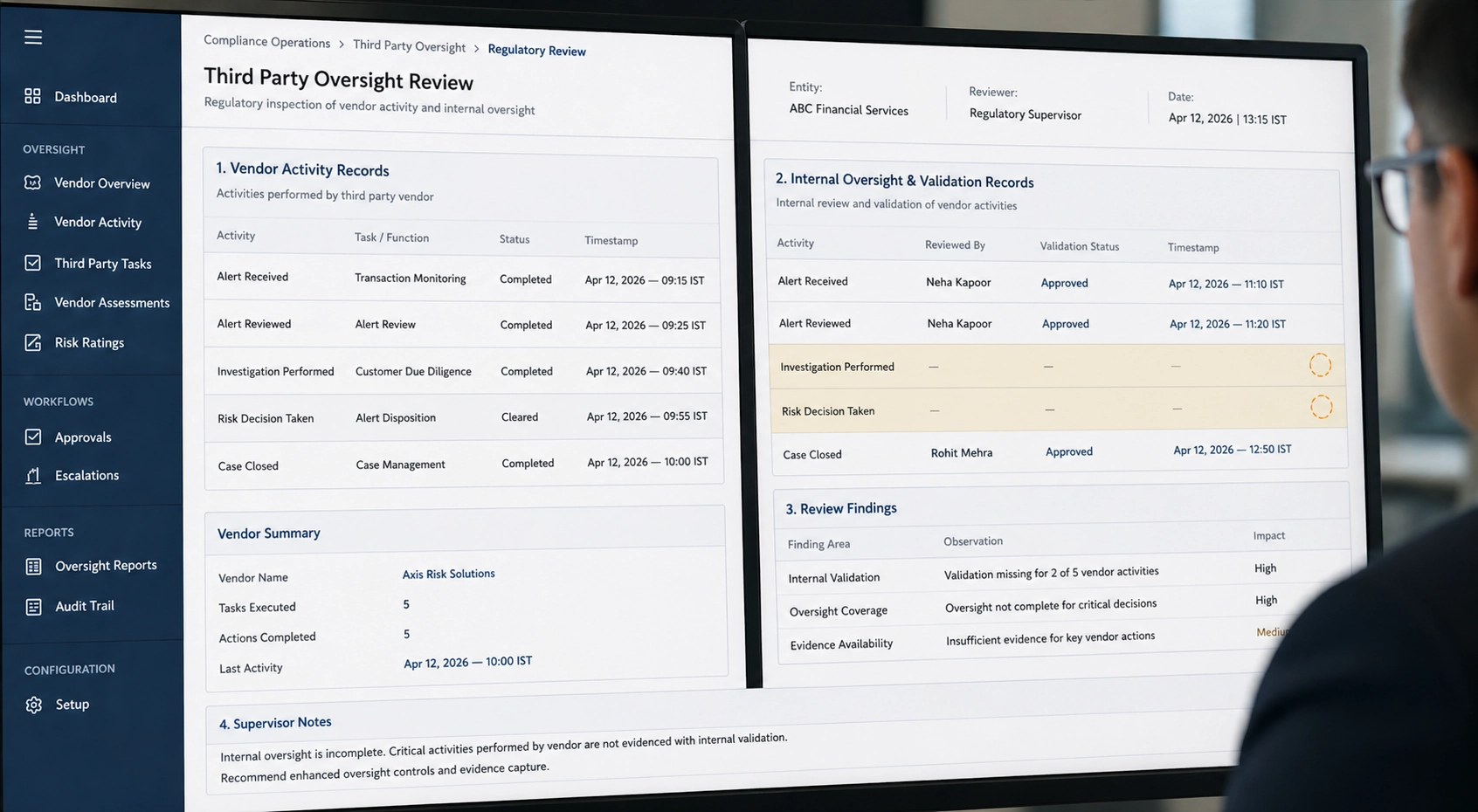
Where evidence is difficult to produce, supervisors may question whether control exists in practice.
Firms are increasingly expected to ensure that outsourced activities operate within environments that are controlled, visible, and aligned with internal governance.
This requires extending control beyond organizational boundaries.
In practice, this means:
Vendor activities are captured within systems accessible to the firm
Decisions made externally are reviewed before action is finalized
Oversight is embedded within workflows rather than applied after completion
Control standards remain consistent across internal and external execution
When these conditions are met, firms are better positioned to demonstrate that outsourcing does not weaken their control environment.
Provide us with a bit of information about your business needs and we will be in touch to arrange a no commitment demonstration.


"*" indicates required fields