
Over the past decade, many firms operating in the Gulf Cooperation Council have adopted regional hub and group-wide operating models. Compliance, risk management, and corporate oversight are frequently centralized outside the licensed entity, often for efficiency or consistency. While these structures are not prohibited, supervisors across the GCC have increasingly highlighted that they introduce supervisory friction when accountability, data ownership, and decision-making are dispersed across jurisdictions.
By 2026, supervisory reviews will no longer assess group structures only at a conceptual level. Regulators are examining how cross-border models function in practice and whether local regulatory responsibilities are genuinely exercised within the licensed entity.
Group structures are typically designed to centralize expertise, reduce duplication, and standardize controls. In theory, group policies and centralized compliance functions should enhance consistency. In practice, supervisors often encounter gaps between group-level design and local execution.
Common supervisory concerns arise where:
Supervisors are not challenging the existence of group models themselves. Instead, they are questioning whether local management retains sufficient authority and responsibility to meet jurisdiction-specific regulatory obligations.
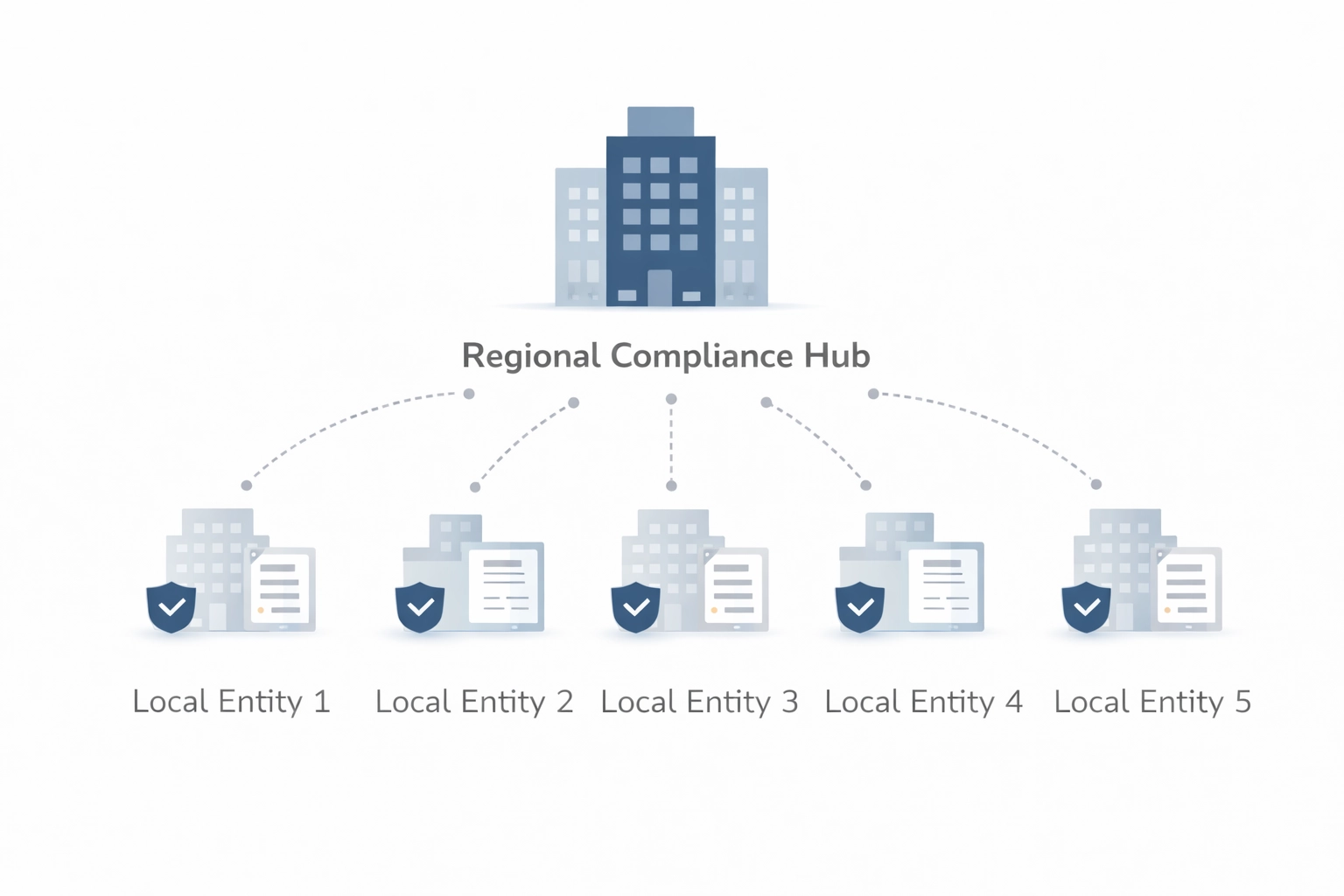
Firms operating in the GCC remain individually responsible for compliance with local laws and supervisory expectations, regardless of group arrangements. Authorities such as the Central Bank of the UAE, the Saudi Central Bank, and the Qatar Central Bank continue to emphasize that regulatory accountability cannot be outsourced to a parent entity or regional hub.
Supervisory reviews increasingly test whether:
Where local entities rely entirely on group assurances without independent oversight, supervisors often identify governance weaknesses, even in the absence of specific rule breaches.
Cross-border supervisory friction often surfaces during inspections and thematic reviews rather than during routine reporting. Regulators reconstruct how decisions flow through the organization and assess whether accountability remains anchored locally.
Common friction points include:
These issues complicate supervisory engagement and can lead regulators to deepen their reviews, particularly where timelines or explanations diverge.

Group policies are frequently cited by firms as evidence of strong governance. However, supervisors increasingly evaluate how those policies are adapted, implemented, and monitored at local level. A group policy that is not demonstrably embedded within the regulated entity is often viewed as insufficient.
Supervisors may ask:
Where these mechanisms are informal or undocumented, supervisors tend to conclude that governance exists in form but not in substance.
Data governance has become a central issue in cross-border supervision. Transaction monitoring outputs, client due diligence records, and risk assessments are often generated or stored at group level, sometimes outside the regulator’s jurisdiction.
In 2026, supervisors increasingly expect that regulated entities can:
Where firms cannot readily retrieve or explain data due to group-level constraints, supervisors may question whether the entity is genuinely in control of its compliance framework.

Cross-border models can also complicate remediation following inspections. Supervisors frequently observe that remediation plans depend on group-level system changes or approvals, extending timelines and diluting accountability.
Typical follow-up issues include:
From a supervisory perspective, prolonged remediation driven by offshore decision-making is often interpreted as a governance risk rather than a technical delay.
By 2026, the regulatory message across the GCC is consistent: group models must support, not obscure, local accountability. Supervisors are not seeking decentralization for its own sake, but they expect clarity, explainability, and control within the regulated entity.
Effective cross-border governance typically includes:
Firms that can demonstrate these elements generally experience smoother supervisory engagement, even when operating complex group structures.
Many firms struggle to evidence cross-border accountability because governance records, compliance data, and decision logs are dispersed across multiple systems and jurisdictions. Reconstructing supervisory narratives becomes time-consuming and error-prone.
Unified governance environments can help firms maintain consistent records of group policies, local adaptations, approvals, escalations, and remediation actions across jurisdictions. When these elements are structured within a single operational environment, firms are better positioned to demonstrate how group models function without undermining local regulatory responsibility.
For firms operating across jurisdictions, Moebius provides an enabling operational environment supporting both Corporate Management and AML, KYC, and Compliance Management while preserving jurisdiction-specific accountability.
Cross-border group structures are no longer assessed as static design choices. They are treated as ongoing supervisory considerations, evaluated through behavior, responsiveness, and outcomes over time. Firms that rely on group structures without maintaining clear local control increasingly encounter supervisory friction across the GCC.
Provide us with a bit of information about your business needs and we will be in touch to arrange a no commitment demonstration.


"*" indicates required fields