
The GCC family office is changing. What was once primarily focused on managing investments and coordinating family wealth is increasingly becoming a sophisticated operating environment spanning businesses, investments, real estate, succession structures, trusts, foundations and international assets.
The UAE is at the centre of that evolution. ADGM provides family offices with structuring options including holding companies, SPVs, trusts and foundations, while DIFC has developed a dedicated ecosystem around family businesses, ultra-high-net-worth individuals, succession planning and multi-generational wealth. The sophistication of these structures is creating a corresponding need for more sophisticated operating infrastructure.
The question is no longer simply how a family should structure its wealth. It is how the organisation responsible for managing that wealth can operate effectively as the structure becomes more complex.
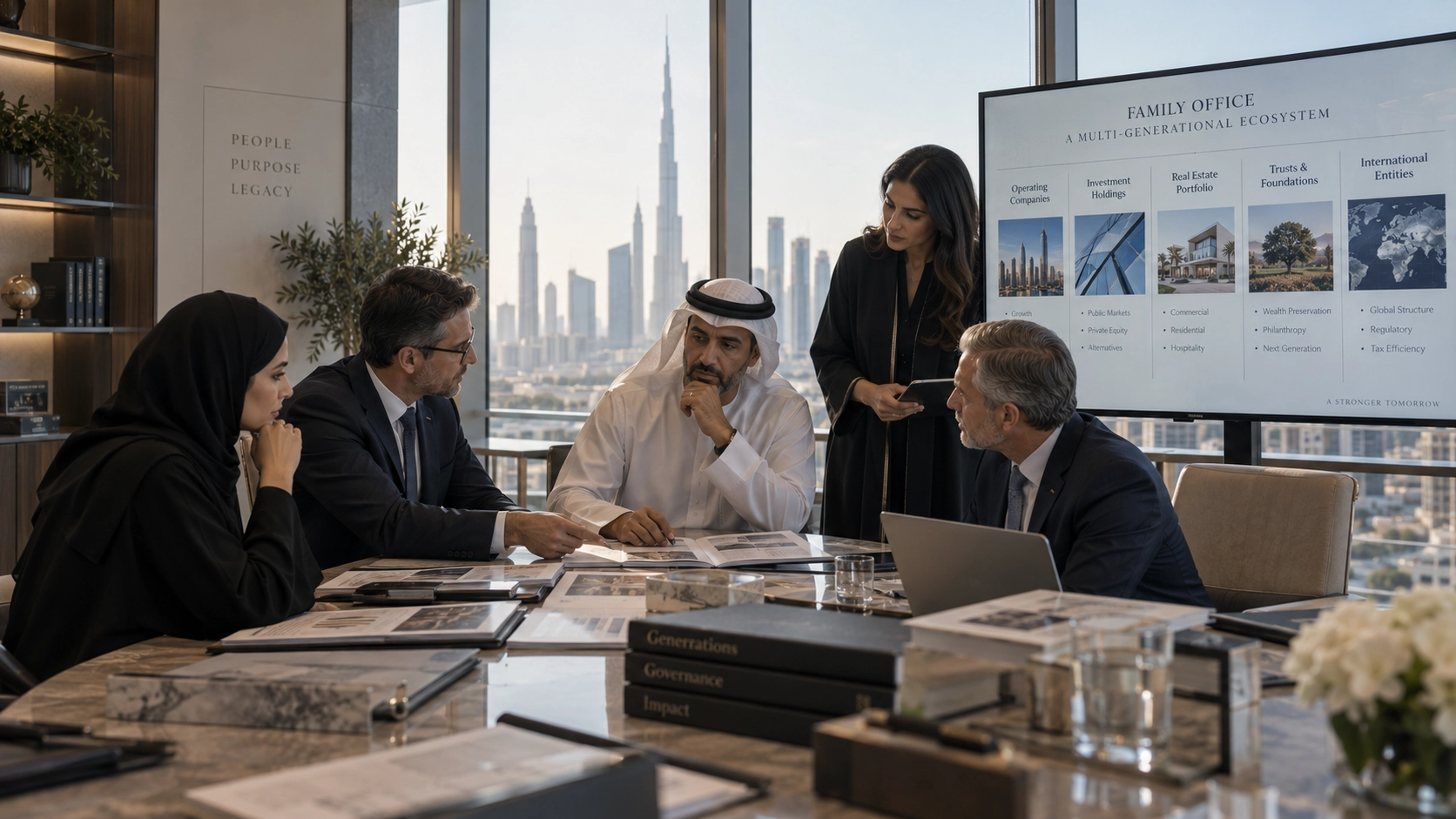
A modern family office may sit at the centre of a much wider ecosystem than its name suggests.
Alongside investment portfolios, it may coordinate operating companies, holding entities, foundations, trusts, property interests, bank accounts and succession arrangements. It may also work with lawyers, accountants, investment managers, trustees, corporate service providers, tax advisers and other specialists across multiple jurisdictions.
As these relationships multiply, the family office becomes less like a traditional administrative function and more like a professional operating institution. It has to maintain institutional knowledge, coordinate external expertise, manage sensitive information and support decisions that can affect assets and relationships across generations.
That creates a different technology requirement. The organisation needs more than systems that perform individual tasks. It needs an environment that can keep the underlying information connected.
Most sophisticated family offices already use technology. The challenge is that technology is often introduced function by function.
Investment information may sit in one system. Documents may be stored somewhere else. Contact information can exist in a CRM, while corporate records, entity information and adviser relationships are maintained separately. Critical updates may still arrive through email or remain dependent on individual employees who know where particular information can be found.
Each system may perform its own task effectively. The problem appears when someone needs to understand the relationship between those pieces of information.
Consider a family-owned holding structure with several subsidiaries, a foundation, external advisers and investment interests across jurisdictions. Finding an individual document may not be difficult. The challenge is understanding which entity it relates to, who is responsible for it, what other records are connected to it and what activity needs to happen next.
This is where a family office can become digitally equipped without becoming digitally integrated.
The most valuable family-office technology is not necessarily the technology with the greatest number of features. It is the technology that reflects how the organisation actually operates.
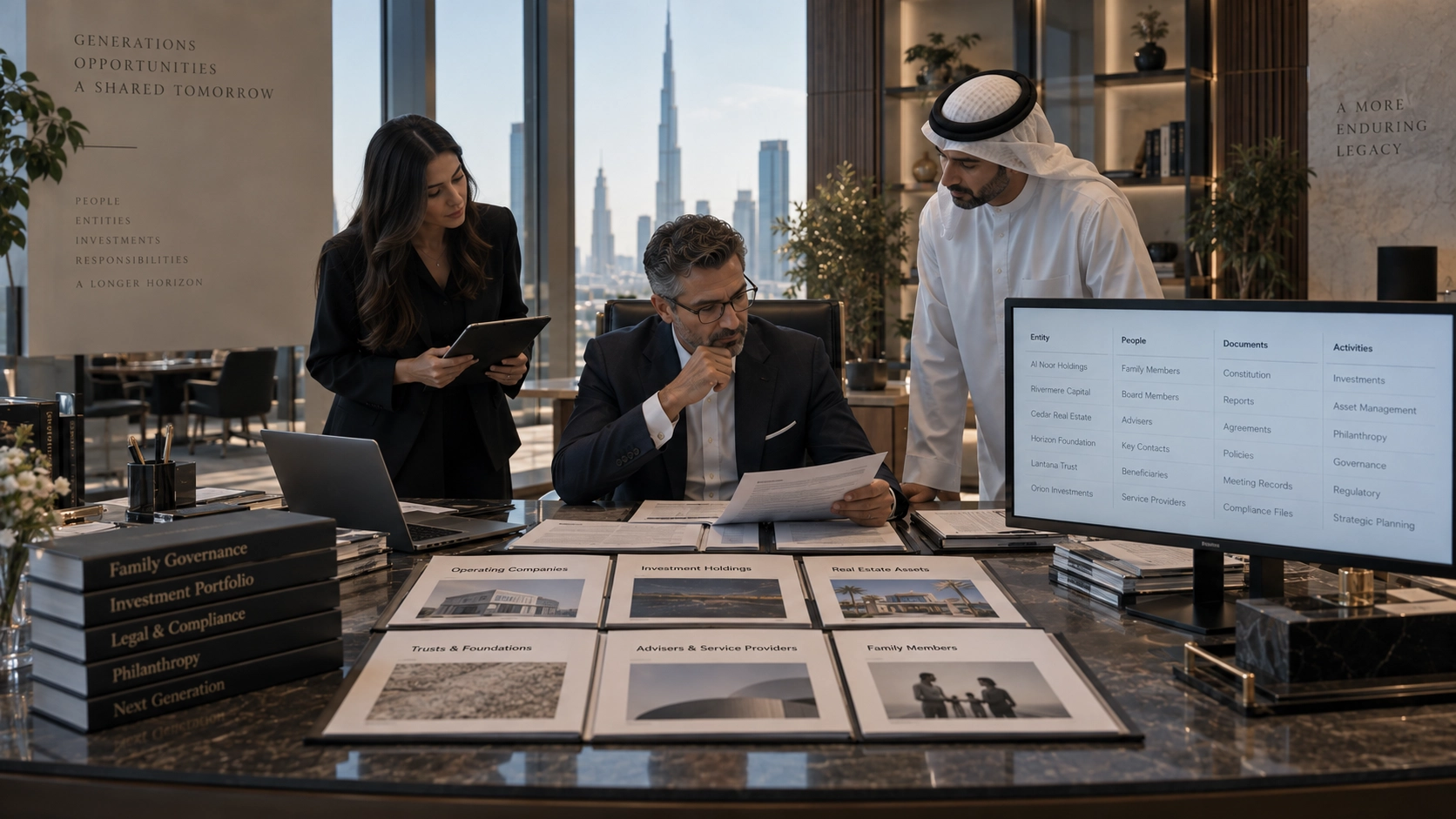
At the centre should be a reliable view of the entities, people and relationships that make up the family office. Around that foundation, documents, activities, responsibilities, communications and workflows can be connected to the relevant context.
This changes how teams work. Instead of searching separately for a company record, a director’s information, a foundation document and the relevant adviser correspondence, teams can work from a connected operational record.
The benefit is not simply faster information retrieval. It is continuity. When information is structured around the relationships and entities it belongs to, the organisation becomes less dependent on individual employees remembering where information sits or how different pieces of information fit together.
Family offices often place significant emphasis on confidentiality, discretion and long-term relationships. Those qualities remain essential, but they can create an unexpected operational challenge.
A great deal of knowledge can become concentrated in a small number of trusted individuals. One person may understand the history of a particular family structure. Another may know which adviser manages a specific entity. Someone else may understand why a particular document was created or how a historical decision shaped the current structure.
That model works while those people remain available. It becomes increasingly fragile when responsibilities move between employees, new generations become involved or the family office expands its professional team.
Technology should therefore do more than store information. It should preserve the context around that information so that institutional knowledge becomes part of the organisation rather than remaining inside individual relationships.
For a family office operating across generations, that distinction can become strategically important.
Artificial intelligence will increasingly become part of the family-office technology stack. It can help teams analyse information, identify patterns, support research and accelerate tasks that previously required significant manual effort.
But AI does not remove the need for a strong operational foundation.
An intelligent system can only provide useful context if the underlying information is structured, accessible and sufficiently connected. If corporate records sit separately from documents, relationships and activities, AI may make individual searches faster without necessarily giving the organisation a complete understanding of the situation.
The sequence therefore matters: connect the information first, then make it increasingly intelligent.
For family offices, this means building a reliable information layer before adding increasingly sophisticated automation and AI capabilities on top. The technology should make the organisation more capable without making the underlying operation harder to understand.
There is no universal technology architecture for every family office. A single-family office managing a focused portfolio will have different requirements from a multi-family office coordinating multiple structures and client relationships.
The underlying principles, however, remain consistent.
Corporate information should provide a clear view of entities, ownership, officers, beneficiaries and related structures. Documents should remain connected to the entities, people and activities they support. Relationships should provide visibility across family members, advisers, service providers and other stakeholders. Workflows should make recurring activities, approvals and responsibilities easier to manage.
Most importantly, these elements should not operate as isolated islands.
The objective is not to force every function into one application simply for the sake of consolidation. It is to ensure that the information required to operate the family office can move naturally between the functions that depend upon it.
This is where Möbius Corporate Management becomes particularly relevant to the modern family-office environment.
Möbius provides a structured environment for managing complex legal entities, including companies, trusts, partnerships and foundations. It supports ownership and capital information, corporate registers, officers, beneficial owners, registered addresses and banking information, giving teams a structured view of the entities they are responsible for managing.
For a family office, that corporate layer can become the foundation around which the wider operational environment is organised.
The value becomes greater when it is connected to the rest of the Möbius platform. Moebius Document Management provides centralised filing, retrieval, version control, access controls and document workflows, while Moebius Contact Management provides a centralised view of clients, partners, advisers and other stakeholders.
This creates a more connected environment in which entities, people and documents can be managed together rather than reconstructed across separate systems.
For family offices and fiduciary teams managing increasingly sophisticated structures, that means technology can support the complexity of the organisation without adding another layer of disconnected administration.
The objective of technology investment should not be to make the family office look more sophisticated. It should be to make the organisation more capable without making it more complicated to operate.
That means reducing the time spent searching for information, reconstructing relationships, checking multiple systems and relying on individual institutional knowledge. It means giving authorised teams access to the context they need while maintaining appropriate control over sensitive information.
It also means creating a foundation that can evolve.
A family office may add new entities, enter new jurisdictions, bring new generations into the business, change advisers or adopt new investment strategies. The technology supporting it should be able to accommodate those changes without forcing the organisation to rebuild its operating model each time.
This is ultimately what the new family-office stack should deliver: continuity, context and capacity.
The GCC family office is no longer simply an administrative layer around family wealth. As family structures become more international, professional and multi-generational, the family office itself is becoming an institution that needs institutional-grade operating infrastructure.
The technology question is therefore changing. It is no longer simply about where information is stored or which application manages a particular task. It is about whether the organisation can maintain a connected understanding of its entities, people, documents and activities as complexity increases.
For family offices planning not just for the next investment cycle but for the next generation, that capability can become a strategic asset.
Provide us with a bit of information about your business needs and we will be in touch to arrange a no commitment demonstration.


"*" indicates required fields