
The firm had invested heavily in finance technology.
Invoices were generated automatically. Revenue reports were produced on time. Financial dashboards provided leadership with real-time visibility into performance, profitability, and growth trends.
From a financial reporting perspective, everything appeared under control.
Yet during an external audit, a seemingly straightforward question exposed an unexpected weakness.
“Can you demonstrate exactly how this invoice was generated?”
The finance team produced the invoice immediately.
Explaining the complete operational journey behind it proved significantly more difficult.
The engagement had involved multiple consultants, several scope changes, additional client requests, numerous approvals, revised timelines, and activities performed across different jurisdictions. Information existed throughout the organization, but no single view connected service delivery, approvals, contractual obligations, time records, and billing events into one defensible revenue story.
The invoice was accurate.
The path that created it was not immediately visible.
Across the GCC, organizations are increasingly discovering that producing revenue and explaining revenue are very different capabilities.
As auditors, regulators, and stakeholders place greater emphasis on governance, transparency, and traceability, the ability to reconstruct how work became revenue is becoming just as important as revenue recognition itself.
Revenue does not begin in the finance department.
It begins operationally.
A client engagement is initiated. Work is assigned. Services are delivered. Time is recorded. Milestones are achieved. Deliverables are approved. Scope changes occur. Expenses are incurred. Only then does billing take place.
Every stage contributes to the final financial outcome.
In many organizations, however, these activities occur across disconnected environments.
Project teams may manage work in one system. Time records may be maintained elsewhere. Approvals often occur through email. Contract amendments may remain within document repositories, while finance ultimately generates invoices using information gathered from multiple sources.
The result is a contradiction.
Organizations frequently maintain excellent visibility into financial outcomes while lacking visibility into the operational activities that created those outcomes.
As service environments become increasingly complex, maintaining revenue traceability through spreadsheets, email chains, and disconnected applications becomes progressively more difficult.
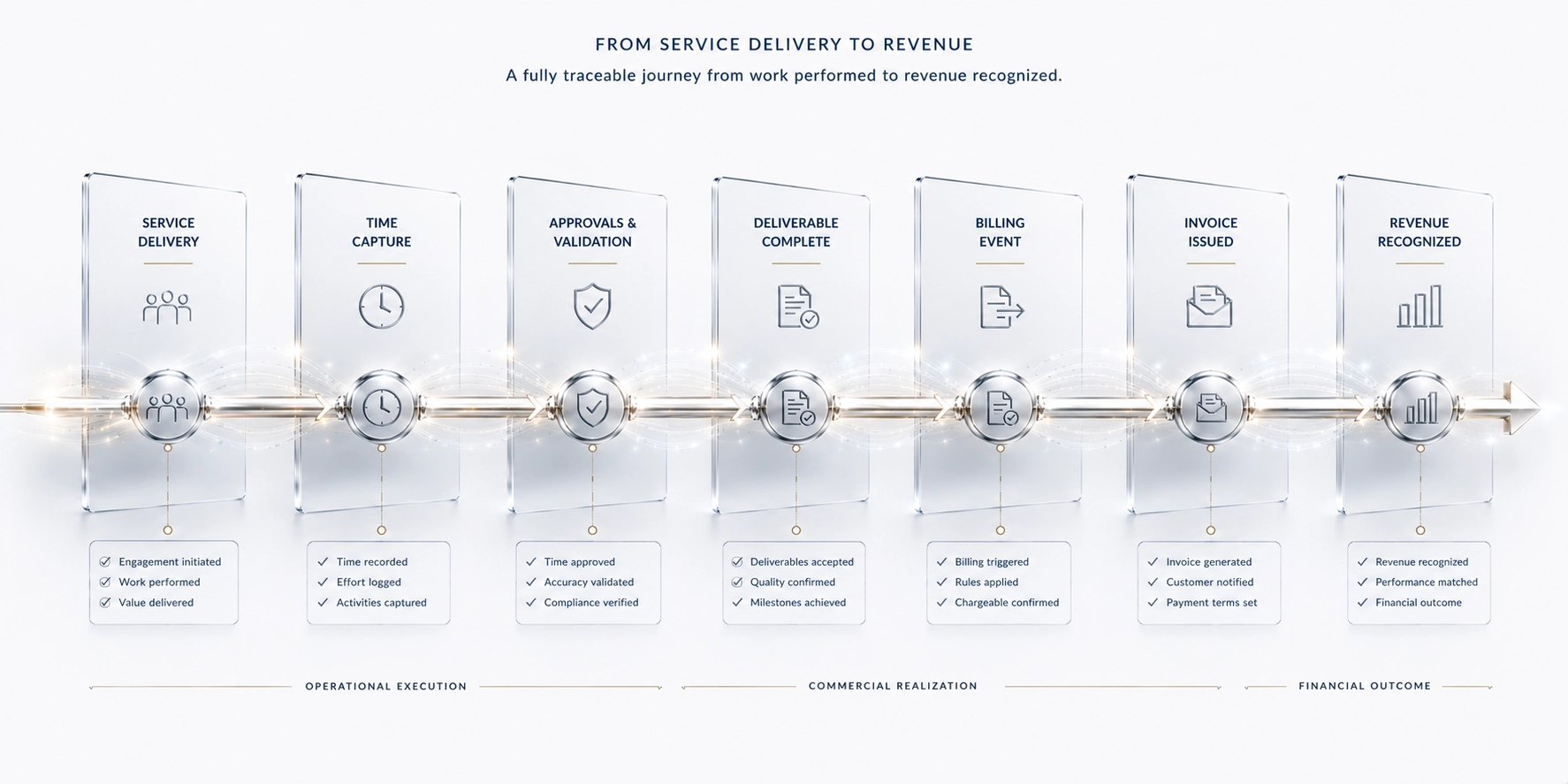
Every invoice tells a story.
The challenge is that many organizations cannot easily tell it.
Professional services engagements rarely remain static. Clients request additional work. Timelines change. New resources become involved. Deliverables evolve. Commercial terms are amended. Billable activities expand beyond the original scope.
These developments are entirely normal.
The difficulty emerges when operational evidence becomes fragmented.
Time entries may reside within one platform. Deliverables may be stored elsewhere. Contract changes may exist only within correspondence. Approval histories may never be formally linked to billing records.
Without integrated time tracking, workflow management, document management, and billing processes, organizations often struggle to maintain a continuous and defensible service-to-revenue trail.
The revenue remains visible.
The operational history behind it gradually disappears.
International financial reporting standards such as IFRS 15, published by the IFRS Foundation, place significant emphasis on demonstrating how performance obligations are satisfied and how revenue recognition aligns with actual service delivery.
Similarly, the International Federation of Accountants (IFAC) continues to emphasize transparency, accountability, and strong governance across financial reporting processes.
Across the GCC, supervisory institutions such as the Central Bank of the UAE (CBUAE) and the Saudi Central Bank (SAMA) continue to reinforce expectations around financial governance, accountability, and effective operational controls.
A regional consulting organization operating across several GCC jurisdictions underwent an external audit covering a portfolio of complex advisory engagements.
The firm had successfully invoiced clients and recognized revenue without issue. Financial results had already been reported.
However, auditors requested evidence demonstrating how selected invoices had been generated.
The organization quickly discovered that supporting information was dispersed across project management tools, spreadsheets, email approvals, engagement documentation, and finance systems.
Although the invoices themselves were accurate, reconstructing the operational history behind those invoices required significant manual effort involving consultants, project managers, finance teams, and engagement leaders.
Following the audit, the organization introduced integrated time tracking, workflow-driven approvals, centralized engagement documentation, and automated billing controls.
The result was not merely improved efficiency.
The organization gained the ability to explain and defend every revenue event from service delivery through revenue recognition.
Auditors increasingly distinguish between financial accuracy and revenue traceability.
An invoice may be financially correct while still exposing governance weaknesses if organizations cannot clearly demonstrate how operational activities, approvals, contractual obligations, and billable events evolved into recognized revenue.
The ability to evidence the complete service-to-revenue journey is increasingly viewed as an indicator of financial governance maturity.
Revenue trail gaps frequently become visible during audits, financial reviews, governance assessments, or client disputes.
Reviewers often begin with a simple request:
“Please explain how this invoice was generated.”
Organizations typically provide the invoice, financial records, and supporting documentation.
The pressure point emerges when auditors move beyond the invoice itself.
They seek to understand:
At this stage, organizations often discover that while financial outcomes are clear, the operational pathway that produced those outcomes is significantly harder to reconstruct.
Critical approvals may exist within email chains. Scope changes may never have been formally linked to billing records. Supporting evidence may reside across several disconnected systems.
The review therefore moves beyond billing administration.
It becomes an assessment of financial governance.
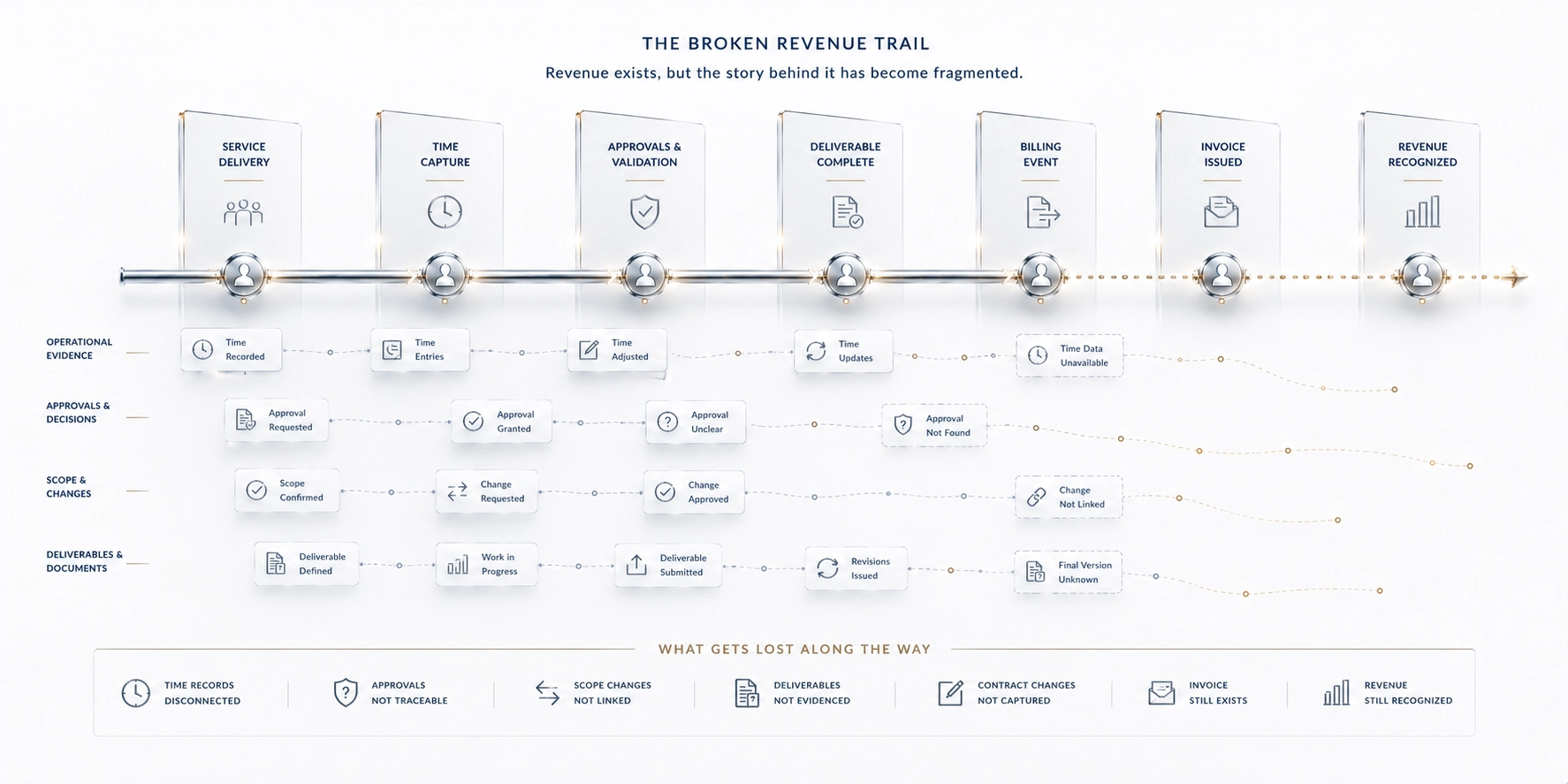
Auditors rarely evaluate traceability issues in isolation.
Instead, they examine what those issues reveal about the broader control environment.
Missing approval histories may trigger questions regarding authorization controls. Incomplete time records may lead reviewers to examine workflow governance. Inconsistent supporting evidence may prompt broader scrutiny of documentation practices and management oversight.
What initially appears to be a billing issue can quickly evolve into a wider assessment of governance effectiveness.
This escalation is increasingly common within complex service environments.
Organizations that cannot confidently explain how work became revenue often face greater scrutiny regarding financial controls, operational transparency, and overall governance maturity.
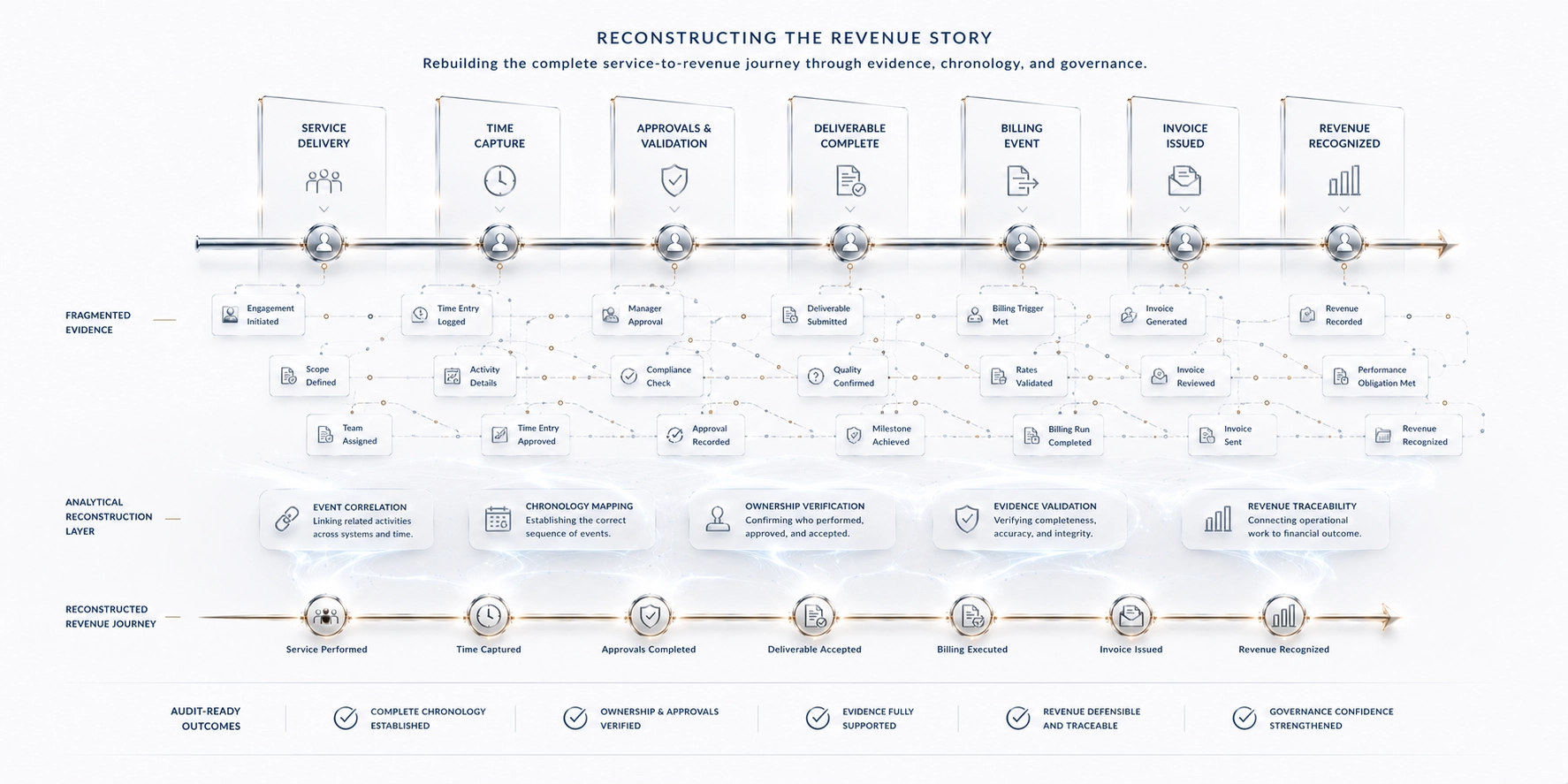
Many organizations continue to view revenue generation primarily as a finance process.
Increasingly, that perspective is being challenged.
Revenue confidence depends upon maintaining visibility across the entire service-to-revenue lifecycle. Organizations need to understand not only what revenue was recognized, but also how work was performed, how activities were approved, how obligations were fulfilled, and how operational events ultimately generated financial outcomes.
This level of traceability is becoming increasingly difficult to achieve through manual coordination, disconnected applications, and fragmented documentation.
Organizations therefore require more than billing software.
They require integrated operational and financial environments capable of connecting time tracking, workflow activities, document management, approvals, billing events, and financial oversight within a single governance framework.
This is where Moebius supports organizations.
By combining Billing & Invoicing Automation, Financial Management, Workflow Management, Time Tracking, and Document Management capabilities within a unified platform, Moebius enables organizations to establish a complete and defensible service-to-revenue trail across every client engagement.
The organizations that inspire the greatest confidence during audits are rarely those with the largest finance teams.
They are the organizations that can explain the complete story behind every invoice without rebuilding it manually.
Provide us with a bit of information about your business needs and we will be in touch to arrange a no commitment demonstration.


"*" indicates required fields