
The quarterly executive review was expected to be routine.
Revenue from the firm’s top twenty clients remained strong. Renewal rates were healthy. No major complaints had been escalated, and relationship managers reported that key accounts were progressing as planned.
Leadership concluded that the client portfolio was stable.
Three weeks later, an internal governance assessment challenged that assumption.
The review revealed that several strategic client relationships had evolved significantly over the previous eighteen months. New stakeholders had become influential decision-makers without being formally recorded. Additional services had been introduced outside the original engagement scope. In one instance, a client’s ownership structure had changed entirely, yet internal systems still reflected historical information.
None of these developments were unknown.
The problem was that no single system reflected the complete reality of the relationship.
The organization had not lost contact with its clients. It had lost visibility into how those relationships had evolved.
Across Europe, this disconnect is becoming a significant governance concern. Organizations may maintain extensive onboarding records, CRM data, and customer documentation, yet still struggle to demonstrate that their understanding of a client accurately reflects the relationship as it exists today.
The exposure often remains hidden until auditors, supervisors, or internal reviewers ask a deceptively simple question:
“How did this relationship evolve over time?”
Most organizations invest considerable effort at the beginning of a client relationship.
Customer due diligence is completed. Risk assessments are performed. Stakeholders are identified. Contracts are executed. Information is entered into CRM systems, creating confidence that the relationship has been properly documented.
The challenge emerges after onboarding.
Clients rarely remain static. Businesses expand into new jurisdictions. Decision-makers change.
New subsidiaries are established. Additional services are introduced. Commercial priorities shift. Internal teams grow, and communication patterns evolve.
Relationships mature continuously.
Records often do not.
Over time, valuable relationship intelligence becomes distributed across emails, meeting notes, document repositories, workflow histories, spreadsheets, and individual employee knowledge. Relationship managers may understand one aspect of the client, while compliance, finance, and operations teams maintain entirely different perspectives.
Eventually, organizations can find themselves managing a client relationship that no longer resembles the information stored within official systems.
This is relationship drift.
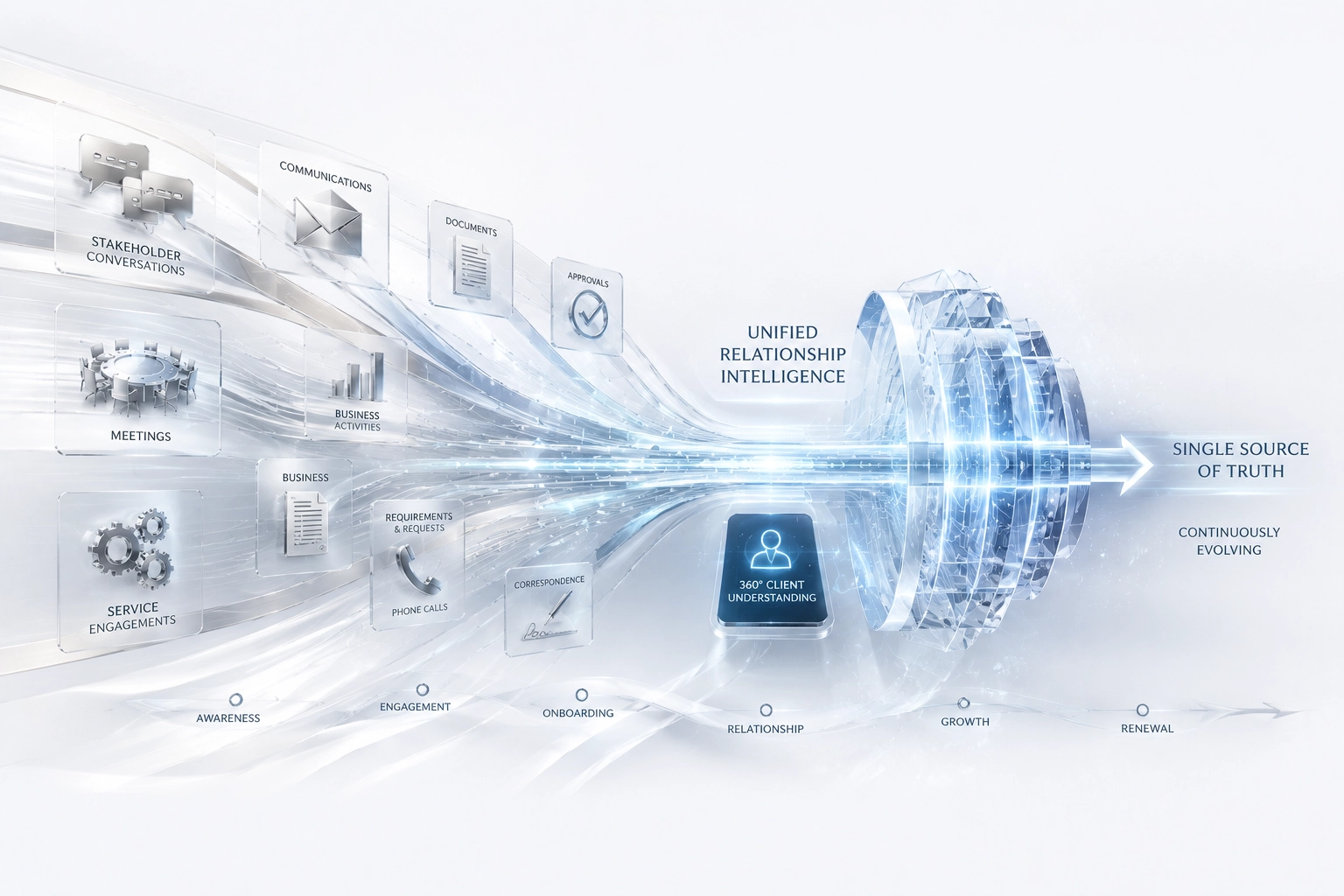
Relationship drift is frequently viewed as a data quality issue.
In reality, its consequences extend much further.
When customer intelligence becomes fragmented across CRM environments, stakeholder repositories, workflow records, and disconnected document stores, organizations risk making important decisions based on incomplete information.
Commercial teams may negotiate using outdated assumptions. Compliance teams may assess risk against historical rather than current realities. Senior management may approve strategic initiatives without understanding how client expectations or structures have changed.
Operational inefficiencies also increase significantly.
Employees often spend substantial time reconstructing interaction histories, identifying current decision-makers, or locating supporting documentation before responding to customer requests or governance inquiries.
As relationships become more sophisticated, maintaining visibility through disconnected systems becomes increasingly unsustainable.
The consequences extend beyond operational efficiency. Relationship drift can affect governance oversight, risk management, customer experience, regulatory compliance, and ultimately organizational reputation.
The European Banking Authority’s guidelines on internal governance emphasize that institutions should maintain an ongoing understanding of their customers and ensure that information remains accurate, complete, and up to date throughout the customer lifecycle. More information can be found at:
Similarly, the Financial Action Task Force (FATF) expects organizations to conduct ongoing due diligence rather than relying solely on information collected during onboarding.
European supervisors are increasingly focusing on lifecycle visibility rather than point-in-time documentation.
Regulators want assurance that organizations understand not only who the customer was when the relationship began, but who the customer is today.
This expectation aligns with supervisory principles promoted by the European Banking Authority (EBA), the European Securities and Markets Authority (ESMA), and broader governance expectations across European markets.
Supervisory reviews increasingly examine:
Organizations that cannot evidence these changes often face broader questions regarding governance effectiveness, accountability, and oversight maturity.
A large European advisory firm operating across multiple jurisdictions discovered during an internal review that relationship intelligence had gradually become dispersed across the organization.
Relationship managers maintained stakeholder updates locally. Compliance teams managed due diligence information separately. Commercial teams documented service expansions independently, while key discussions frequently remained buried within email conversations.
The fragmentation remained invisible until a regulator requested evidence explaining the evolution of a long-standing client relationship.
Reconstructing the complete history required contributions from five separate departments and several former employees.
Following the review, the organization centralized customer lifecycle processes, introduced structured stakeholder management workflows, and established a unified repository for relationship documentation and engagement histories.
As a result, relationship intelligence became continuously visible rather than dependent on institutional memory.
Modern organizations interact with clients through multiple functions.
Sales teams initiate relationships. Operations teams support service delivery. Finance teams manage commercial interactions. Compliance teams oversee regulatory obligations. Legal teams become involved when contractual issues emerge.
Each interaction generates valuable insight.
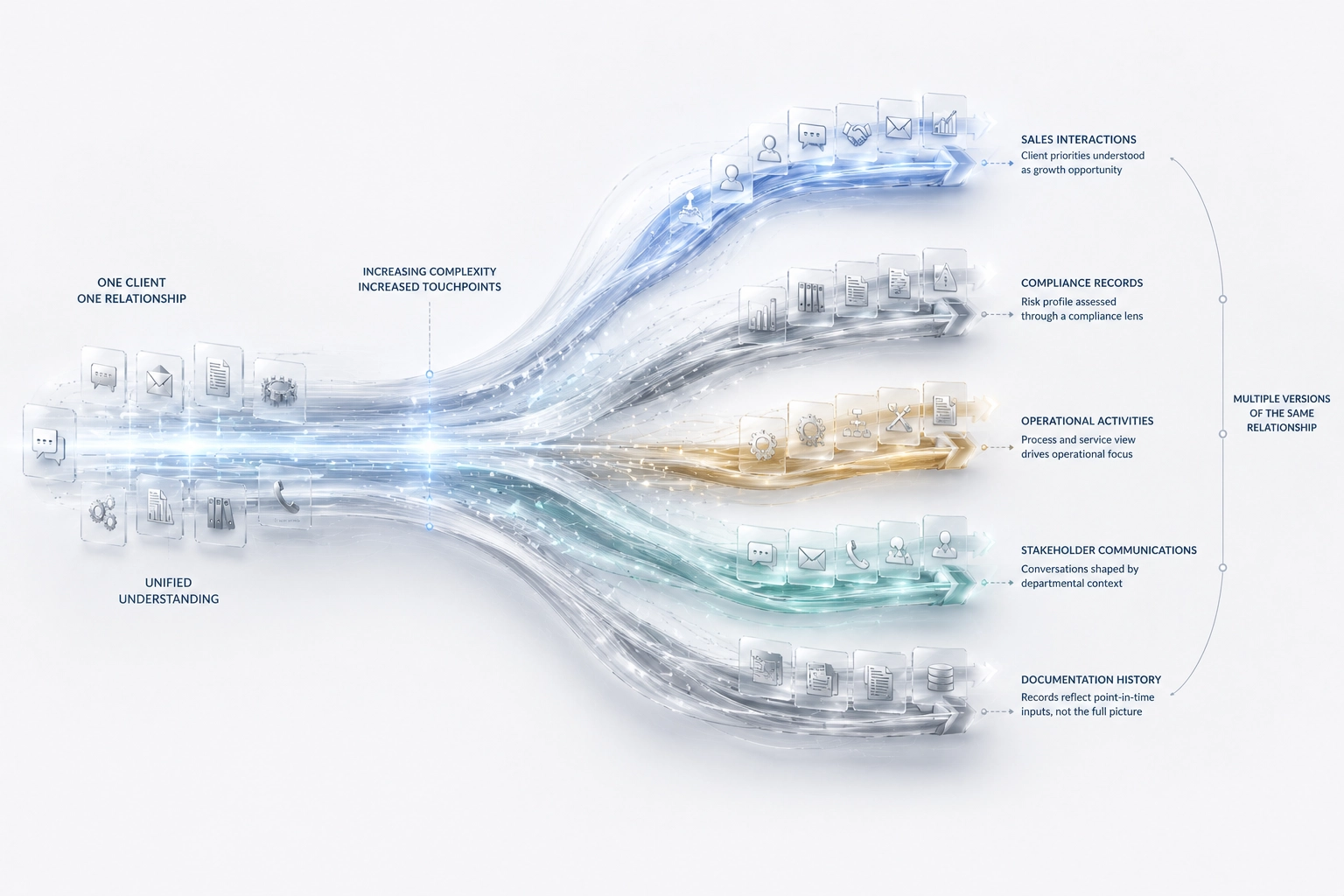
However, when these insights remain isolated within departmental systems, organizations no longer maintain a single understanding of the relationship.
One team may understand changing commercial expectations. Another may be aware of emerging risks. A third may know that new stakeholders have become influential decision-makers.
Collectively, these observations describe the real relationship.
Individually, they create fragmented realities.
Maintaining relationship visibility increasingly requires integrated customer lifecycle management environments capable of connecting stakeholder information, communications, workflow activities, supporting documentation, and governance actions within a single operational framework.
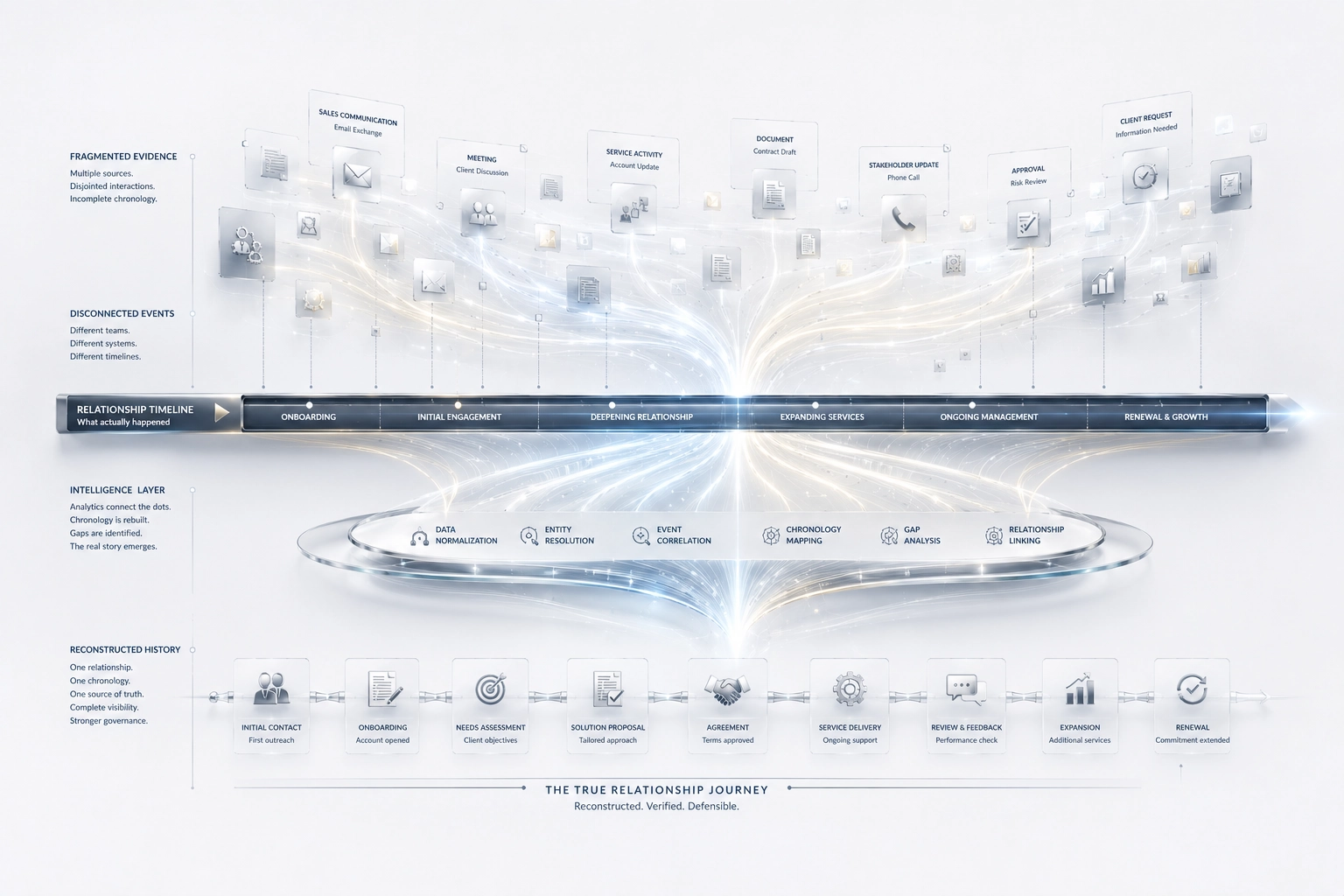
Review teams increasingly distinguish between maintaining customer records and maintaining customer understanding.
Organizations may possess extensive documentation while still struggling to demonstrate that governance processes accurately reflected how a client relationship evolved over time.
The ability to evidence stakeholder changes, relationship developments, and lifecycle events is becoming an important indicator of governance maturity.
Relationship drift frequently surfaces during audits, supervisory inspections, customer lifecycle reviews, or governance assessments.
Reviewers often request evidence explaining when stakeholders became involved, how services expanded, or whether significant developments were appropriately governed.
Organizations typically begin by providing CRM records, customer files, and supporting documentation.
The challenge emerges when reviewers compare those records against the actual history of the relationship.
Critical interactions may exist only within email trails. Important decisions may depend on employee recollection. Supporting evidence may be scattered across multiple repositories. Key changes may never have been formally documented.
At this point, the discussion moves beyond CRM administration.
It becomes an assessment of governance visibility.
What initially appears to be a recordkeeping issue often expands into broader concerns regarding accountability, oversight effectiveness, and information reliability.
Many executives assume that complete onboarding files and traditional CRM systems provide sufficient visibility into customer relationships.
Increasingly, that assumption is being challenged.
Modern relationships evolve continuously. Stakeholders change. Services expand. Risks shift. Strategic decisions are influenced by interactions occurring across multiple departments, jurisdictions, and communication channels.
Organizations that continue managing these developments through fragmented systems and institutional memory frequently discover that relationship visibility deteriorates long before anyone notices.
Maintaining an accurate understanding of customer relationships now requires more than a static CRM database.
Organizations increasingly need integrated operational environments that connect CRM, Customer Lifecycle Management, Workflow Automation, Document Management, and stakeholder governance into a continuously updated view of the relationship.
This is where Moebius supports organizations.
By combining CRM, Customer Lifecycle Management, Workflow Automation, and Document Management capabilities within a unified platform, Moebius enables organizations to preserve relationship intelligence, maintain continuous lifecycle visibility, and strengthen governance across evolving customer relationships.
Leadership teams should therefore ask a simple question:
If a supervisor requested evidence tomorrow explaining how one of your most important client relationships evolved during the last three years, could your organization confidently provide the complete story?
Provide us with a bit of information about your business needs and we will be in touch to arrange a no commitment demonstration.


"*" indicates required fields