
The board committee meeting had been scheduled for months.
Among the agenda items was an update on a regulatory inquiry that had been ongoing for nearly eighteen months. Senior leadership expected a straightforward discussion. The matter was still active, but no major concerns had been raised recently. External counsel had been engaged, periodic updates had been provided, and the organization believed the issue remained under control.
Then a committee member asked a seemingly simple question.
“Can we walk through how this matter has been governed since it was opened?”
The legal team could explain the current status.
Reconstructing how oversight had been maintained throughout the previous eighteen months proved considerably more difficult.
Responsibilities had shifted several times. Deadlines had changed. New obligations had emerged. Additional stakeholders had become involved. Critical decisions had been taken across meetings, email chains, and informal discussions.
Everyone understood what the matter was about.
Far fewer people could explain how control had been maintained as the matter evolved.
Across Europe, this scenario is becoming increasingly familiar. Regulators, auditors, and governance reviewers are paying closer attention not only to legal outcomes, but to how organizations govern legal matters throughout their entire lifecycle.
Increasingly, organizations are discovering that successful resolution alone is no longer sufficient.
Legal and regulatory matters rarely unfold in a straight line.
A matter may begin with a regulatory inquiry, contractual dispute, internal investigation, or governance concern. Immediate attention follows. Teams mobilize quickly. Responsibilities are assigned. External advisors may be appointed. Leadership receives frequent updates.
During these early stages, oversight is usually strong.
The challenge emerges once the initial urgency subsides.
Months pass. New information is received. Deadlines move. Additional actions are introduced. Supporting documentation expands. Stakeholders change. Priorities shift as other operational demands emerge.
The matter remains active.
Visibility often does not.
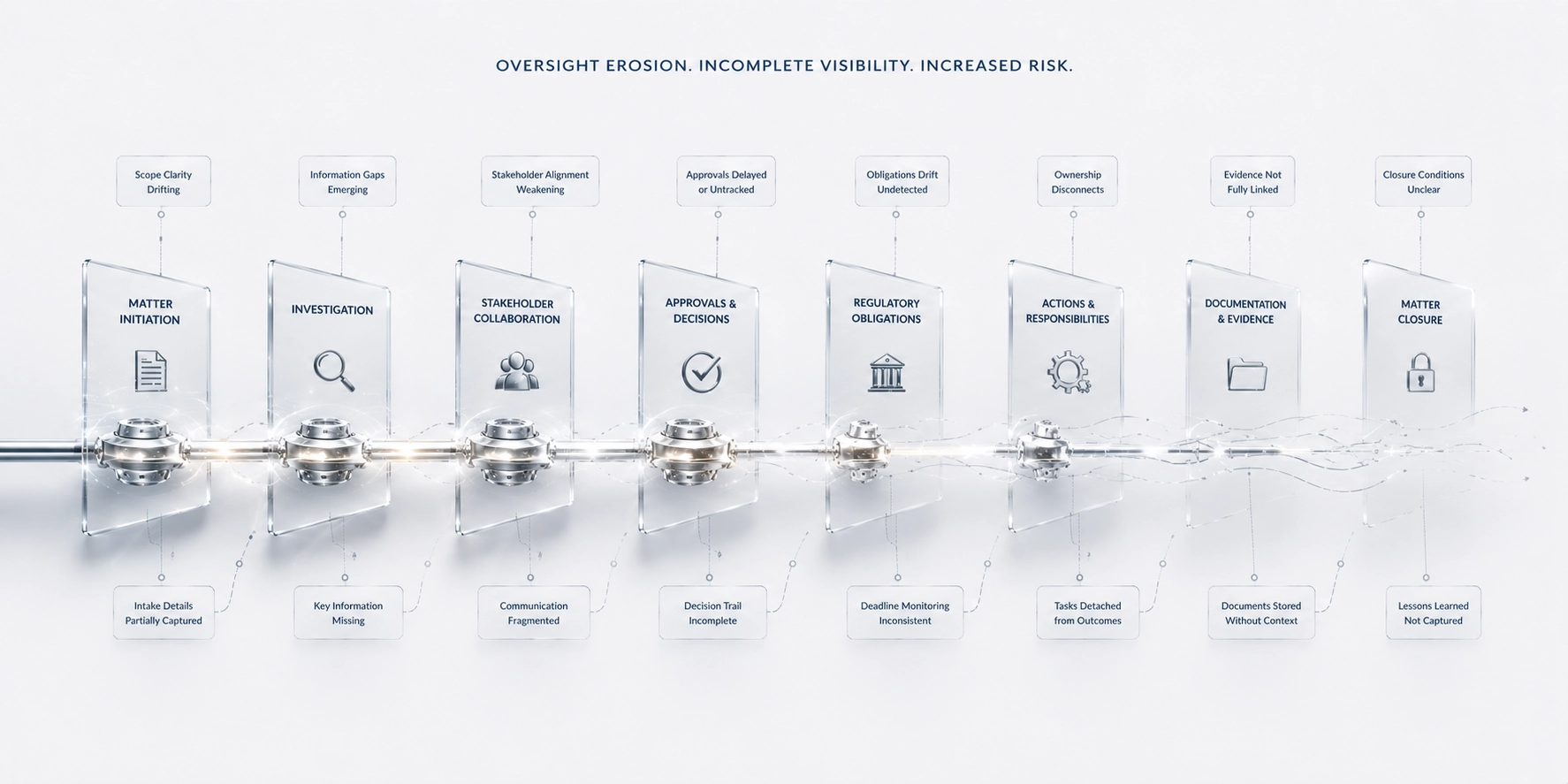
Over time, information relating to the matter becomes dispersed across legal files, document repositories, workflow histories, email correspondence, meeting notes, and individual employees. Organizations can find themselves managing an active legal matter without maintaining a complete view of its lifecycle.
This gradual weakening of oversight is legal exposure by attrition.
Most organizations do not intentionally neglect legal matters.
The erosion of oversight usually develops gradually.
A deadline extension is agreed during a call but not formally recorded. A responsibility moves from one individual to another without a structured handover. A key approval is documented within email correspondence rather than within the official matter file. Supporting evidence is stored in separate locations because multiple teams are involved.
Individually, these events appear manageable.
Collectively, they create an environment where nobody maintains a complete understanding of the matter.
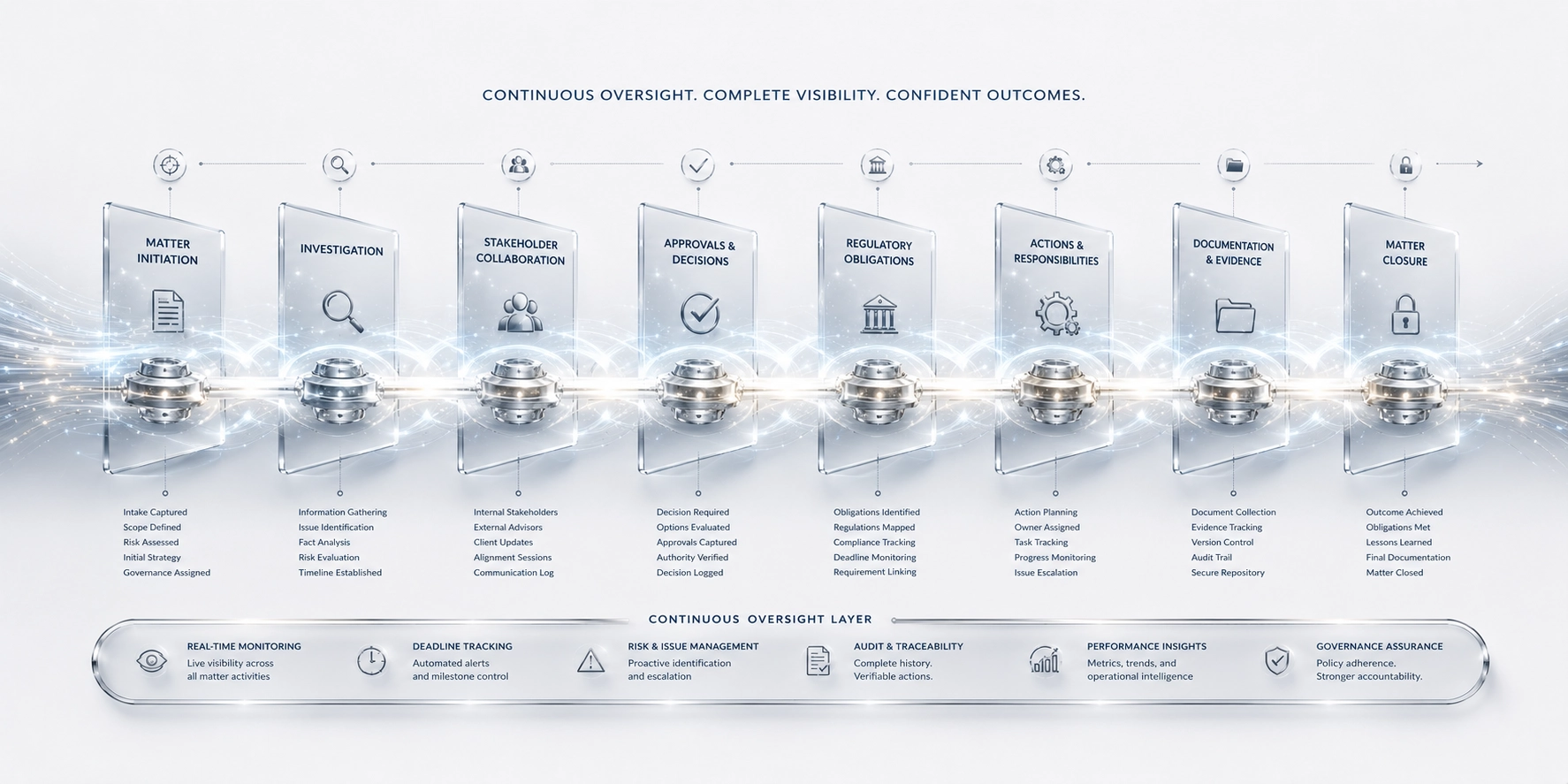
As legal portfolios expand, organizations increasingly require structured Legal Case Management environments capable of centralizing matter histories, ownership records, obligations, approvals, deadlines, and supporting documentation throughout the entire lifecycle of every matter.
Without this visibility, oversight frequently becomes dependent on institutional memory rather than governed processes.
The European Banking Authority (EBA) emphasizes through its guidance on internal governance that organizations should maintain effective oversight arrangements, clear accountability structures, and reliable information flows across critical activities throughout their lifecycle.
Similarly, the European Securities and Markets Authority (ESMA) continues to reinforce expectations around governance transparency, accountability, and effective supervisory oversight across regulated entities.
A multinational professional services organization operating across several European jurisdictions managed more than three hundred active legal and regulatory matters simultaneously.
Although every matter had been formally opened, an internal governance review revealed that ownership transitions, deadline changes, and approval decisions were often being managed through email rather than within a centralized legal environment.
The issue remained largely invisible until external reviewers requested evidence demonstrating how a high-profile regulatory inquiry had been governed over a fourteen-month period.
The organization could produce the final outcome.
Demonstrating how responsibilities evolved, how deadlines were monitored, and how management oversight had been maintained required substantial manual reconstruction involving multiple teams and former employees.
Following the review, the organization introduced centralized Legal Case Management, workflow-driven task allocation, automated deadline monitoring, and integrated document management controls.
As a result, legal teams gained continuous visibility across every stage of the matter lifecycle.
Long-running matters create a challenge that many organizations underestimate.
Attention naturally declines over time.
Once immediate risks appear contained, legal matters often transition into a maintenance phase. Status updates become less frequent. Escalations reduce. Leadership focus shifts elsewhere.
Yet legal obligations rarely stand still.
Additional correspondence arrives. Regulators request new information. External counsel provides advice. Deadlines evolve. New actions emerge.
When organizations lack structured workflows, automated reminders, task ownership controls, and centralized matter histories, maintaining consistent oversight becomes increasingly difficult. The risk is rarely a missed deadline alone.
The greater risk is that organizations gradually lose confidence in their ability to explain how the matter has been governed.
Reviewers increasingly distinguish between maintaining legal files and maintaining legal oversight.
Organizations may possess extensive documentation while still struggling to demonstrate how responsibilities, decisions, approvals, and obligations were governed throughout the lifecycle of a matter.
The ability to evidence continuous oversight is increasingly viewed as an indicator of governance maturity.
Legal exposure by attrition often becomes visible during audits, supervisory inspections, board reviews, or regulatory assessments.
Reviewers rarely focus exclusively on the final outcome.
Instead, they seek to understand:
Organizations typically begin by providing legal files, correspondence, and status reports.
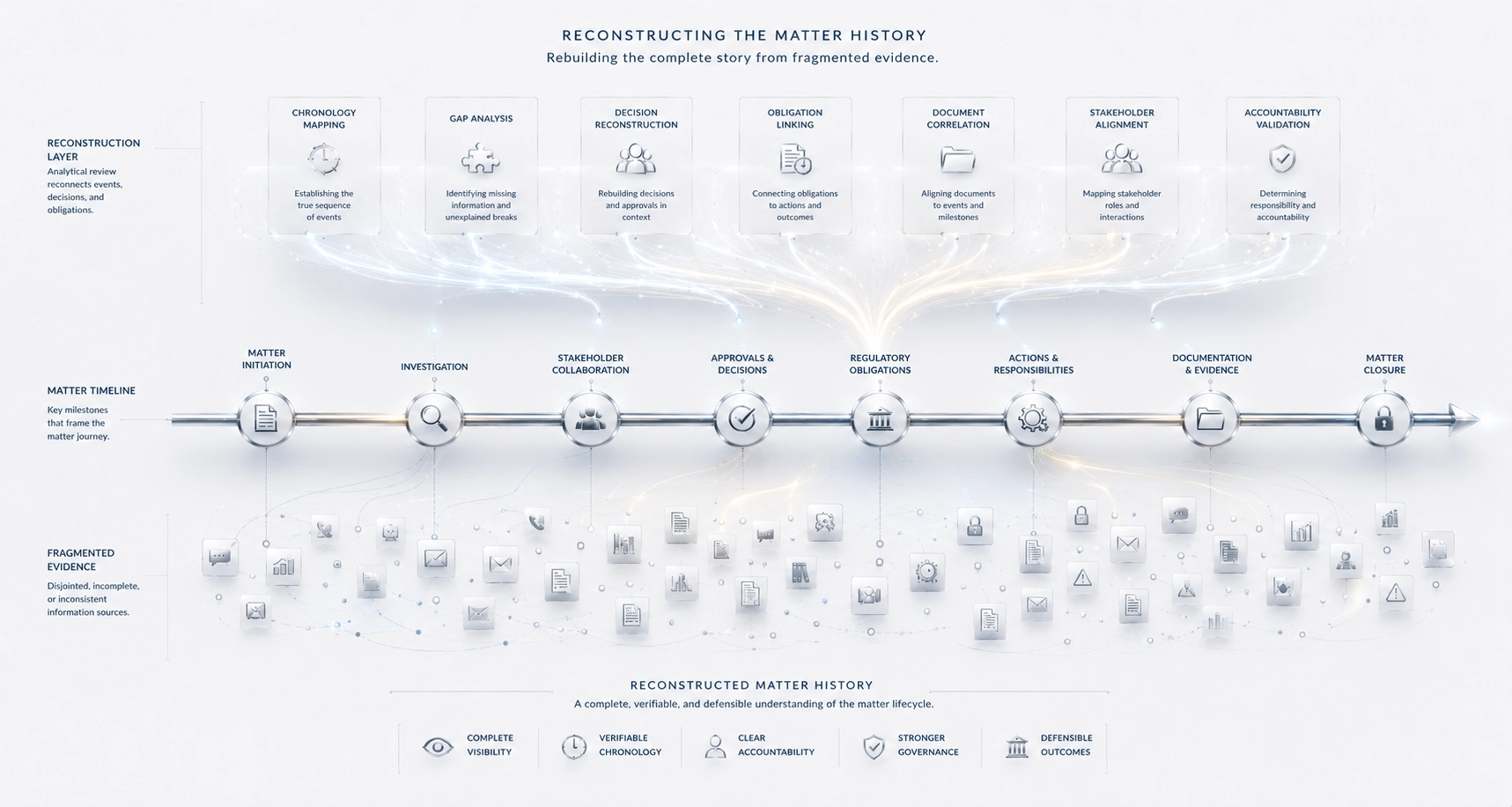
The pressure point emerges when reviewers attempt to reconstruct the complete history of the matter.
Critical decisions may exist only within email chains. Ownership changes may never have been formally recorded. Historical context may depend upon employee recollection. Supporting documentation may be distributed across several repositories.
At this stage, the review moves beyond legal administration. It becomes an assessment of governance effectiveness.
Regulators rarely assess visibility gaps in isolation.
Instead, they examine what those gaps reveal about the broader control environment.
An unresolved ownership transition may prompt questions regarding accountability. Missing evidence may trigger scrutiny of documentation controls. Inconsistent status reporting may lead reviewers to examine escalation mechanisms and management oversight arrangements.
What initially appears to be an administrative weakness can therefore expand into a much broader evaluation of governance maturity.
This escalation pathway is becoming increasingly common across regulated environments.
Organizations that cannot confidently explain how matters were governed often face greater scrutiny regarding the effectiveness of their overall governance framework.
Many organizations continue to manage legal matters through a combination of emails, spreadsheets, shared drives, and manual follow-ups.
These approaches may appear adequate when only a limited number of matters are active.
However, as legal obligations, stakeholders, documentation requirements, and regulatory expectations increase, maintaining continuous oversight becomes significantly more challenging.
Organizations increasingly require more than a traditional matter file.
They need an operational environment capable of connecting matter histories, workflow activities, task ownership, approvals, deadlines, supporting evidence, and governance records into a single, continuously visible lifecycle.
This is where Moebius supports legal and governance teams.
Through its integrated Legal Case Management, Workflow Automation, Task Management, and Document Management capabilities, Moebius enables organizations to maintain continuous visibility across every stage of a legal matter while strengthening accountability and governance oversight.
The true cost of legal exposure by attrition is rarely discovered when a matter is opened.
It is discovered months or years later, when organizations are asked to prove they remained in control throughout the journey.
Provide us with a bit of information about your business needs and we will be in touch to arrange a no commitment demonstration.


"*" indicates required fields