
Most organizations do not lose critical corporate knowledge because records disappear.
They lose it because the knowledge never made it into the records in the first place.
Across the GCC, supervisors increasingly encounter organizations that can explain historical ownership decisions, governance approvals, licensing commitments, and entity relationships in remarkable detail. The problem emerges when those explanations depend on a specific employee rather than documented evidence.
The risk often remains invisible for years.
Then a key individual leaves, a regulator requests historical evidence, or an inspection attempts to reconstruct how a decision was made.
What follows is rarely a debate about documentation.
It becomes a question of governance.
Most organizations assume their corporate records accurately reflect their institutional knowledge. In reality, critical information often exists outside official systems and records.
Historical ownership changes may be remembered by a corporate administrator who has been with the organization for years. Licensing commitments may be understood by a specific team member. Governance decisions may rely on context that was never formally documented because everyone involved already understood the rationale at the time.
The organization continues to operate effectively because the knowledge exists somewhere within the business. The challenge is that the knowledge exists in people rather than in a structured and defensible form.
Over time, these informal arrangements become accepted as normal. Teams know who to ask when questions arise. Problems appear manageable because answers remain available.
Until they are not.
Supervisory Observation
Many organizations assume that retaining documents is sufficient.
During reviews, however, supervisors increasingly test whether firms can reconstruct the context behind historical decisions, not simply produce the documents themselves.
The issue is no longer whether information exists.
The issue is whether that information can be independently verified when scrutiny occurs.
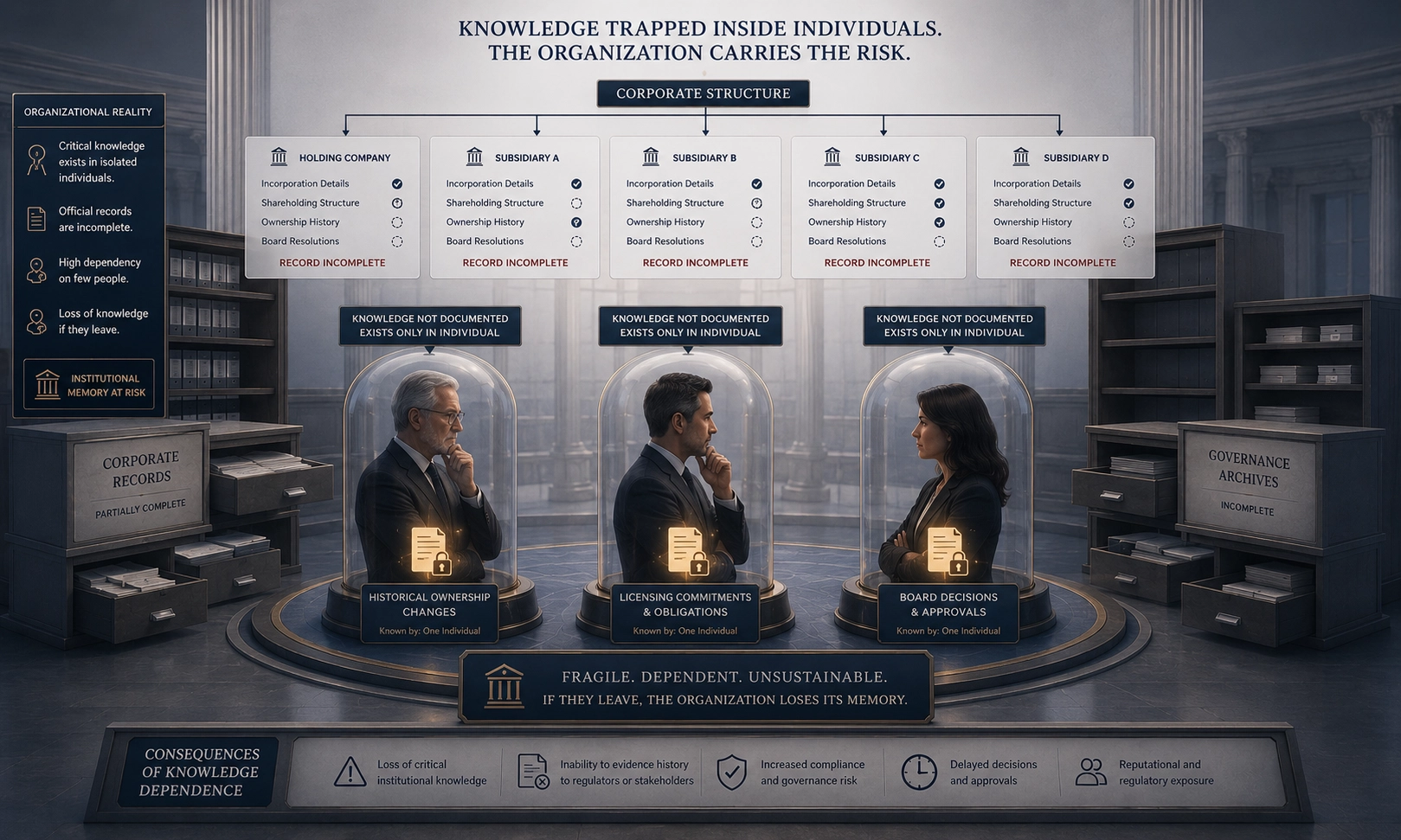
Corporate memory is often viewed as an administrative concern. However, the consequences extend far beyond record keeping.
When critical knowledge is concentrated within a small number of individuals, routine activities become increasingly dependent on their availability. Ownership verification may take longer. Governance reviews may require additional investigation. Regulatory submissions may involve reconstructing historical events from fragmented information sources.
The impact is not limited to compliance teams.
Business continuity can be affected when organizations struggle to retrieve information quickly, validate historical decisions, or explain how key governance actions were approved. Employee departures, organizational restructuring, and leadership changes can further amplify these risks.
What begins as a documentation issue can gradually become an operational resilience challenge.
At the same time, regulatory expectations are evolving.
Historically, regulators focused on whether required records existed and whether statutory obligations had been fulfilled. Today, supervisory expectations are increasingly moving beyond record availability and toward record reliability.
Across the GCC, authorities are placing greater emphasis on whether organizations can consistently demonstrate how ownership structures evolved, how governance decisions were made, and how regulatory obligations were managed over time.
This trend is particularly visible as jurisdictions strengthen transparency, beneficial ownership, and governance expectations in line with standards promoted by the Financial Action Task Force and reinforced through initiatives led by authorities such as the Central Bank of the UAE and the Saudi Central Bank (SAMA).
Consider a corporate administrator who has managed entity records for many years.
Whenever questions arise regarding ownership history, governance approvals, shareholder changes, or licensing obligations, that individual knows exactly where to find the answer. Over time, the organization becomes comfortable with this arrangement because it appears efficient and reliable.
Then the employee leaves.
Several months later, a regulator requests evidence relating to a historical governance decision.
The information is not missing. Different employees remember parts of the story. Documents exist across shared drives, email chains, spreadsheets, and archived folders.
The challenge is assembling a complete and defensible explanation.
What was once organizational knowledge has suddenly become an organizational investigation.
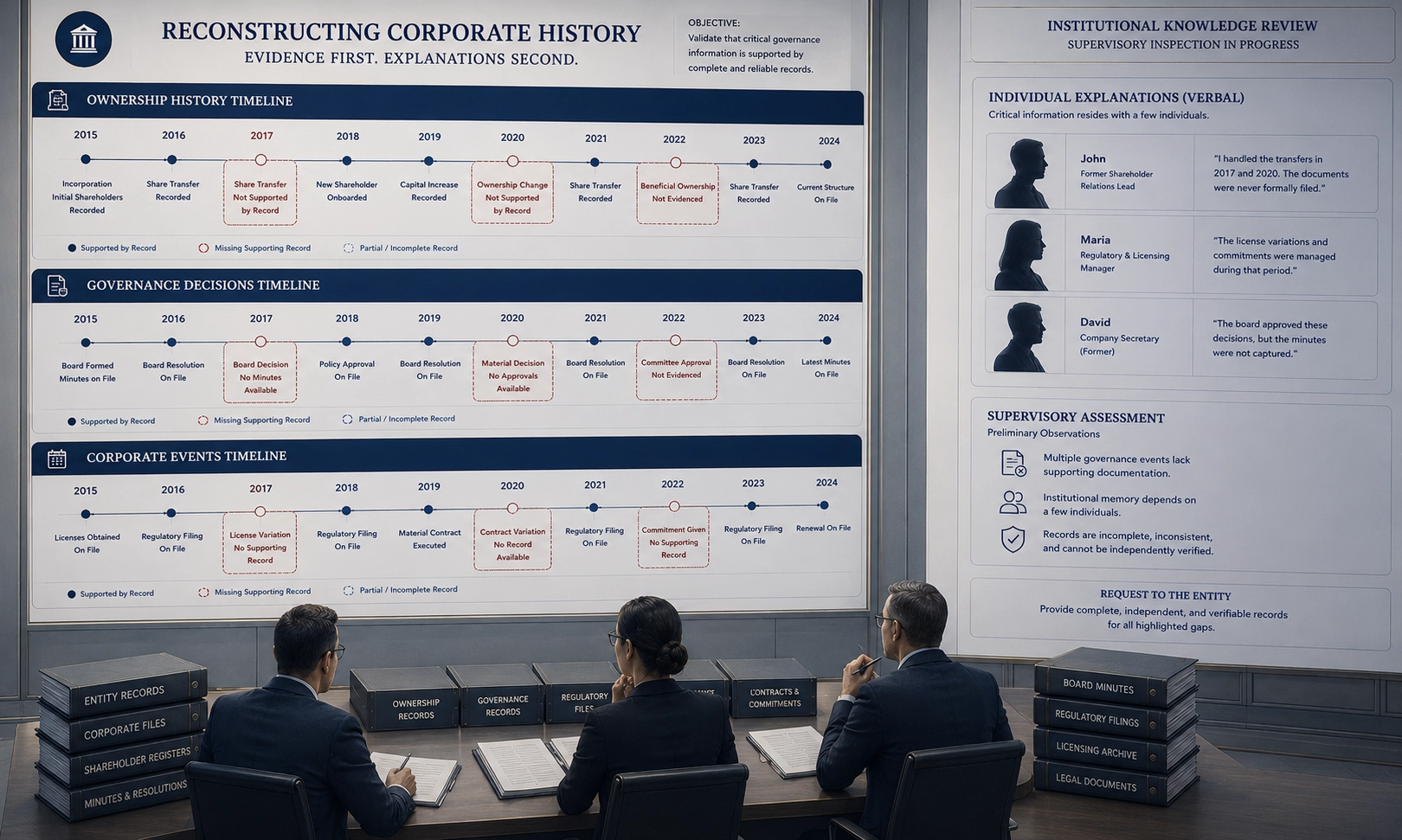
This issue frequently becomes visible during regulatory inspections, licensing reviews, and governance assessments.
A supervisor may request information relating to an entity’s ownership structure, historical governance approvals, licensing commitments, or regulatory obligations. Initially, the organization provides corporate records and supporting documentation that appear complete.
The pressure point emerges when regulators seek to understand why decisions were made, how approvals were obtained, or how ownership structures evolved over time.
In many cases, the answers depend on employee explanations rather than documented evidence. Historical context may exist across emails, spreadsheets, personal files, or individual recollection. Supporting information may be fragmented across departments and systems.
At this stage, the review extends beyond record keeping.
Supervisors begin assessing whether the organization maintains effective institutional control over its governance information.
A Common Inspection Pattern
Organizations often discover the importance of institutional memory only when a supervisor requests evidence relating to an event that occurred several years earlier.
The challenge is rarely the absence of information.
The challenge is proving that the information existed, was accurate, and was available at the time the decision was made.
When gaps between corporate memory and official records are identified, regulators rarely treat them as isolated administrative weaknesses.
Instead, supervisory attention often shifts toward broader questions regarding accountability, governance effectiveness, and management oversight.
If firms cannot clearly evidence ownership history, governance actions, or regulatory obligations, supervisors may conclude that critical oversight depends on individuals rather than controlled processes. Historical decisions may not be independently verifiable. Entity management frameworks may not be operating consistently. Operational resilience may also be weakened by excessive dependence on key personnel.
In GCC supervisory environments, findings of this nature frequently trigger wider reviews of governance controls, corporate administration practices, ownership oversight, and management accountability.
What initially appears to be a records issue can quickly escalate into a wider governance assessment.
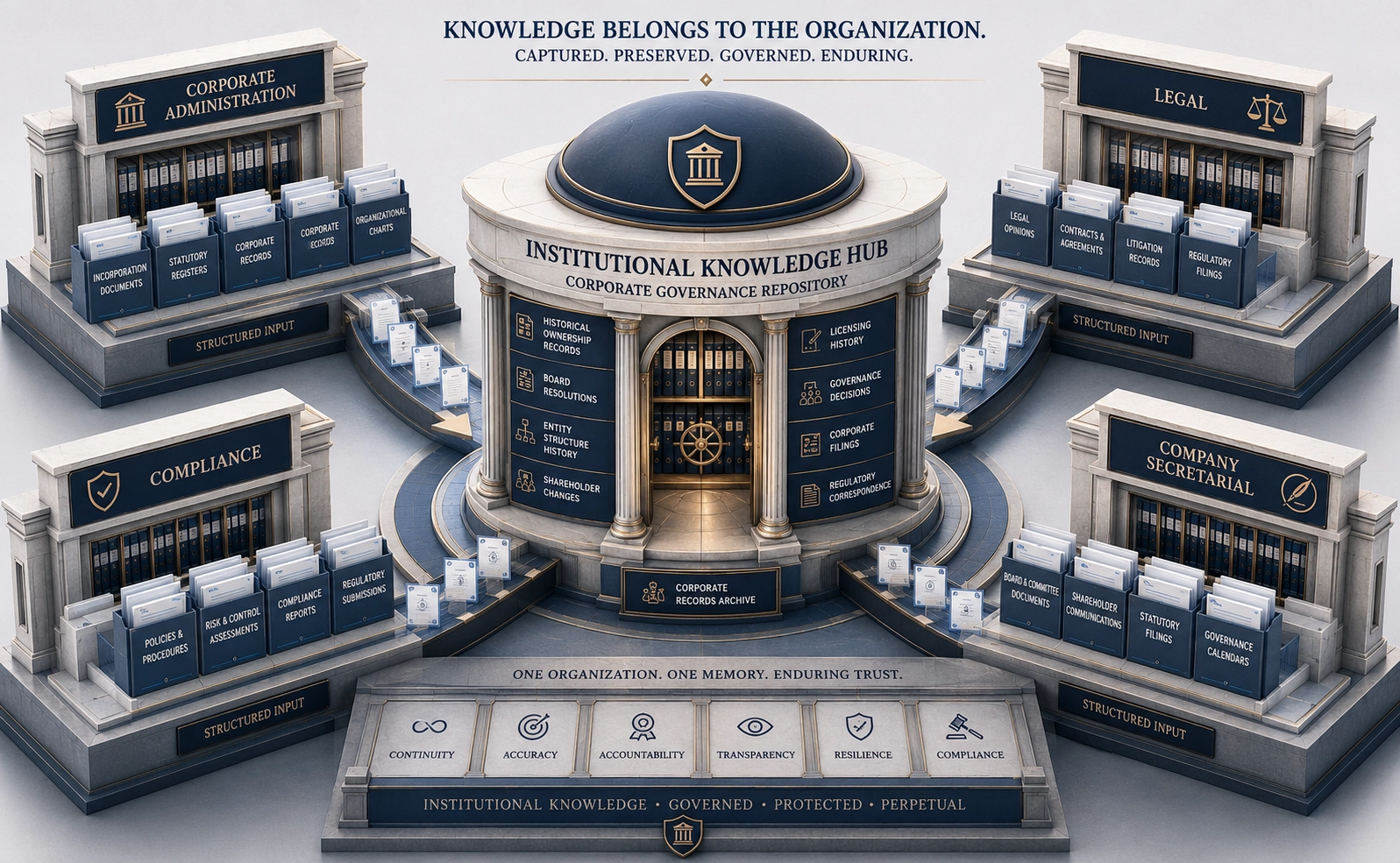
Addressing corporate memory risk requires more than storing documents.
Organizations need a structured environment where entity records, ownership history, governance decisions, licensing obligations, and supporting evidence remain connected throughout the lifecycle of the entity.
Information must remain accessible, traceable, and defensible regardless of personnel changes. Historical context should be preserved alongside supporting records. Governance actions should be linked to approvals, documentation, and ownership changes in a way that allows organizations to reconstruct decisions long after they occur.
The objective is not simply record retention.
The objective is institutional continuity.
Moebius addresses this challenge by bringing entity management, ownership tracking, governance records, document management, workflow automation, and historical auditability into a single operational environment.
Rather than relying on individual recollection to connect historical events, organizations can maintain structured records that preserve the relationship between ownership changes, governance actions, supporting documentation, and regulatory obligations.
By connecting corporate administration, entity oversight, document management, and governance workflows within one platform, organizations gain a centralized and defensible source of truth. This reduces dependence on key personnel, improves visibility across governance processes, and strengthens the ability to respond confidently during inspections and reviews.
Instead of searching for information across multiple systems and individuals, teams can access a connected view of the records, context, approvals, and historical evidence that support critical governance decisions.
Organizations that successfully address corporate memory risk typically achieve:
Most importantly, institutional knowledge becomes a governance asset rather than a governance vulnerability.
Provide us with a bit of information about your business needs and we will be in touch to arrange a no commitment demonstration.


"*" indicates required fields