
A control can be documented, tested, monitored, and reported on regularly—and still have an ownership problem.
This usually becomes visible when something goes wrong. A reviewer asks who was accountable for the control, and several departments point to different parts of the process. Everyone can explain what they were responsible for, but nobody can clearly demonstrate who ultimately owned the outcome.
That distinction is becoming increasingly important as organisations across the GCC build more complex control environments. Business functions, Compliance, Risk, Finance, Operations, Technology, and Internal Audit often contribute to the same control framework, creating layers of expertise and oversight that strengthen governance but can also make accountability difficult to evidence.
The organisation may therefore have plenty of responsibility.
What it may not have is clear ownership.
Modern controls rarely belong to one department alone.
A customer due diligence control, for example, may involve relationship managers performing the activity, Compliance defining the requirement, Operations maintaining records, Risk assessing exposure, Technology supporting the system, and Internal Audit independently testing effectiveness. Each function has a legitimate role, but those roles are not interchangeable.
The difficulty begins when the organisation cannot clearly distinguish between the person who performs a control, the function that monitors it, the team that tests it, and the individual ultimately accountable for ensuring that it remains effective.
When everything works, this distinction may not receive much attention.
When a control fails, it becomes critical.
Imagine a control designed to ensure that high-risk client relationships are reviewed within a defined timeframe.
The relationship team performs the review. Compliance establishes the requirements. Risk monitors the exposure. Operations maintains the records, while Technology provides the workflow and reminder infrastructure.
Now imagine several reviews become overdue.
The relationship team explains that information was missing. Compliance points to the business owner’s responsibility. Operations confirms that the records it received were processed correctly, while Technology demonstrates that the required reminders were generated.
Every explanation may be accurate.
Yet the control has still failed, and leadership now faces a much more important question: who was accountable for making sure the control worked?

There is nothing inherently wrong with distributing responsibility across several functions.
In fact, strong governance often depends on it. Business teams understand operational realities, Compliance interprets regulatory requirements, Risk assesses exposure, Technology enables control execution, and Internal Audit provides independent assurance.
The problem arises when these responsibilities are distributed without a clearly defined accountability structure.
A control can therefore have several participants while still requiring one clearly identifiable owner who is responsible for its effectiveness. Without that distinction, control management can become dependent on coordination between departments, with each team completing its own activity while assuming another function is responsible for the overall outcome.
This is where a control ownership gap begins to develop.
The importance of clear control accountability is reflected in current GCC supervisory frameworks. The Saudi Central Bank (SAMA) states that financial institutions should establish clear limits for responsibility and accountability at all levels and define the competencies and distribution of tasks across organisational levels. SAMA’s governance principles also require the Board to remain responsible for the institution’s business even when powers are delegated.
In the UAE, the Central Bank of the UAE (CBUAE) requires internal control frameworks to define duties and responsibilities, establish clear delegation of authority, and ensure appropriate separation of critical functions. Its current internal control requirements also state that business units must own, manage, and report risks and remain accountable for establishing and maintaining effective internal controls.
These requirements point toward a broader governance principle: assigning activities across multiple teams is not enough. Organisations must be able to demonstrate how responsibility, oversight, and accountability connect across the complete control environment.
One of the most useful questions an organisation can ask is not simply, “Who performs this control?”
The more important question is, “Who owns the outcome when the control does not operate as intended?”
A Compliance officer may monitor whether a regulatory control is operating, but that does not necessarily make Compliance the operational owner. Internal Audit may identify a control weakness, but independence requires that Internal Audit does not become responsible for operating or remediating the control it assesses.
The distinction matters because accountability should remain with the function that has the authority and responsibility to ensure that the underlying risk is properly managed.
When that relationship is unclear, control failures can become exercises in responsibility mapping rather than opportunities for immediate remediation.
Consider a financial services organisation operating across several GCC markets.
A key client onboarding control involves the relationship team, Compliance, Operations, Risk, and Technology. Each function has documented responsibilities, and management receives periodic reporting on the performance of the control.
During a review, several onboarding cases are found to have bypassed a required verification step.
The relationship team believes Compliance should have identified the issue. Compliance argues that the business remains responsible for executing the control. Operations confirms that the records it received were processed correctly, while Technology demonstrates that the underlying system functioned according to its configuration.
The organisation has evidence of activity from every function.
What it cannot immediately demonstrate is who was ultimately accountable for ensuring that the control operated effectively from beginning to end.
The issue is therefore not a lack of involvement.
It is a lack of ownership clarity.
A mature control environment should make several questions answerable without extensive manual reconstruction.
Who owns the control? Who performs it? Who monitors it? What risk does it address? How frequently is it reviewed? What happens when it fails? Who is responsible for remediation, and how is management informed?
These questions become particularly important when controls span departments, legal entities, jurisdictions, or multiple lines of defence.
The CBUAE’s internal control framework reflects this separation of roles. Its requirements distinguish business units as the first line, control functions such as Risk and Compliance as the second line, and Internal Audit as an independent third line, while explicitly stating that responsibility for internal control does not simply transfer from one line to another.
That distinction is critical.
Oversight can be shared.
Accountability still needs to be defined.

Control ownership is not something that can be assigned once and forgotten.
Organisations restructure. Employees change roles. Functions are centralised. Activities move between countries. New systems replace old ones, and regulatory requirements introduce new responsibilities.
The control may remain exactly the same on paper while the organisation around it changes significantly.
This creates a practical governance risk. A control that had a clearly defined owner two years ago may now sit between two departments because responsibilities have shifted without the underlying control framework being updated.
That is why ownership needs to remain part of the control lifecycle.
Organisations should be able to identify when ownership changes, why it changed, who approved the change, and whether the new owner has the authority and resources required to maintain the control effectively.
Many organisations already maintain control registers, risk registers, policies, and audit records.
These are important governance tools, but documentation alone does not guarantee effective control ownership.
A register can tell management that a control exists. Effective control governance should also make it possible to understand the control’s owner, operating responsibilities, monitoring arrangements, review history, identified weaknesses, remediation actions, and current status.
This is where the difference between documenting controls and governing controls becomes significant.
The objective is not simply to maintain a complete inventory.
It is to maintain a living view of who is accountable for the controls that protect the organisation.
This is where Moebius Compliance Management becomes relevant.
Rather than treating compliance controls, risk information, monitoring activities, alerts, reporting, and audit evidence as disconnected activities, Möbius provides an integrated environment for managing compliance and risk processes with configurable rules, reminders, alerts, reporting, and audit trails. Moebius Compliance Management.
That structure allows organisations to move beyond simply recording that a control exists. Control-related activities can be connected to the people, processes, evidence, monitoring requirements, and governance actions that support them, creating greater visibility into how controls are operating across the organisation.
For organisations looking to strengthen control ownership, GCC, compliance controls UAE, and broader governance accountability Middle East requirements, this distinction is important. The goal is not another control register; it is a governed operating environment in which accountability can be demonstrated throughout the control lifecycle.
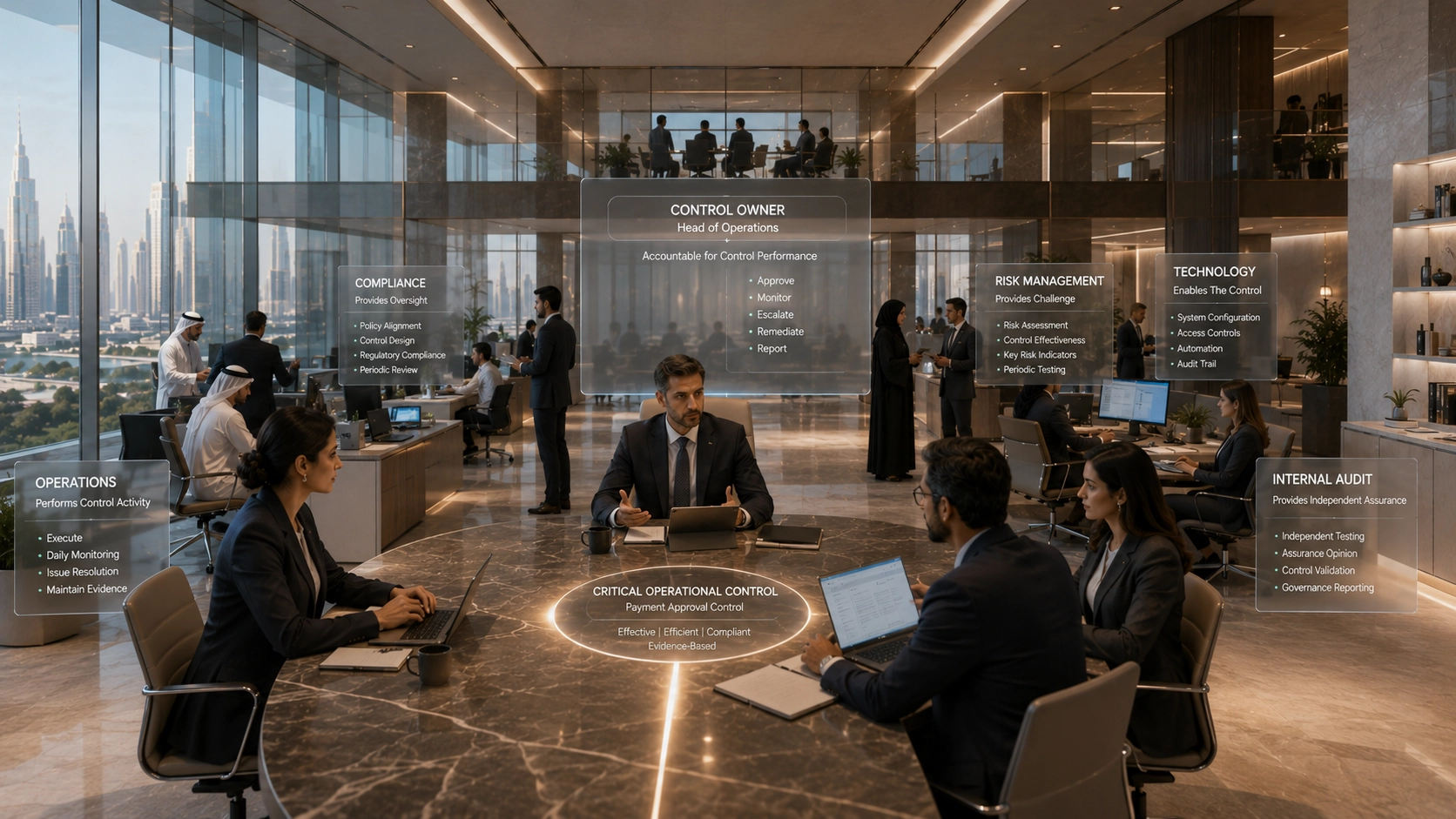
The more complex an organisation becomes, the more functions will inevitably participate in its controls.
That complexity is not itself a weakness. The risk emerges when organisational complexity makes it difficult to determine who has ultimate responsibility for a control’s effectiveness.
A business function may execute the activity. Compliance may monitor the requirement. Risk may challenge the exposure. Technology may enable the process. Internal Audit may independently assess the framework.
All of those roles can coexist within a strong governance model.
What cannot be left unclear is who ultimately owns the control and has the authority to ensure that weaknesses are addressed.
That clarity becomes particularly valuable when something changes.
A control fails. A remediation action becomes overdue. A team is reorganised. A new regulation takes effect. A process moves to another jurisdiction.
When ownership is clearly governed, the organisation knows where the issue belongs and how it should move forward.
The question leadership should be asking is therefore no longer simply:
“Do we have the right controls in place?”
It should be:
“Can we clearly demonstrate who owns each critical control, who is responsible for operating and monitoring it, and who is accountable when it does not work?”
That is the difference between having a control framework and having a control environment that can withstand scrutiny.
Because when everyone has a role, governance needs to make sure that accountability does not disappear between those roles.
Provide us with a bit of information about your business needs and we will be in touch to arrange a no commitment demonstration.


"*" indicates required fields