
A regional financial services firm had just secured one of its largest corporate clients.
The commercial team had completed negotiations, legal had finalized the contract, compliance had cleared the customer due diligence requirements, and operations stood ready to begin onboarding. From every operational perspective, the organization was prepared to move forward.
One approval remained outstanding.
It wasn’t a complicated approval. It wasn’t even disputed. It had simply been waiting for the right person to review it.
Over the following eight days, the approval moved between inboxes, was forwarded to different stakeholders, returned for clarification, and was delayed again because another executive was travelling. During that time, the client postponed implementation, project timelines shifted, and internal teams repeatedly paused and restarted their work while waiting for authorization.
Nothing had technically gone wrong.
Yet the organization had already begun absorbing the cost of delayed governance.
As organizations expand across business units, jurisdictions, and management layers, approval processes inevitably become more sophisticated. New controls are introduced, additional reviewers become involved, and accountability becomes increasingly important.
Ironically, the very controls designed to strengthen governance can begin slowing the business they were created to protect.
Across the GCC, regulators and auditors are paying closer attention to this issue. They are no longer assessing only whether approvals exist, but whether organizations can demonstrate that approval processes remain efficient, transparent, and consistently governed throughout their lifecycle.
The question is gradually changing.
It is no longer:
“Was this eventually approved?”
Increasingly, reviewers want to understand:
“Why did this approval take so long, who was responsible at each stage, and could the organization have identified the delay before it affected operations?”
Most organizations don’t experience approval congestion overnight.
It develops gradually as the business becomes more successful.
New clients require additional reviews. Larger contracts involve multiple departments. Regulatory obligations introduce new checkpoints. Senior executives become responsible for approving an increasing number of operational, financial, legal, and compliance decisions.
Each new control appears reasonable when viewed independently.
Collectively, however, they create approval environments that become increasingly difficult to manage.
A procurement request may require finance approval before moving to operations. Client onboarding may depend on legal, compliance, and commercial teams completing separate reviews. Vendor payments may wait for multiple authorization levels spread across different business units.
Every additional approval improves oversight.
Every additional approval also introduces another potential delay.
Without centralized visibility, organizations often discover approval congestion only after clients begin waiting, projects slow down, or operational performance starts deteriorating.

Organizations often assume approval delays result from individual performance.
In reality, the underlying causes are usually structural.
Approvers may not know an item requires their attention. Requests may be routed incorrectly. Supporting documentation may be incomplete. Dependencies between departments may remain invisible until work reaches a bottleneck. High-priority approvals may compete with routine requests because every item enters the same queue.
As organizations grow, these challenges become increasingly common.
Approval responsibilities become distributed across multiple offices, legal entities, business units, and senior decision-makers. Without standardized workflows, automated routing, task visibility, and escalation mechanisms, even relatively simple decisions can spend days waiting between operational stages.
The issue is rarely unwillingness to approve.
More often, organizations lack continuous visibility into where approvals are waiting, why they are delayed, and what operational impact those delays are creating.
This is why approval governance is increasingly becoming an operational capability rather than an administrative task.
The Central Bank of the UAE (CBUAE) continues to emphasize effective governance arrangements, clear accountability, and robust internal control environments through its
Corporate Governance Regulations and Standards. Strong governance increasingly requires organizations to demonstrate not only that controls exist, but that decision-making processes remain effective and proportionate.
Similarly, the Saudi Central Bank (SAMA) reinforces expectations around governance, oversight, and effective operational controls within regulated entities, encouraging firms to maintain transparent decision-making frameworks that support timely and accountable execution.
Approval congestion rarely affects only one department.
Its consequences spread quietly across the organization.
A delayed client approval postpones onboarding activities. Operations reschedules implementation. Finance cannot issue invoices. Project managers adjust resource allocations. Customer expectations begin to change while internal teams continue waiting for authorization to proceed.
Eventually, what began as a simple approval delay evolves into a chain of operational inefficiencies.
These hidden costs often remain invisible because each department experiences only a small part of the overall delay.
No individual team sees the complete picture.
Organizations increasingly require integrated workflow environments capable of connecting approvals, supporting documentation, task ownership, escalation rules, and reporting into a single operational process. Without this visibility, identifying recurring bottlenecks becomes extremely difficult.
A large professional services organization operating across several GCC countries experienced increasing delays in approving new client engagements.
Leadership initially believed the problem stemmed from rising business volumes.
However, a detailed operational review revealed that approval requests routinely passed through six different departments before work could begin. Each team completed its own review efficiently, but there was no centralized visibility into the overall approval journey. Requests frequently remained idle between departments because ownership changed without automated notifications or escalation triggers.
By the time delays became visible to leadership, project schedules had already shifted and several clients had expressed concerns about implementation timelines.
Rather than reducing governance controls, the organization redesigned its approval framework.
Workflow automation was introduced to automatically route requests, notify approvers, escalate overdue approvals, and provide management with real-time visibility into approval status across every stage of the process.
The result was not fewer approvals.
It was better governance.
Approvals became faster because accountability became visible.

Regulators increasingly distinguish between approval completion and approval governance.
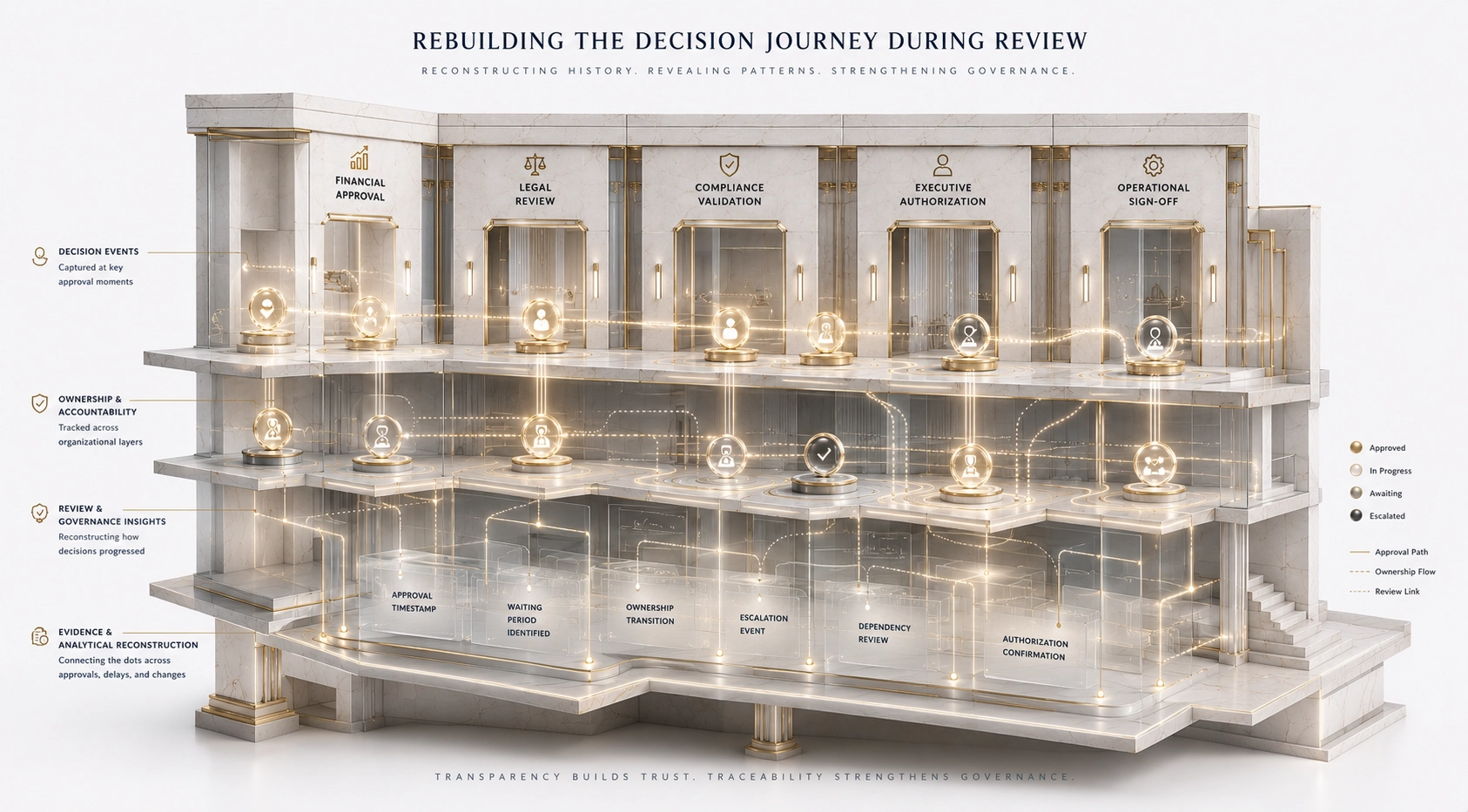
An organization may ultimately approve every request while still exposing governance weaknesses if it cannot demonstrate how approvals progressed, where delays occurred, who owned each decision at different stages, and whether escalation mechanisms functioned as intended.
Approval timelines are no longer viewed simply as operational metrics.
They are increasingly regarded as evidence of governance maturity, management oversight, and organizational responsiveness.
Approval congestion often remains hidden during day-to-day operations.
It becomes highly visible when an auditor, regulator, or supervisory authority asks the organization to reconstruct the journey of a critical decision.
The review rarely begins with questions about technology.
Instead, reviewers typically ask:
Organizations usually have little difficulty producing the final approved document.
The challenge begins when reviewers request the operational history behind that decision.
Approval requests may have travelled through multiple email chains. Supporting documents may have been stored in separate repositories. Comments may exist within collaboration platforms, while delegated approvals were communicated verbally or through informal messaging.
Reconstructing the complete approval journey often requires contributions from several departments, consuming valuable time and exposing weaknesses in governance visibility.
At that point, the discussion shifts.
It is no longer about one delayed approval.
It becomes an assessment of whether the organization has effective governance over its entire approval framework.
Approval congestion affects much more than turnaround times.
Delayed commercial approvals can postpone client onboarding. Procurement approvals may slow vendor engagement. Deferred financial approvals can delay invoicing and revenue recognition. Compliance approvals may affect regulatory reporting, while legal approvals can postpone contract execution.
Although each delay appears isolated, together they create friction across the organization.
More importantly, they reduce management’s ability to respond quickly to changing business conditions.
Hidden approval bottlenecks also increase operational risk.
Employees may begin bypassing formal approval routes to maintain momentum. Managers may approve requests outside established processes because they perceive official workflows as too slow. Temporary workarounds gradually become accepted operating practices.
Ironically, controls designed to strengthen governance can unintentionally encourage behaviour that weakens it.
This is why leading organizations increasingly focus not only on adding controls, but on ensuring those controls remain efficient, transparent, and measurable.
Approval congestion rarely remains an isolated operational issue.
Reviewers often examine what prolonged approval timelines reveal about the broader control environment.
Repeated delays may indicate unclear ownership. Inconsistent approval routes may raise questions regarding delegated authority. Missing audit trails can prompt scrutiny of documentation practices, while recurring bottlenecks may lead supervisors to evaluate management oversight and workflow governance.
What initially appears to be a process inefficiency can therefore evolve into a much broader assessment of governance effectiveness.
Organizations that cannot confidently explain how approvals move through their business increasingly face questions about operational resilience, accountability, and decision-making transparency.
For leadership teams, the issue extends beyond efficiency.
Delayed decisions can influence client satisfaction, financial performance, regulatory responsiveness, employee productivity, and organizational agility.
Approval governance is therefore becoming an executive concern rather than simply an operational one.
As organizations grow, approval frameworks naturally become more sophisticated.
Additional controls, reviewers, and governance checkpoints are introduced to strengthen oversight and reduce risk. Yet if those controls are not supported by visibility, automation, and clear accountability, they can gradually become obstacles to effective decision-making.
The strongest governance environments are not those with the highest number of approvals.
They are the ones where every approval is visible, every responsibility is clearly assigned, every delay is measurable, and every decision can be confidently reconstructed when required.
This is where Moebius supports organizations.
Through its integrated Workflow Automation, Task Management, Document Management, and Reporting capabilities, Moebius enables organizations to orchestrate complex approval processes within a single governance environment. Approval requests are automatically routed, responsibilities remain visible, supporting documents stay connected to each decision, escalation rules are enforced consistently, and leadership gains real-time insight into approval performance across the organization.
As regulatory expectations continue to evolve across the GCC, organizations are increasingly expected to demonstrate that governance enables timely, transparent, and accountable decision-making, not that it slows it down.
The question executives should now be asking is not:
“Do we have enough approvals?”
It is:
“Can we prove our approval process strengthens governance without slowing the business?”
Provide us with a bit of information about your business needs and we will be in touch to arrange a no commitment demonstration.


"*" indicates required fields