
The supervisor repeated the question.
Four managers sat across the table. Each had participated in the customer onboarding process at different stages. Operations had initiated the activity. Compliance had performed reviews. Legal had assessed contractual obligations. The relationship team had ultimately completed the onboarding.
Everyone had contributed.
No one could clearly demonstrate who had been accountable on that specific date.
The process itself had been completed successfully. The client had been onboarded, approvals had been obtained, and services had commenced without incident.
Yet the inspection continued.
Reviewers were no longer examining whether the process had been completed. They were examining how accountability had been maintained as work moved across the organization.
Across the GCC, this scenario is becoming increasingly familiar. Supervisors, auditors, and governance reviewers are paying growing attention to what happens between operational stages, particularly when activities move between teams, departments, jurisdictions, or third-party providers.
Increasingly, organizations are discovering that completing work and evidencing accountability are not the same thing.
Most organizations invest heavily in designing robust operational processes.
Policies are documented. Controls are established. Teams understand their responsibilities. Approval requirements are defined, and service standards are clearly communicated.
Within individual teams, processes often function effectively.
Governance weaknesses frequently emerge elsewhere.
They emerge at the precise moments when work changes hands.
A customer onboarding activity may move from relationship managers to compliance teams. A complaint may transition from operations to legal. A regulatory obligation may require contributions from multiple departments before final approval is granted.
Each transition introduces complexity.
Each handover creates the possibility that accountability, supporting documentation, outstanding obligations, or critical context may not move with the work itself.
The process continues.
Accountability often becomes less visible.
Organizations increasingly require structured workflow environments capable of preserving ownership histories, documenting handovers, maintaining task visibility, and ensuring that accountability remains visible throughout the operational lifecycle.
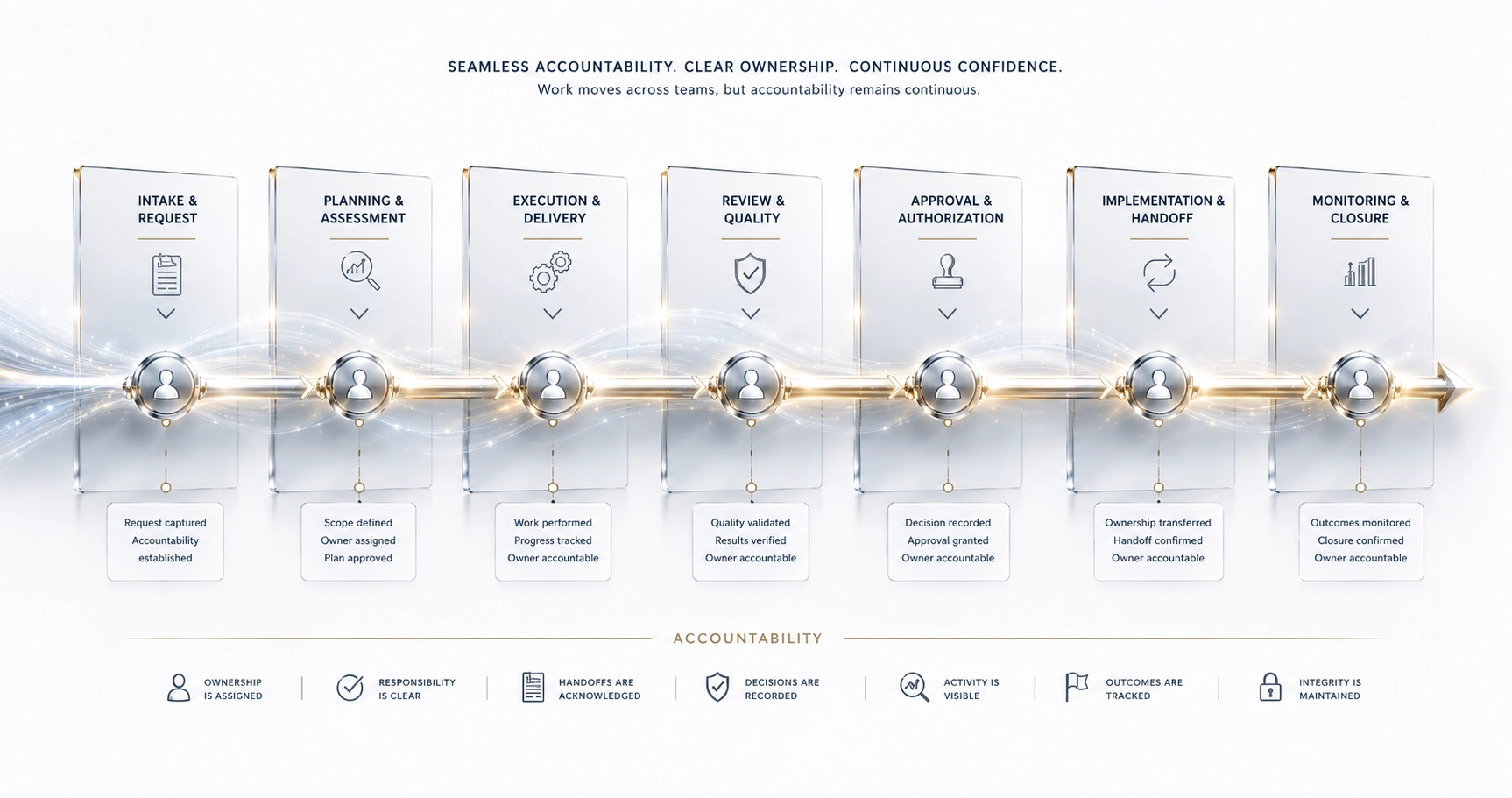
Operational handovers rarely fail dramatically.
More often, accountability weakens gradually.
A task is reassigned during a meeting, but ownership is never formally acknowledged.
Supporting documentation is shared through email rather than attached to the workflow record. A deadline is communicated verbally and later forgotten. Teams assume that responsibility has transferred simply because work has progressed.
Individually, these situations appear insignificant.
Collectively, they create environments where operational activities continue, but accountability becomes increasingly difficult to evidence.
Modern organizations face additional complexity.
Processes increasingly span multiple business units, legal entities, geographic locations, outsourced providers, and specialist functions. Hybrid working arrangements have further increased dependence on digital coordination, workflow transparency, and structured ownership management.
Without workflow automation, documented ownership transitions, centralized task histories, and integrated document management, organizations frequently become dependent on institutional memory to explain operational decisions.
As organizations scale, this dependency creates significant governance risk.
Research published by the Project Management Institute (PMI) consistently identifies unclear ownership and ineffective handovers as significant contributors to delays, operational inefficiencies, and governance failures across complex organizations.
Similarly, governance expectations promoted by the Financial Action Task Force (FATF) emphasize the importance of clear accountability, effective internal controls, and documented governance arrangements throughout critical business processes.
A GCC financial institution operating across multiple business units undertook an internal review of its customer onboarding process following several onboarding delays.
The review revealed that activities routinely moved between relationship managers, compliance specialists, legal teams, and operations staff. Although each team completed its assigned activities, ownership transitions were largely managed through email and informal communication.
The organization discovered that several high-risk onboarding cases had experienced delays because teams believed responsibility had already been transferred, while receiving teams had not formally accepted ownership.
Internal audit concluded that the issue was not process failure.
It was accountability failure.
In response, the institution introduced workflow-driven ownership transfers, automated escalation mechanisms, centralized task management, and integrated document controls.
As a result, accountability became continuously visible rather than dependent upon individual follow-up.
Operational handovers are rarely tested during routine business activities.
They are tested during inspections.
Auditors and supervisors frequently ask organizations to explain how work progressed across multiple teams and whether accountability remained continuous throughout the process.
Reviewers often seek answers to questions such as:
Organizations generally have little difficulty describing the process itself.
The challenge emerges when reviewers request evidence.
Ownership histories may exist within emails. Approvals may be distributed across multiple systems. Supporting documents may reside within shared drives, while handover discussions remain undocumented.
At this stage, organizations often discover that operational continuity does not necessarily demonstrate governance continuity.
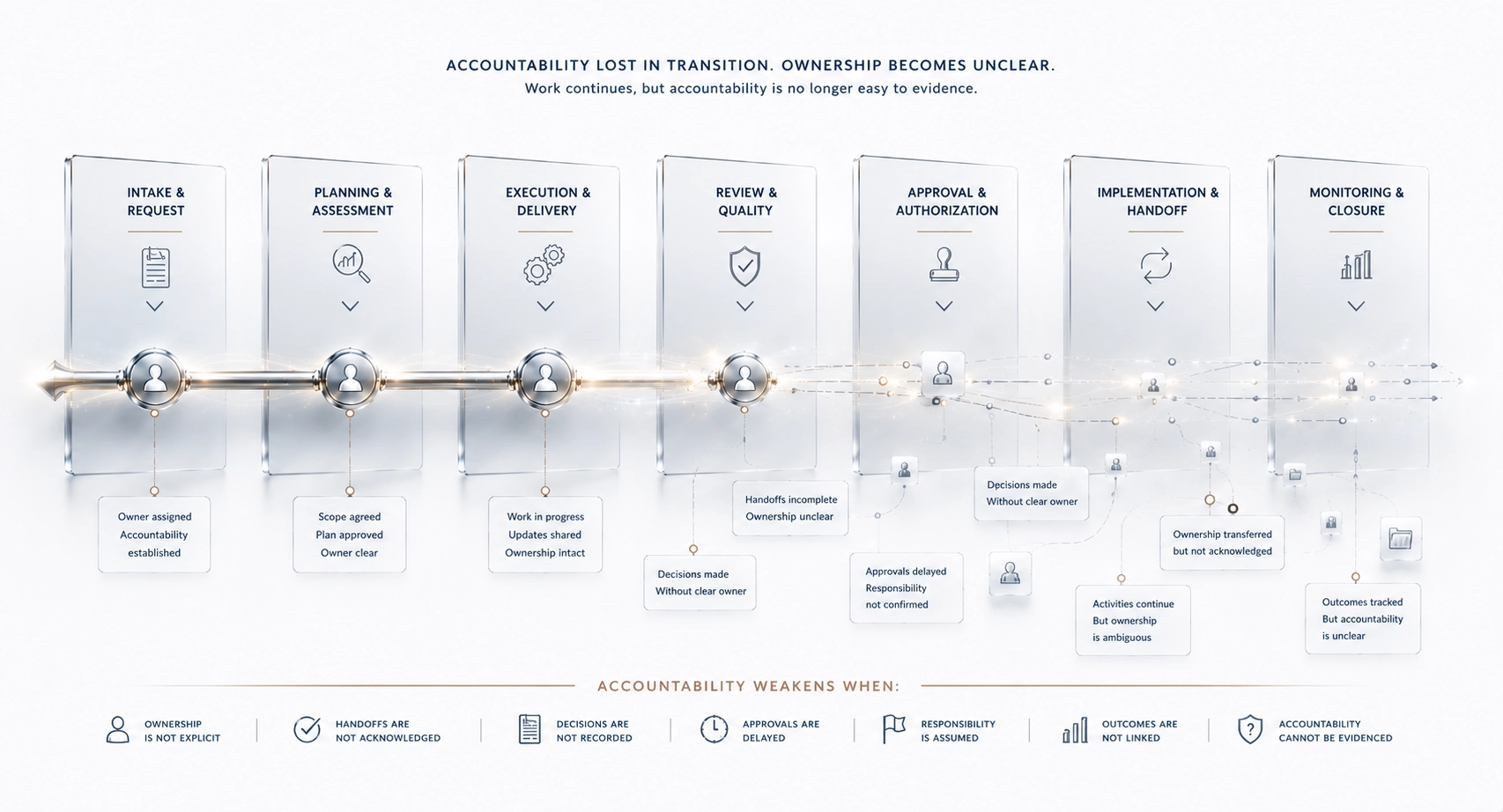
Governance reviewers increasingly distinguish between work completion and accountability evidence.
A process may be completed successfully while still exposing significant weaknesses if organizations cannot demonstrate how ownership evolved, how responsibilities were accepted, and how obligations were governed throughout execution.
The ability to evidence accountability is increasingly viewed as an important measure of operational maturity.
Handover risks rarely begin as major incidents.
A missed acknowledgement. An undocumented ownership transfer. An unresolved action. A deadline that fails to move with the workflow.
These issues often appear operational.
Supervisors rarely view them in isolation.
Instead, they assess what these weaknesses reveal about broader governance arrangements.
A missing ownership history may trigger questions regarding accountability frameworks. Incomplete handover evidence may prompt reviews of workflow governance. Unresolved actions may lead regulators to examine escalation procedures and management oversight practices.
What initially appears to be a simple operational handover issue can therefore expand into a broader assessment of governance effectiveness.
This escalation pathway is increasingly evident across regulated environments throughout the GCC.
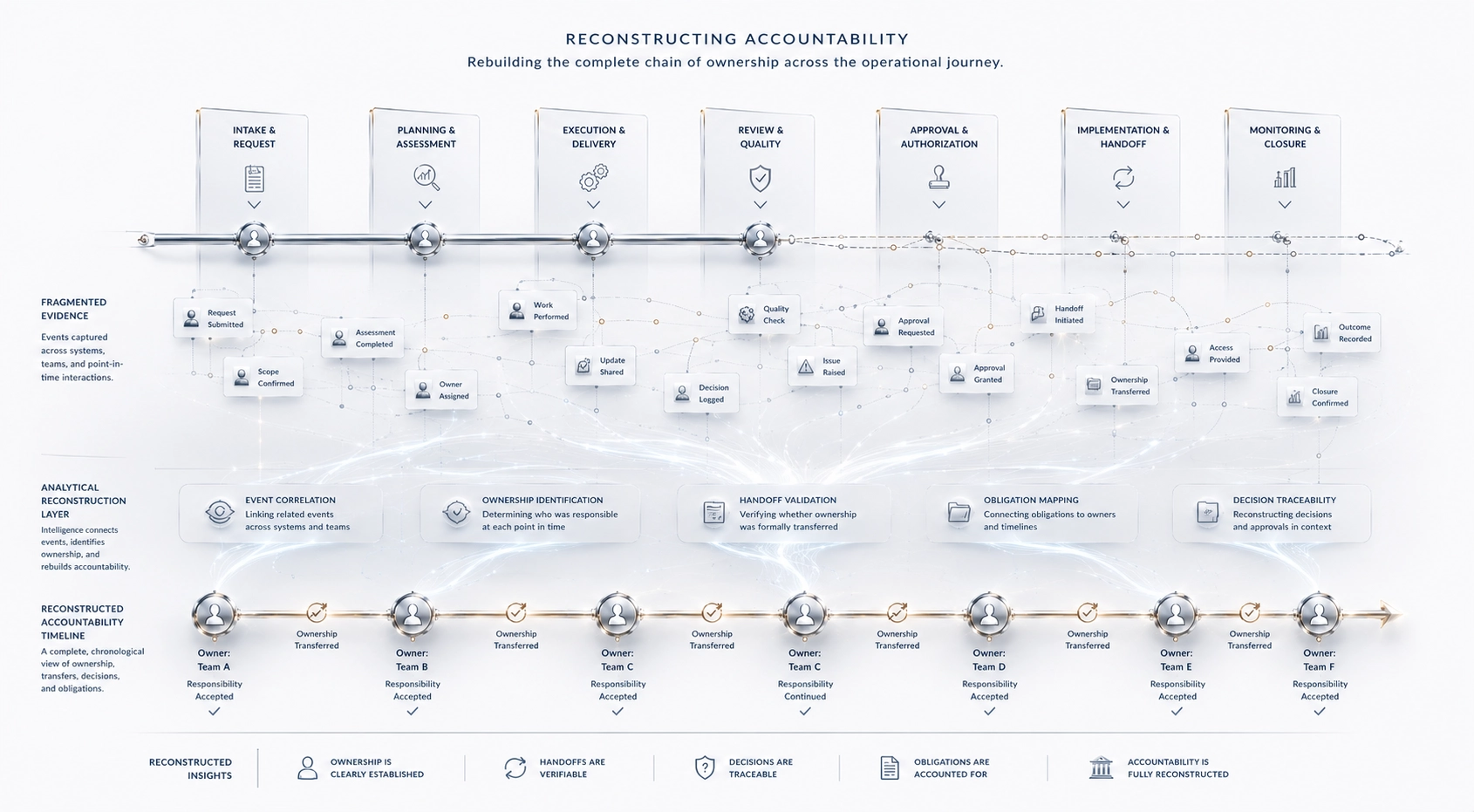
Organizations frequently assume that communication alone is sufficient to support operational handovers.
Increasingly, that assumption is being challenged.
Modern operational environments require significantly greater transparency. Organizations need the ability to demonstrate how work moved across teams, when ownership changed, who accepted responsibility, what obligations remained outstanding, and how decisions were documented throughout the process.
Emails, spreadsheets, and informal coordination mechanisms rarely provide this level of visibility consistently.
Organizations increasingly require integrated workflow environments capable of connecting task ownership, workflow automation, document management, approvals, escalation pathways, and complete operational histories within a single governance framework.
This is where Moebius supports organizations.
By combining Workflow Management, Workflow Automation, Task Management, and Document Management capabilities within a unified operational platform, Moebius enables organizations to maintain continuous accountability across complex workflows while preserving a complete and auditable history of every operational handover.
When inspectors ask, “Who owned this process on a specific date?”, leading organizations are able to answer immediately.
Not because individuals remember.
But because the operational history remembers for them.
Provide us with a bit of information about your business needs and we will be in touch to arrange a no commitment demonstration.


"*" indicates required fields