Ownership does not become a regulatory risk when control changes.
It becomes a regulatory risk when governance records fail to keep pace with that change.
Across the GCC, supervisors increasingly encounter organizations that are confident they understand who controls an entity today, yet struggle to demonstrate when that control emerged, how it evolved, and when it was formally recognized.
The issue often remains invisible until regulators attempt to reconstruct the ownership history of an entity.
At that point, delayed updates, fragmented records, and undocumented control relationships can quickly become governance concerns.
What appears to be an administrative gap often raises a much larger question:
Did the organization truly have visibility over its ownership structure as it evolved?
Ownership structures rarely remain static.
Shareholdings change, beneficial interests evolve, investors enter and exit, and influence shifts across formal and informal relationships. In many organizations, these developments occur gradually through a series of transactions, commercial arrangements, indirect holdings, or evolving decision making authority rather than through a single identifiable event.
Because these changes often happen incrementally, organizations may continue operating without recognizing that governance records are no longer fully aligned with operational reality.
Management understands who holds influence. Stakeholders understand who is making decisions. The business continues functioning normally.
The problem emerges when the records tell a different story.
Over time, a gap can develop between actual control and documented ownership. That gap often remains invisible until a regulatory review, audit, or governance assessment brings it into focus.
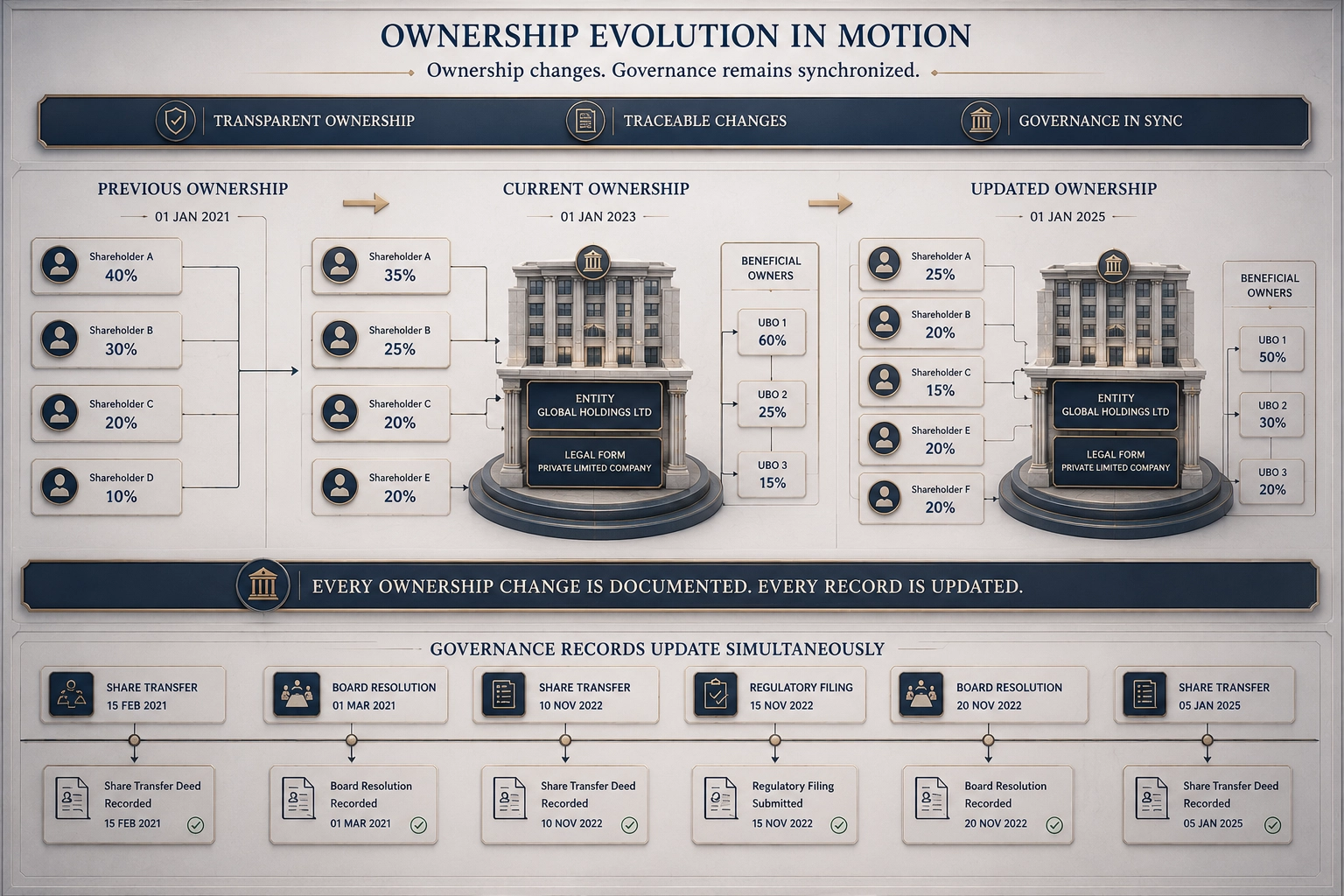
Organizations often view ownership updates as an administrative responsibility.
In reality, ownership visibility sits at the center of governance, transparency, and decision making.
When ownership information is not updated promptly, multiple business functions can be affected. Governance reviews become more complex. Regulatory filings may require additional validation. Beneficial ownership assessments become harder to complete accurately.
Management teams may struggle to demonstrate how control relationships evolved over time.
The consequences extend beyond compliance.
Delayed visibility can create uncertainty around accountability, approval authority, shareholder rights, and reporting obligations. As ownership structures become more complex, small visibility gaps can gradually become significant governance challenges.
What begins as a delayed update can evolve into a much broader oversight problem.
Across the GCC, regulatory expectations around ownership transparency continue to evolve.
Authorities increasingly expect organizations to maintain an accurate and current understanding of who owns, controls, or ultimately benefits from an entity. This focus is being reinforced by standards promoted by the Financial Action Task Force (FATF) and supervisory initiatives led by authorities such as the Central Bank of the UAE and the Saudi Central Bank (SAMA).
While reporting obligations differ across jurisdictions, the underlying expectation remains consistent.
Regulators increasingly want organizations to demonstrate not only who owns an entity today, but also how ownership evolved, when control shifted, and how those changes were identified and documented.
The ability to evidence ownership transitions is becoming just as important as maintaining ownership records themselves.
Supervisory Observation
Regulators are increasingly concerned with the timing of ownership visibility rather than ownership visibility alone.
In many reviews, organizations can eventually produce accurate ownership information. The challenge is demonstrating that the information was accurate at the moment decisions were made, obligations were triggered, or regulatory filings were submitted.
A delay between operational reality and documented ownership can create uncertainty around governance oversight.
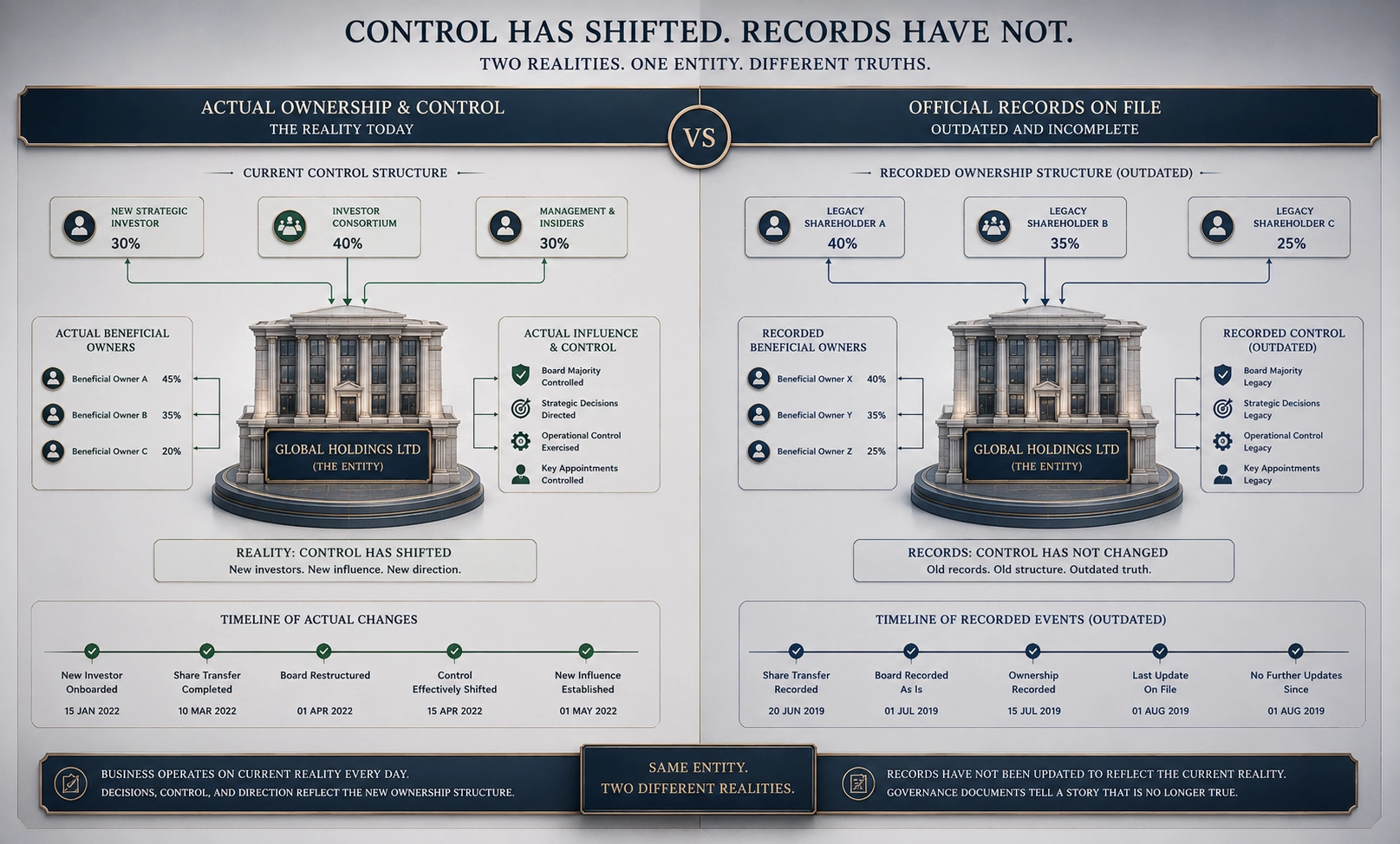
One of the most common ownership challenges occurs when actual control shifts before supporting records are updated.
A transfer of shares may be agreed upon before documentation is finalized. Beneficial interests may change through indirect holdings. New decision makers may begin exercising influence before ownership records are formally updated. Voting rights, financing arrangements, and commercial relationships may alter control structures without immediately triggering governance updates.
Internally, these developments may be well understood.
The difficulty arises when governance systems fail to reflect the same reality.
As time passes, organizations become increasingly reliant on informal understanding rather than documented ownership visibility.
The longer the delay persists, the harder it becomes to establish a clear timeline of how control evolved.
Consider a common governance scenario.
An organization undergoes a series of ownership changes over several years. New investors enter. Existing shareholders reduce their involvement. Decision making authority gradually shifts among stakeholders.
Internally, everyone understands the changes.
Management knows who exercises influence. Shareholders understand the evolving ownership structure. Business decisions continue without disruption.
Several months later, a regulator requests information relating to beneficial ownership, shareholder history, or control arrangements.
The organization provides ownership records, shareholder registers, and supporting documentation.
That is when the challenge begins.
Regulators attempt to reconstruct how ownership evolved over time and compare official records against the actual sequence of events.
Suddenly, what appeared to be a straightforward ownership structure becomes significantly harder to explain.
Ownership blind spots rarely emerge because organizations are unaware of changes.
More commonly, regulators discover that ownership developments were understood internally but were not reflected consistently across governance records, shareholder registers, supporting documentation, and oversight processes.
This distinction is important.
Regulators increasingly assess how quickly organizations identify, validate, document, and govern ownership changes once they occur.
A Common Inspection Pattern
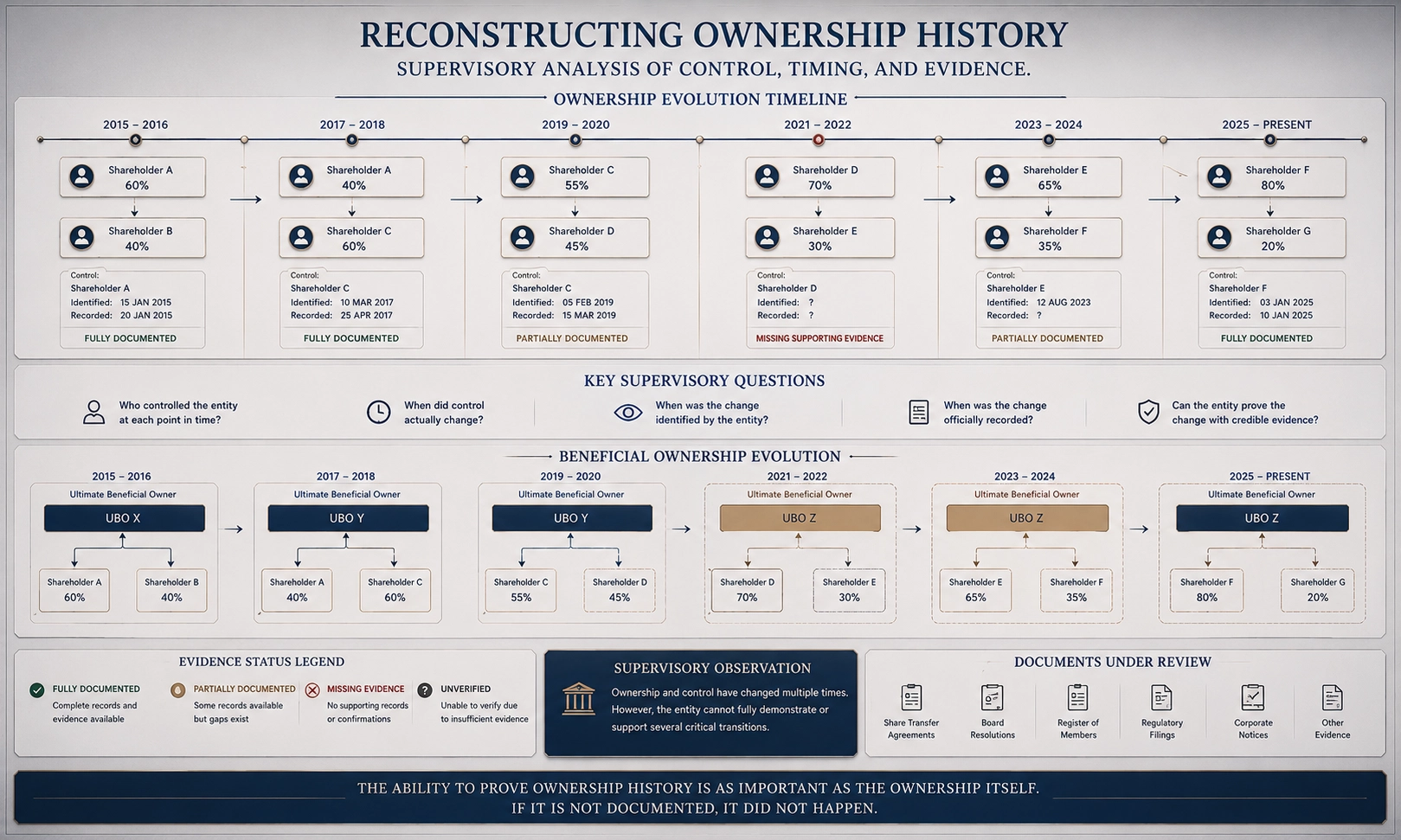
Organizations often discover the significance of ownership visibility only when supervisors attempt to reconstruct a historical control timeline.
The challenge is rarely determining who controls the entity today.
The challenge is demonstrating who controlled the entity at a specific point in time, when that control emerged, and how the organization identified and governed the transition.
When organizations cannot answer those questions confidently, regulatory attention often expands beyond ownership records and into broader governance controls.
When ownership blind spots are identified, regulators rarely treat them as isolated recordkeeping issues.
Instead, supervisory attention often expands into broader questions regarding governance effectiveness, transparency controls, management oversight, and ownership monitoring.
If organizations cannot clearly demonstrate when ownership changed, who exercised control, or how those changes were identified and governed, regulators may question the reliability of the wider governance framework.
In GCC supervisory environments, ownership inconsistencies frequently trigger additional scrutiny relating to beneficial ownership monitoring, shareholder oversight, entity administration, and regulatory reporting.
What begins as a delayed ownership update can quickly escalate into a broader assessment of transparency and control effectiveness.
Supervisory expectations are increasingly shifting toward continuous ownership visibility rather than periodic ownership verification.
Organizations are expected to maintain a structured understanding of ownership and control relationships as they evolve. This requires ownership changes to be identified promptly, validated consistently, reviewed appropriately, and reflected across governance processes without unnecessary delay.
Effective governance frameworks do more than maintain shareholder records.
They provide visibility into ownership transitions, preserve historical control relationships, and allow organizations to demonstrate how ownership structures evolved over time.
The objective is not simply maintaining accurate records.
The objective is maintaining continuous ownership oversight.
Moebius addresses this challenge by bringing entity management, beneficial ownership tracking, shareholder oversight, governance records, document management, and workflow automation into a single operational environment.
Rather than treating ownership information as a static register, organizations gain visibility into how ownership structures evolve, how control relationships change, and how governance actions relate to those developments over time.
By connecting ownership records, supporting documentation, approval workflows, and governance oversight within one platform, organizations can maintain a consistent and defensible view of ownership throughout the entity lifecycle.
This enables firms to move beyond reactive ownership updates and establish a more transparent, continuously monitored, and operationally resilient approach to ownership governance.
Organizations that successfully address ownership visibility challenges typically achieve:
Most importantly, ownership information becomes a continuously monitored governance asset rather than a historical record that is updated after change has already occurred.
Provide us with a bit of information about your business needs and we will be in touch to arrange a no commitment demonstration.


"*" indicates required fields