
Across tightly regulated European markets, regulatory enforcement rarely arrives without warning. In most cases, enforcement action is the result of a long sequence of observable breakdowns that develop quietly inside an organization long before a regulator intervenes.
Authorities are no longer focused on isolated compliance failures. Instead, they assess recurring institutional patterns, including ineffective Anti-Money Laundering (AML) control execution, inconsistent documentation, governance weaknesses, and fragmented operational workflows. These deficiencies rarely emerge suddenly. They tend to accumulate over extended periods before formal supervisory action is initiated.
Cyprus provides a useful reference point for understanding these dynamics. As a jurisdiction operating under European Union AML frameworks, Financial Action Task Force (FATF) pressure, and increasing cross-border supervisory coordination, Cyprus illustrates how enforcement risk accumulates when internal compliance structures fail to operate consistently in practice.
This is not a Cyprus-only issue. The same enforcement patterns now surface across Europe’s most tightly regulated markets.

One of the most common misconceptions among regulated firms is that enforcement action is triggered by a single event.
In reality, enforcement usually follows a pattern of degradation.
Regulators do not move from compliance to penalties overnight. They escalate when they observe repeated signals that internal controls do not function as intended.
These signals typically include:
By the time enforcement action is taken, regulators have often already concluded that the issue is systemic rather than accidental.
Cyprus operates within a regulatory environment shaped by multiple overlapping supervisory forces rather than a single authority.
Firms operating there are subject to:
This combination places Cyprus at the intersection of EU regulation, international standards, and national supervision.
As a result:
In this environment, enforcement signals identified in one jurisdiction no longer remain local. They contribute to a wider supervisory picture and influence how similar firms are assessed across Europe.
Across regulatory investigations, several control weaknesses appear repeatedly before enforcement escalates.
AML Controls That Exist on Paper Only
Many firms maintain formal AML policies that satisfy documentation requirements but fail to operate consistently in daily workflows.
Common red flags include:
Regulators increasingly test whether AML controls operate continuously, not whether they exist in manuals.
Documentation That Cannot Be Reconstructed
Enforcement cases often reveal that firms cannot explain why past compliance decisions were made.
Examples include:
The inability to reconstruct historical decisions is treated as a governance failure, not an administrative oversight.
Governance Fragmentation
When compliance responsibility is distributed across disconnected teams, accountability weakens.
Regulators observe:
These governance fractures are frequently cited in enforcement findings.

The Financial Action Task Force (FATF) has fundamentally altered how enforcement unfolds across Europe.
FATF mutual evaluations now focus heavily on effectiveness rather than technical compliance. Authorities assess whether institutions actually prevent, detect, and respond to financial crime risks in practice.
This has created a shift in enforcement posture:
In this environment, regulators are less patient with firms that repeatedly fix symptoms without addressing structural causes.
One of the most significant changes is the speed at which enforcement risk travels across borders.
Findings uncovered during inspections in one jurisdiction are now routinely shared with supervisory counterparts elsewhere. This coordination affects:
A governance weakness identified during a CySEC review can influence how a firm is assessed by authorities in Germany, the Netherlands, or Luxembourg.
Enforcement patterns are no longer isolated events. They are networked signals.
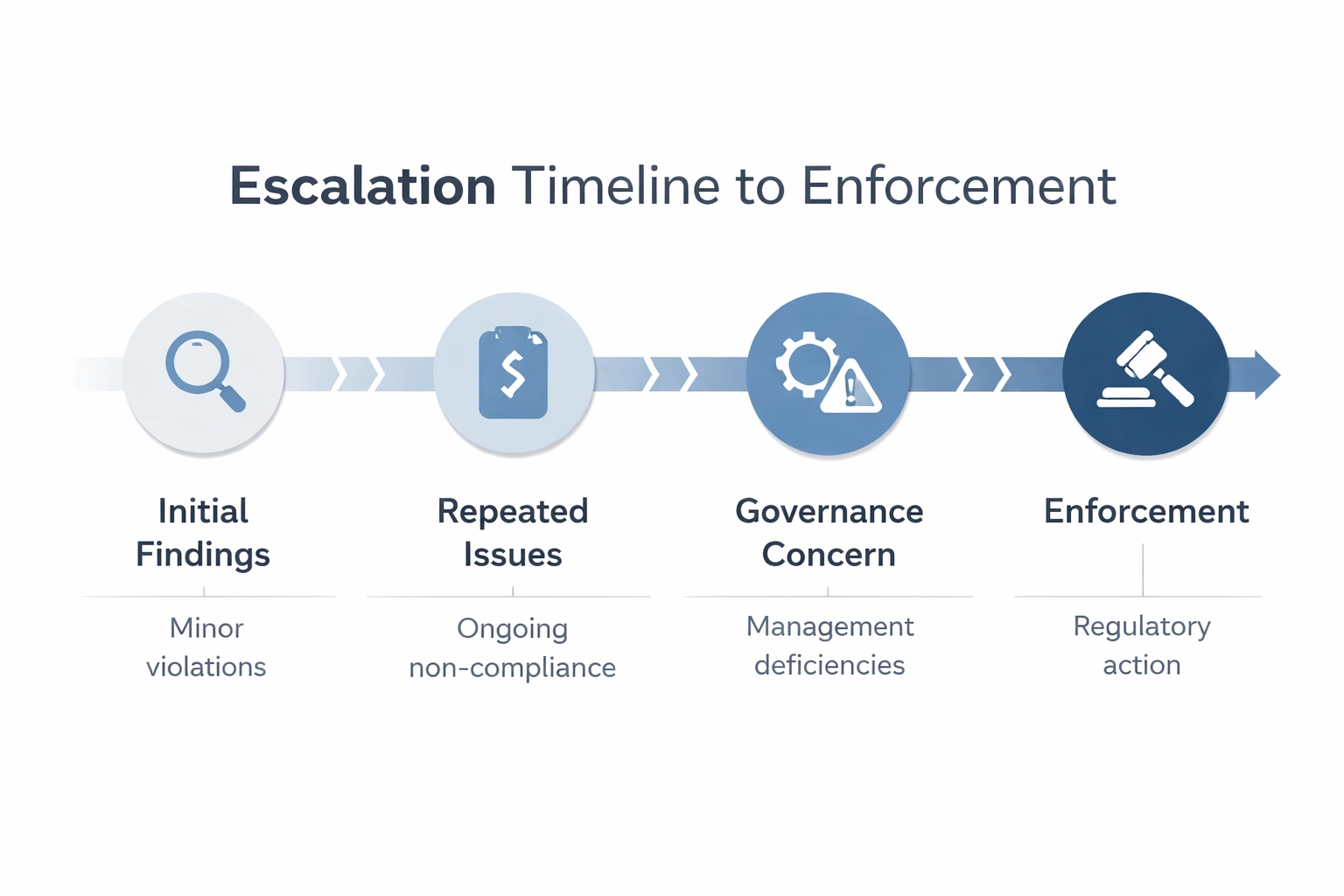
Most enforcement cases follow a recognizable progression.
First, minor findings appear during inspections. These may be framed as documentation issues or control improvements.
Next, similar issues reappear during follow-up reviews. Remediation is partial, manual, or inconsistent. Over time, regulators observe that problems persist despite repeated interventions.
Eventually, the issue is no longer framed as a compliance gap. It is framed as a governance failure. At that point, enforcement action becomes a matter of timing rather than surprise.
Fragmented compliance architectures are a consistent feature of enforcement cases.
When client data, risk assessments, transaction monitoring, documentation, and audit trails sit across disconnected tools:
These weaknesses often remain hidden during routine operations. They become visible only when regulators demand comprehensive evidence under pressure.
By then, remediation options are limited.
In tightly regulated markets, regulators increasingly expect firms to demonstrate:
Firms that meet these expectations tend to resolve supervisory findings without escalation. Firms that cannot appear in enforcement statistics.
Firms that successfully avoid enforcement action share one common trait. They treat compliance as an operational system, not a reporting function.
This includes:
Unified compliance environments enable this level of control.
Platforms such as Moebius are designed to support this operational model by embedding AML controls, documentation, governance workflows, and audit evidence into a single inspection-ready environment.
Moebius helps firms move from reactive remediation to proactive compliance control.
Provide us with a bit of information about your business needs and we will be in touch to arrange a no commitment demonstration.


"*" indicates required fields