
Across the Middle East, licensing reviews and regulatory inspections are no longer procedural formalities. In 2026, they have become some of the most revealing stress tests of a firm’s operational readiness.
Historically, firms approached licensing renewals and inspections as documentation exercises. Policies were compiled, regulatory forms were completed, and evidence was assembled in advance of supervisory engagement.
That model no longer holds.
Regulators now evaluate whether compliance frameworks actually function in daily operations. They assess whether documentation reflects real workflows, whether internal controls operate consistently over time, and whether firms can reconstruct compliance decisions months after they were made.
This shift is reshaping inspection outcomes across banks, fintech firms, corporate service providers, fiduciaries, Designated Non-Financial Businesses and Professions (DNFBPs), and other regulated entities operating throughout the Gulf Cooperation Council.
In 2026, licensing and inspection readiness has become an operational discipline, not an administrative task.

Licensing reviews once focused on whether firms had the right documents on file.
Today, regulators increasingly test whether these controls actually operate in practice.
Under Financial Action Task Force (FATF) aligned supervisory approaches and strengthened national frameworks, such as the United Arab Emirates’ Federal Decree-Law No. 10 of 2025
Authorities now evaluate whether firms can demonstrate:
Supervisory bodies such as the Central Bank of the UAE (CBUAE) and the Saudi Central Bank (SAMA) now expect internal control frameworks to be operationally embedded, not merely defined in manuals.
Static compliance environments built around spreadsheets, periodic reviews, and disconnected tools struggle to meet these expectations consistently.
In 2026, licensing reviews are no longer document audits. They are operational audits.
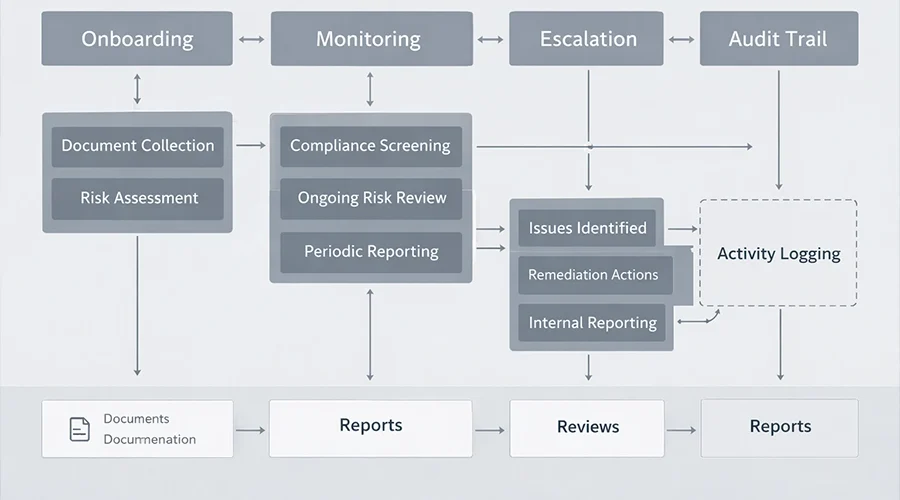
Across regulated sectors, the same structural weaknesses now surface during licensing reviews and inspections.
Documentation gaps
Fragmented workflows
Control inconsistency
These are no longer treated as clerical issues. Regulators increasingly interpret them as governance failures.
Consider a typical supervisory engagement.
A regulator initiates a licensing review and requests:
The regulator expects coherent, reconciled documentation within days.
In firms relying on spreadsheets and siloed tools, this triggers a scramble across compliance, operations, finance, and legal teams.
In firms operating on unified compliance platforms, the same request is procedural.
Data is already structured, traceable, and inspection-ready.
In 2026, this operational difference increasingly determines whether a licensing review remains routine or escalates into a supervisory finding.

Licensing authorities and supervisory bodies across the Middle East now focus on four operational dimensions.
Documentation integrity
Documents must reflect actual workflows, not theoretical procedures.
Workflow consistency
Every compliance action must follow a coherent execution path from initiation to closure.
Control execution evidence
Internal controls must be linked to real transactions, alerts, and decisions.
Organizational traceability
Evidence must remain reproducible across departments, systems, and time periods.
These expectations extend well beyond policy design. They test whether compliance is structurally embedded into daily business operations.
Traditional compliance architectures were not built for modern inspection pressure.
These weaknesses often remain invisible internally until a regulator requests information that cannot be assembled quickly or confidently.
At that point, the issue is no longer operational efficiency.
It is regulatory confidence.
Regulators increasingly view fragmented systems as evidence that internal controls are not genuinely operational.
Operational weaknesses no longer remain local.
FATF mutual evaluations increasingly assess whether countries enforce anti-money laundering obligations at an institutional level, not merely on paper. Findings in one jurisdiction now inform supervisory priorities in others.
This has created a regulatory feedback loop:
In 2026, a documentation gap uncovered during a licensing review in one jurisdiction can materially influence how a firm is reviewed elsewhere. Operational readiness now travels across borders.
To withstand modern licensing reviews and inspections, firms must move beyond policy checklists.
They must demonstrate:
Firms that address these foundations experience smoother inspections, lower regulatory friction, and stronger supervisory confidence.
Those that do not increasingly face prolonged reviews, conditional licenses, and intensified regulatory scrutiny.
For many firms, licensing still sits within legal or administrative functions.
In practice, licensing is now a compliance event.
It tests:
Treating licensing reviews as narrow reporting obligations is no longer defensible in modern regulatory environments. Operational readiness is now a licensing strategy.
Moebius is designed for this regulatory reality.
By unifying client data, internal controls, compliance actions, documentation, billing visibility, and audit trails into a single operational environment, Moebius enables firms to maintain inspection-ready compliance continuously, not just during regulatory events.
This transforms licensing reviews from high-risk reconciliation exercises into controlled, predictable engagements.
Moebius turns regulatory inspections from operational disruptions into routine confirmations of data integrity.
Provide us with a bit of information about your business needs and we will be in touch to arrange a no commitment demonstration.


"*" indicates required fields