
For many regulated firms across the Middle East, anti-money laundering compliance once felt predictable. Annual reviews, periodic risk assessments, and policy documentation created a sense of control. As long as procedures existed and reports could be produced eventually, inspections were considered manageable.
That sense of predictability has quietly disappeared.
As the year unfolds, AML enforcement across the region has become more coordinated, more operational, and far less forgiving. Regulators are no longer asking whether firms have compliance frameworks in place. They are asking whether those frameworks actually work in day-to-day operations, and whether firms can prove it immediately when asked.
This shift is no longer theoretical. It is already shaping inspection outcomes across banks, law firms, corporate service providers, fiduciaries, Designated Non-Financial Businesses and Professions (DNFBPs), fintech firms, and other regulated businesses operating in the Middle East.

The UAE’s Federal Decree-Law No. 10 of 2025 marked a clear turning point. The law expanded the scope of anti-money laundering and counter-terrorist financing (AML/CFT) obligations, introduced proliferation financing as a regulated risk, extended coverage to DNFBPs and virtual asset activities, and strengthened supervisory and enforcement powers.

What matters most is not the legislation itself, but how it is now being applied.
Regulators are increasingly assessing how firms monitor transactions in practice, how beneficial ownership data is maintained over time, how risk decisions are documented, and how quickly evidence can be produced during inspections. Static compliance models, built around periodic reviews and manual consolidation, are no longer sufficient.
This enforcement posture is not limited to the UAE. Saudi Arabia, Qatar, Bahrain, and Oman are aligning supervisory approaches more closely with Financial Action Task Force (FATF) expectations. Cross-border regulatory cooperation has intensified, and weaknesses identified in one jurisdiction are now more likely to attract attention in another. Compliance gaps no longer stay local.
While expectations are converging, enforcement pressure plays out differently across industries.
For law firms, inspections increasingly focus on client onboarding, conflict checks, source-of-funds documentation, and whether matter management, billing, and compliance records tell a consistent story. Disconnected systems make it difficult to present a defensible compliance narrative.
Corporate service providers and fiduciaries face sustained scrutiny around beneficial ownership transparency and economic substance. Regulators expect ownership structures to be current, traceable, and defensible across jurisdictions, not reconstructed under pressure.
DNFBPs are under heightened monitoring because of their exposure to higher-risk clients and complex transactions. Ongoing monitoring decisions, escalation logic, and documentation quality are reviewed closely.
Fintech firms and virtual asset service providers are expected to demonstrate real-time alert handling, investigation workflows, and defensible compliance decisions under increasingly compressed timelines.
Banks, operating under the highest level of scrutiny, experience immediate escalation when delays, inconsistencies, or manual workarounds surface during supervisory engagement.
Across sectors, the issue is rarely intended. It is infrastructure.
There have always been regulations. What has changed is how enforcement now operates.
Regulators now work with broader data access, more frequent inspections, stronger cross-border cooperation, and far less tolerance for fragmented controls. Enforcement is no longer episodic. It is continuous.
For compliance teams, this has created sustained operational strain. Alert volumes are higher. Inspection timelines are shorter. Teams spend late nights assembling data from multiple systems, often under pressure. Dependency on a few key individuals and rising staff burnout have quietly become compliance risks in their own right.
Now regulators increasingly view operational strain as a symptom of weak compliance design, not an acceptable explanation.
Consider a typical supervisory request.

A regulator asks for a list of high-risk clients onboarded in the last twelve months, including ownership structures, risk scores, transaction summaries, and documented justification for closed alerts.
Supporting evidence is expected within hours, not weeks.
In firms relying on spreadsheets and siloed systems, this triggers a scramble across compliance, operations, and finance. Data is inconsistent. Decisions are difficult to explain. Time is lost reconciling versions.
In firms operating on unified compliance platforms, the same request is procedural. Data is already structured, traceable, and inspection-ready.
That difference increasingly determines inspection outcomes.
Most regulated firms follow a similar progression.
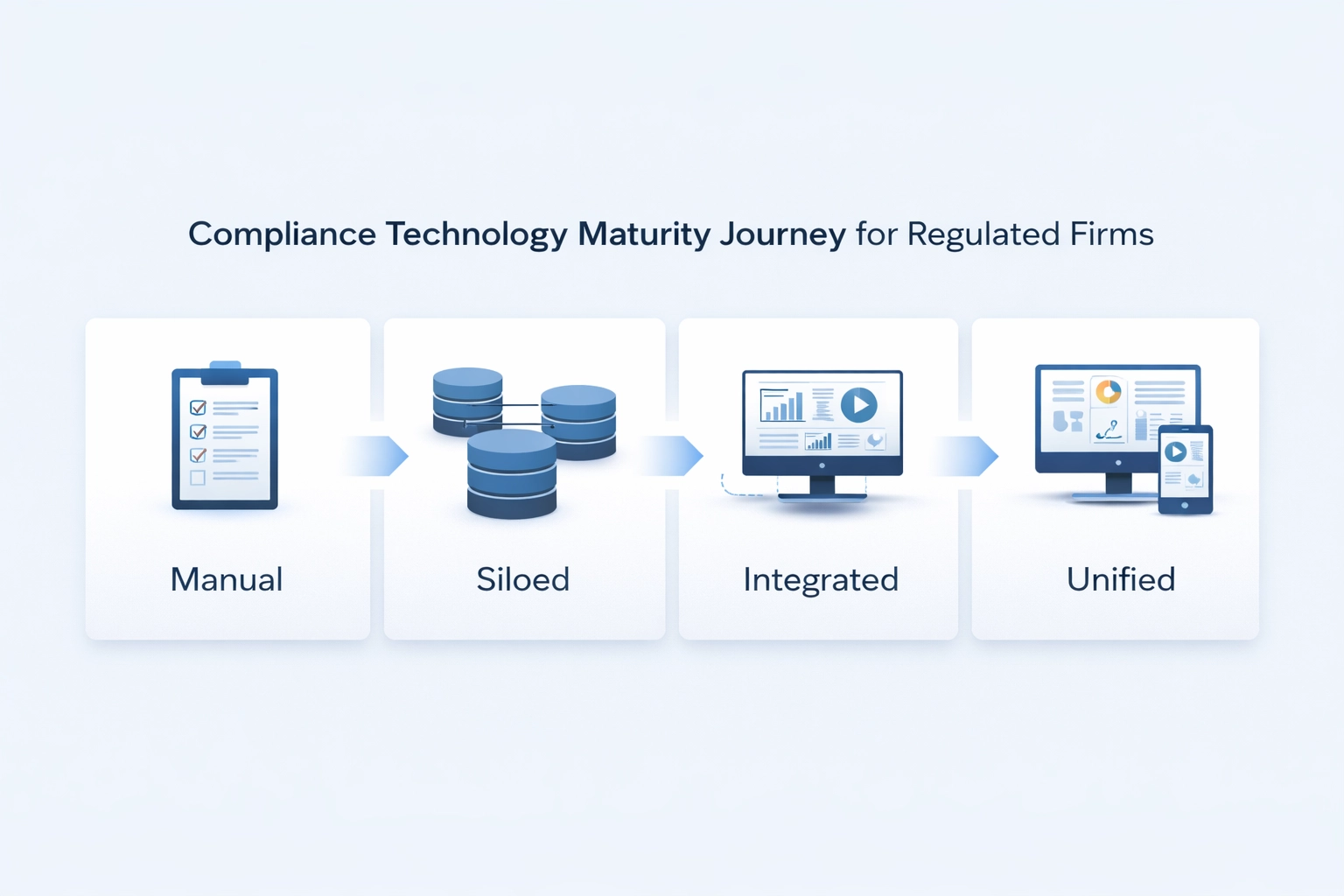
The first stage is manual and reactive, driven by spreadsheets and email trails. The second stage introduces tools, but in silos. Compliance, operations, billing, and documentation remain disconnected.
The third stage brings partial integration, yet still relies on manual reconciliation during inspections.
The final stage is unified and inspection-ready, where compliance workflows, risk data, documentation, and audit trails exist within one operational environment.
Regulators may not label these stages explicitly, but inspections increasingly reveal where firms sit on this journey.
To remain inspection-ready, firms should focus on five priorities:
This is not about adding more policies. It is about building systems that reflect how regulators evaluate risk today.
Modern enforcement realities require more than procedural updates. They require structural change.
Unified compliance platforms such as Moebius are designed for this environment. By embedding AML workflows, case management, documentation, billing visibility, and audit trails into a single operational system, Moebius enables firms to operate with consistency, visibility, and confidence under increasing regulatory scrutiny.
Moebius turns compliance from a reactive obligation into an inspection-ready operating system.
The value is not speed alone. It is known that when regulators ask, the answers already exist.
As AML enforcement intensifies across the Middle East, the firms that respond most effectively are not those adding layers of controls, but those strengthening their operational foundations.
When compliance is embedded into systems rather than managed around them, inspections become predictable rather than disruptive. Regulatory engagement becomes a process, not a crisis.
Compliance readiness is no longer a defensive posture. It is a stability advantage.
Provide us with a bit of information about your business needs and we will be in touch to arrange a no commitment demonstration.


"*" indicates required fields