The client complaints did not initially concern senior leadership.
A handful of service delays had been reported across different business units. Several deadlines had required extensions. Internal quality reviews identified a small increase in documentation errors, while compliance teams noted that remediation activities were taking longer than expected.
Individually, none of these issues appeared significant.
Collectively, they revealed something much larger.
An internal review later discovered that multiple teams had been operating above sustainable capacity for several months. Staff workloads had increased steadily, key specialists had become overextended, and critical activities were being prioritized informally because no centralized view of organizational capacity existed.
The organization had not experienced a sudden operational failure.
It had gradually lost visibility into resource pressure.
Across Europe, this challenge is becoming increasingly important. Supervisors, auditors, and governance reviewers are paying greater attention to whether organizations can identify capacity constraints before service quality, compliance effectiveness, or operational resilience deteriorate.
What often begins as a workforce planning issue can quickly evolve into a governance concern.
Many organizations assume that if work continues to be completed, capacity remains adequate.
This assumption can be misleading.
Modern organizations operate within highly dynamic environments. Client expectations evolve continuously. Regulatory obligations increase. New projects emerge. Specialist expertise becomes concentrated among a limited number of individuals, while operational complexity grows across jurisdictions, service lines, and business functions.
Work continues to move forward.
Capacity pressure often remains invisible.
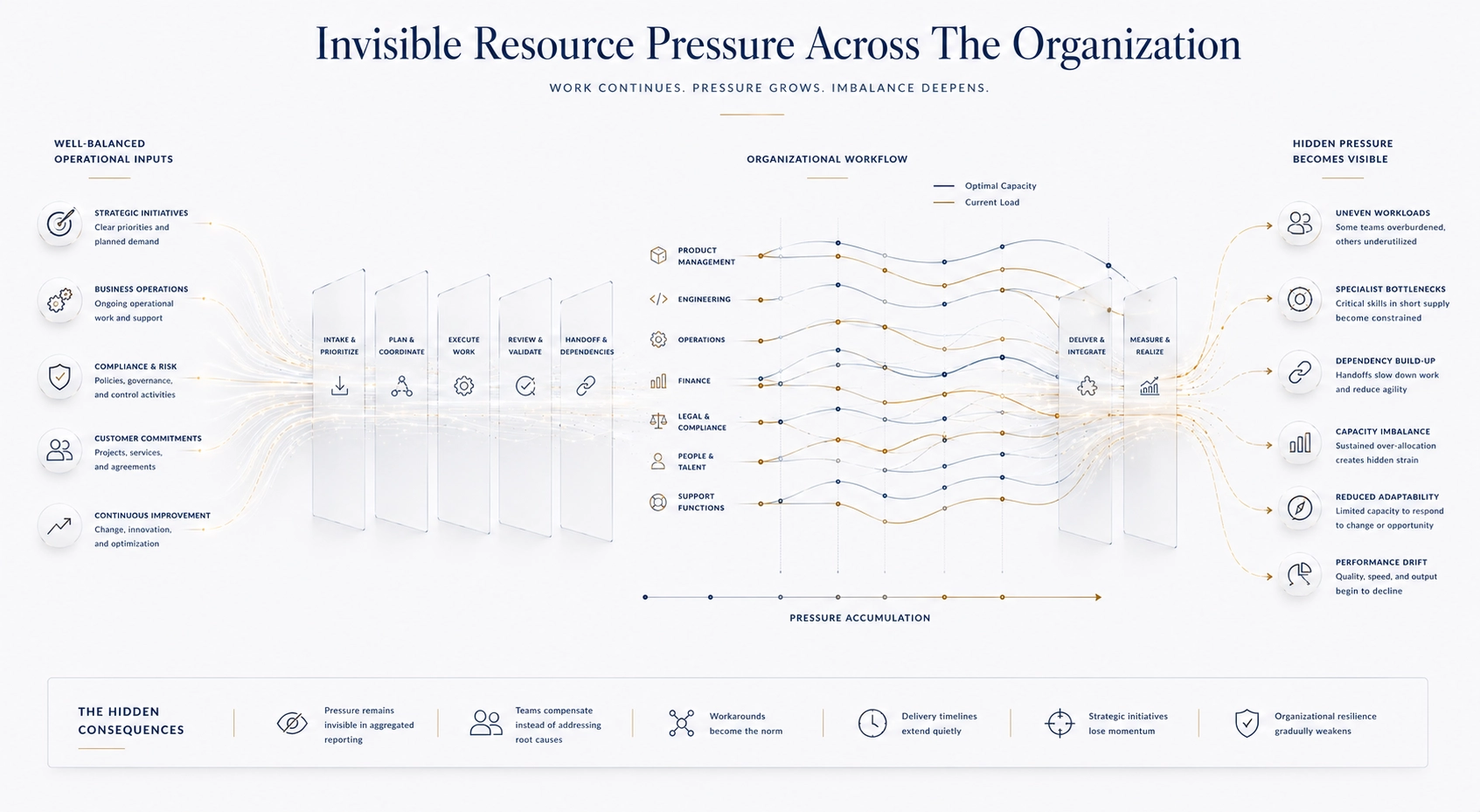
Teams frequently compensate through longer working hours, informal prioritization, delayed non-critical activities, or reliance on institutional goodwill. Performance appears stable because employees absorb the pressure themselves.
Over time, however, hidden capacity constraints begin affecting service quality, decision-making, control execution, and employee resilience.
The organization discovers the pressure only after performance starts deteriorating.
Capacity constraints rarely create immediate failures.
More often, they gradually weaken control environments.
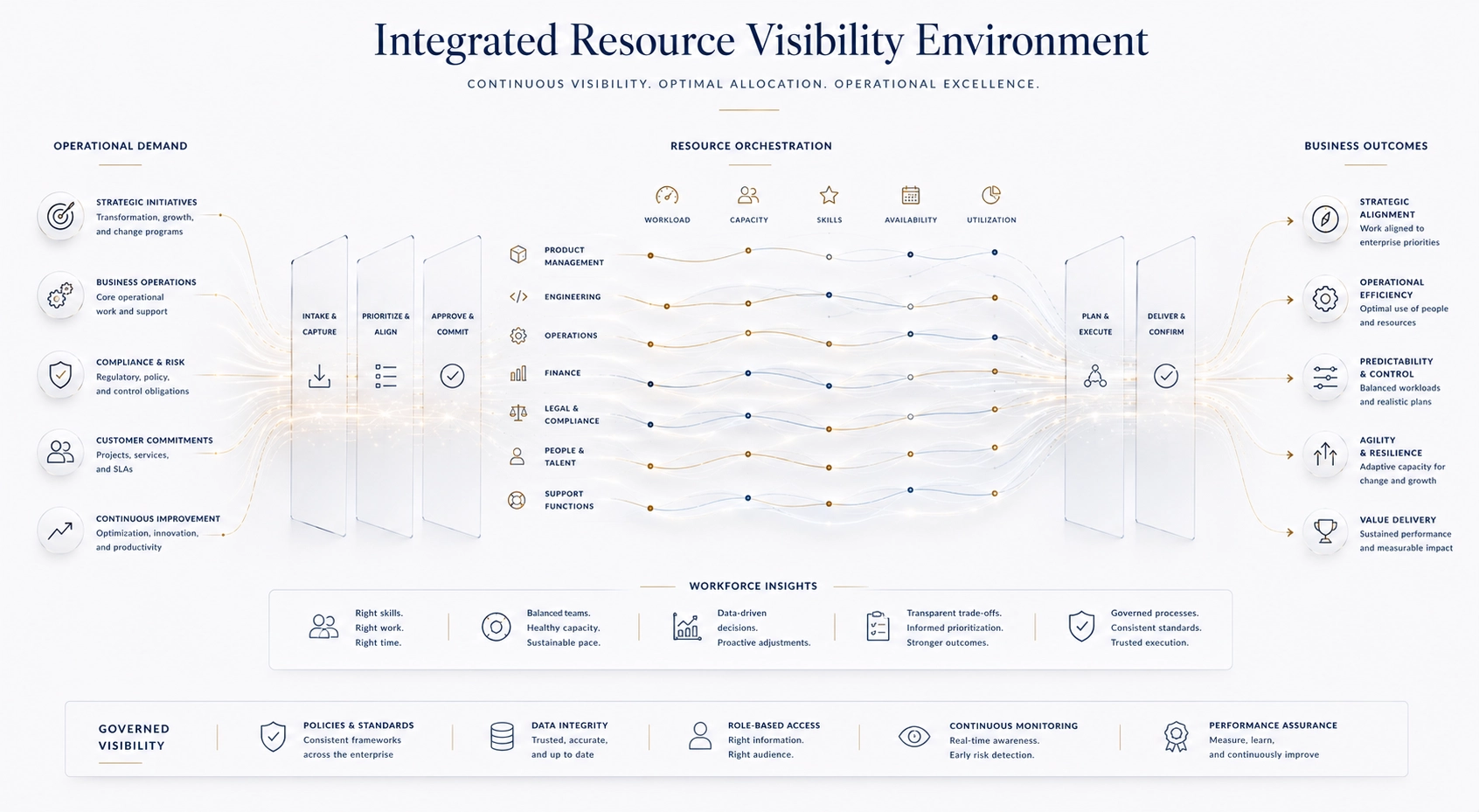
When organizations lack centralized resource visibility, management may struggle to understand where workloads are accumulating, which teams are approaching operational limits, or whether critical activities are adequately resourced.
Important obligations may continue to be completed.
The quality and consistency of execution often decline.
Compliance reviews may take longer. Approvals may be delayed. Documentation quality may deteriorate. Escalations may not occur promptly because employees are attempting to manage growing workloads without formal intervention.
Resource pressure therefore becomes more than an operational concern.
It becomes a governance issue.
Organizations increasingly require integrated resource management environments capable of providing continuous visibility into workloads, resource utilization, capacity constraints, skill availability, and operational demand across the enterprise.
The European Banking Authority continues to emphasize through its guidance on internal governance that organizations should maintain effective governance arrangements, adequate human resources, and sufficient operational capacity to support critical activities.
Similarly, the European Securities and Markets Authority increasingly expects regulated entities to maintain appropriate organizational resources and effective control environments capable of supporting sustainable operations.
Resource pressure frequently develops around specialist knowledge.
A limited number of employees often possess expertise relating to regulatory obligations, client relationships, financial approvals, legal matters, or operational controls. As organizations grow, increasing volumes of work become concentrated around these individuals.
Initially, this concentration appears efficient.
The most experienced people handle the most important work.
Over time, however, dependency creates vulnerability.
Absences, employee turnover, unexpected demand, or competing priorities can quickly expose hidden capacity constraints. Activities begin accumulating. Deadlines become compressed. Control execution may become inconsistent as teams prioritize urgent tasks over important ones.
Organizations frequently discover that capacity issues were visible operationally long before they became visible managerially.
Without structured resource planning, workload management, and capacity oversight processes, identifying these pressure points becomes increasingly difficult.
A multinational professional services organization operating across several European jurisdictions experienced growing delays within its compliance function.
Management initially attributed the delays to temporary increases in client activity.
However, an internal review revealed that a small group of specialists had been managing a substantially higher workload for more than eight months. Although all mandatory activities were eventually completed, quality assurance reviews identified increasing documentation inconsistencies and delayed remediation actions.
The issue remained largely invisible because no centralized environment existed to monitor workload distribution, resource utilization, or emerging capacity constraints.
Following the review, the organization implemented integrated resource management processes, workload monitoring, automated task allocation, and centralized capacity reporting.
Management gained continuous visibility into operational pressure across the organization.
More importantly, emerging risks could now be identified before controls began deteriorating.
Reviewers increasingly distinguish between work completion and sustainable operational capacity.
Organizations may continue meeting obligations while underlying resource pressures steadily weaken control effectiveness, service quality, and governance resilience.
The ability to identify, monitor, and proactively address capacity constraints is increasingly viewed as an important indicator of governance maturity.
Capacity blindness often becomes visible during audits, supervisory reviews, operational resilience assessments, or control effectiveness evaluations.
Reviewers frequently ask questions such as:
Organizations often possess workforce data.
The challenge emerges when reviewers seek evidence demonstrating how that information supports proactive decision-making.
Workload information may exist within spreadsheets. Resource allocation decisions may occur informally. Escalations may depend entirely upon managers recognizing pressure manually. Critical skills may not be mapped centrally.
At this point, the discussion moves beyond staffing.
It becomes an assessment of operational resilience and governance oversight.
What initially appears to be a resource management issue frequently expands into broader questions regarding control sustainability, risk management, and organizational effectiveness.
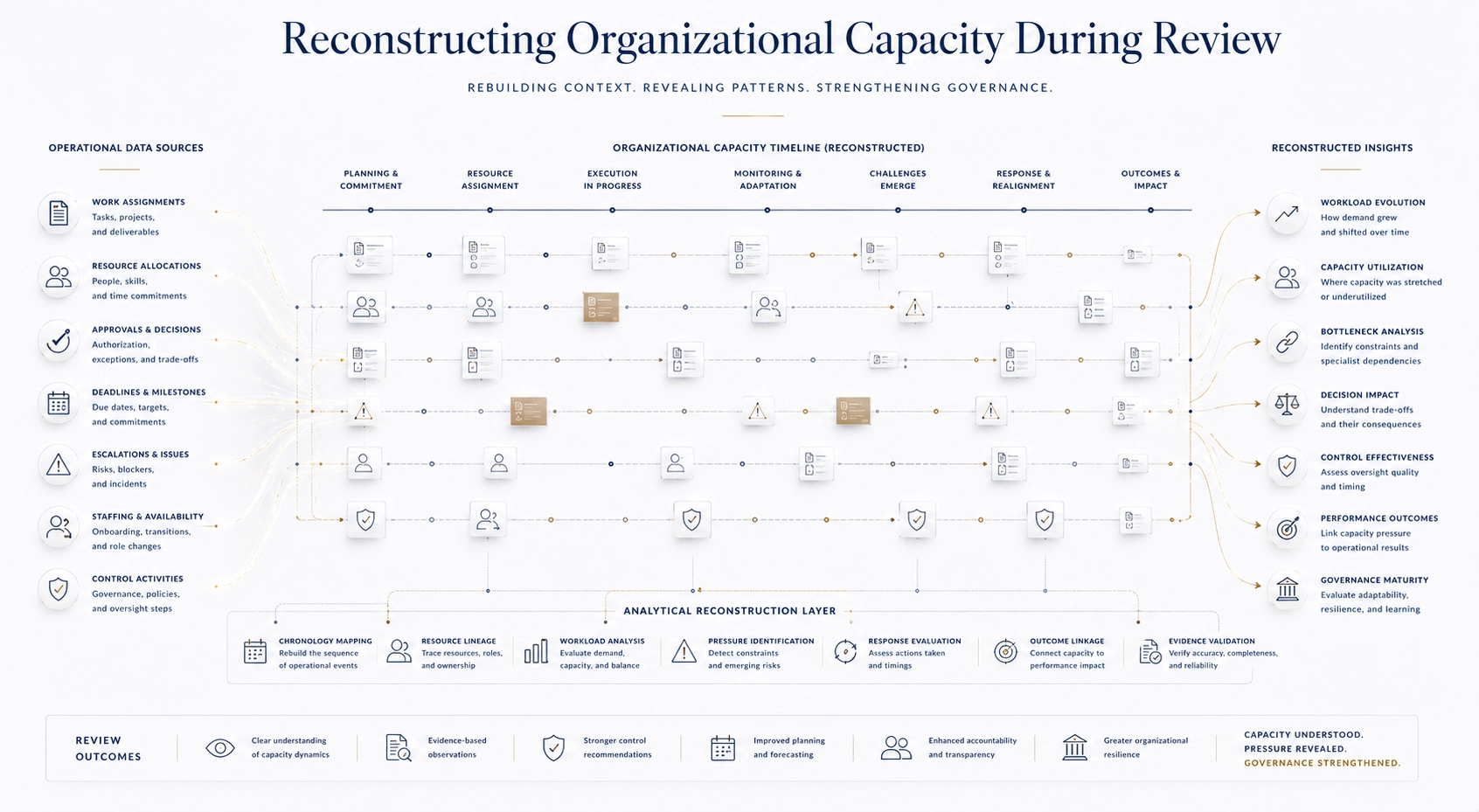
Auditors rarely evaluate resource issues in isolation.
Instead, they examine what those issues reveal about the broader governance environment.
Persistent workload imbalances may trigger questions regarding management oversight. Repeated service delays may prompt reviews of operational resilience. Declining control quality may lead reviewers to examine resource planning practices and governance arrangements.
What initially appears to be a staffing concern can therefore evolve into a much broader assessment of governance effectiveness.
This escalation pathway is becoming increasingly common across regulated industries throughout Europe.
Organizations that cannot confidently demonstrate how capacity pressures are identified and managed often face increased scrutiny regarding operational resilience, governance maturity, and control effectiveness.
Resource pressure rarely announces itself.
Organizations seldom receive a warning that teams are approaching unsustainable workloads, that specialist expertise is becoming overly concentrated, or that operational resilience is beginning to weaken.
Instead, the signals tend to appear indirectly.
Service quality starts to fluctuate. Control exceptions increase. Key employees become overloaded. Escalations take longer. Deadlines become harder to meet. Teams begin relying on extraordinary effort simply to maintain ordinary performance.
By the time these symptoms become visible, hidden capacity constraints may already be affecting governance effectiveness.
As regulatory expectations continue to evolve across Europe, organizations are increasingly expected to demonstrate not only that work is being completed, but that it is being performed within a sustainable and well-governed operating model.
This shift is changing how leadership teams think about resource management.
Workforce planning is no longer solely an HR exercise.
It is becoming a critical component of operational resilience, governance oversight, and risk management.
Forward-looking organizations are therefore moving beyond periodic resource reviews and static workforce reports. They are investing in environments that provide continuous visibility into workloads, skill dependencies, capacity utilization, and emerging operational pressure points.
Moebius supports this transition through integrated HR & Resource Management, Workflow Automation, Task Management, and operational reporting capabilities that help organizations identify resource constraints before they evolve into control failures.
The question for leadership is no longer:
“Do we have enough people?”
It is:
“Can we identify pressure before performance, controls, or resilience begin to deteriorate?”
Provide us with a bit of information about your business needs and we will be in touch to arrange a no commitment demonstration.


"*" indicates required fields