Accessibility used to be something many software teams checked towards the end of a product cycle. A website would be designed, features would be developed, testing would happen, and accessibility would eventually appear on the checklist before launch. Across Europe, that approach is becoming increasingly difficult to sustain as accessibility moves closer to the centre of how digital products are designed, developed and maintained.
The European Accessibility Act (EAA) has been applicable since 28 June 2025 and establishes common accessibility requirements for a range of products and services placed on the EU market. Its scope includes areas such as computers and operating systems, smartphones, e-commerce, banking and payment services, electronic communications and other products and services identified as particularly important for people with disabilities.
For software businesses, the broader implication goes beyond determining whether one particular product falls within the EAA. Accessibility is increasingly becoming a product-quality consideration, a design discipline and a market expectation. Companies building digital products for European customers therefore need to think about accessibility much earlier in the product lifecycle.
The EAA was designed partly to reduce fragmentation across the European single market. Before the common framework, businesses could face different accessibility requirements across Member States, creating additional complexity for companies developing products and services for multiple European markets. The Act establishes common requirements for selected products and services so that accessibility becomes more consistent across the EU.
That creates an important shift for software companies. Accessibility is no longer simply about making a website easier to use for a particular audience; for products and services within scope, businesses need to consider accessibility as part of how the product is designed, delivered, and supported.
The distinction between “accessible enough to launch” and “designed to be accessible” becomes increasingly important. The first approach treats accessibility as remediation. The second treats it as an attribute of the product itself.

One of the easiest mistakes is to think about accessibility only in terms of website design. In reality, European accessibility requirements can touch multiple parts of the digital experience, including software interfaces, mobile applications, electronic documents, authentication processes, support channels, and the way information is presented.
The European standard EN 301 549 is particularly important because it goes beyond traditional web accessibility. It addresses ICT products and services and includes requirements relevant to websites, mobile applications and non-web documents, alongside requirements that extend beyond the WCAG framework itself.
For a software company, that means accessibility needs to be considered across the product ecosystem rather than isolated within the front-end development team. A beautifully accessible homepage does not solve the problem if the core application, downloadable documents, authentication process, or mobile experience creates barriers elsewhere.
Accessibility becomes much more meaningful when viewed through the complete user journey.
Can someone navigate the product using only a keyboard? Can a screen reader communicate the structure and purpose of important elements? Can users understand forms, errors, and instructions? Can information remain usable when text is enlarged? Can interactive elements be identified and operated without relying exclusively on one form of sensory input?
These are not simply technical questions. They are questions about whether the product’s underlying interaction model works for a broader range of users.
The European Commission itself uses practical accessibility expectations such as keyboard navigation, screen-reader compatibility, and the ability to zoom content as part of its own accessibility approach.
That is why accessibility cannot be reduced to adding an accessibility widget to a website after development. If the underlying interface architecture creates barriers, an overlay cannot solve every problem.
A product can look visually simple while being technically difficult to use. A button may look obvious to a sighted user but lack an appropriate accessible name. A form may appear straightforward but provide insufficient information to someone navigating through a screen reader. A drag-and-drop interaction may feel intuitive with a mouse but become difficult or impossible for someone using a keyboard.
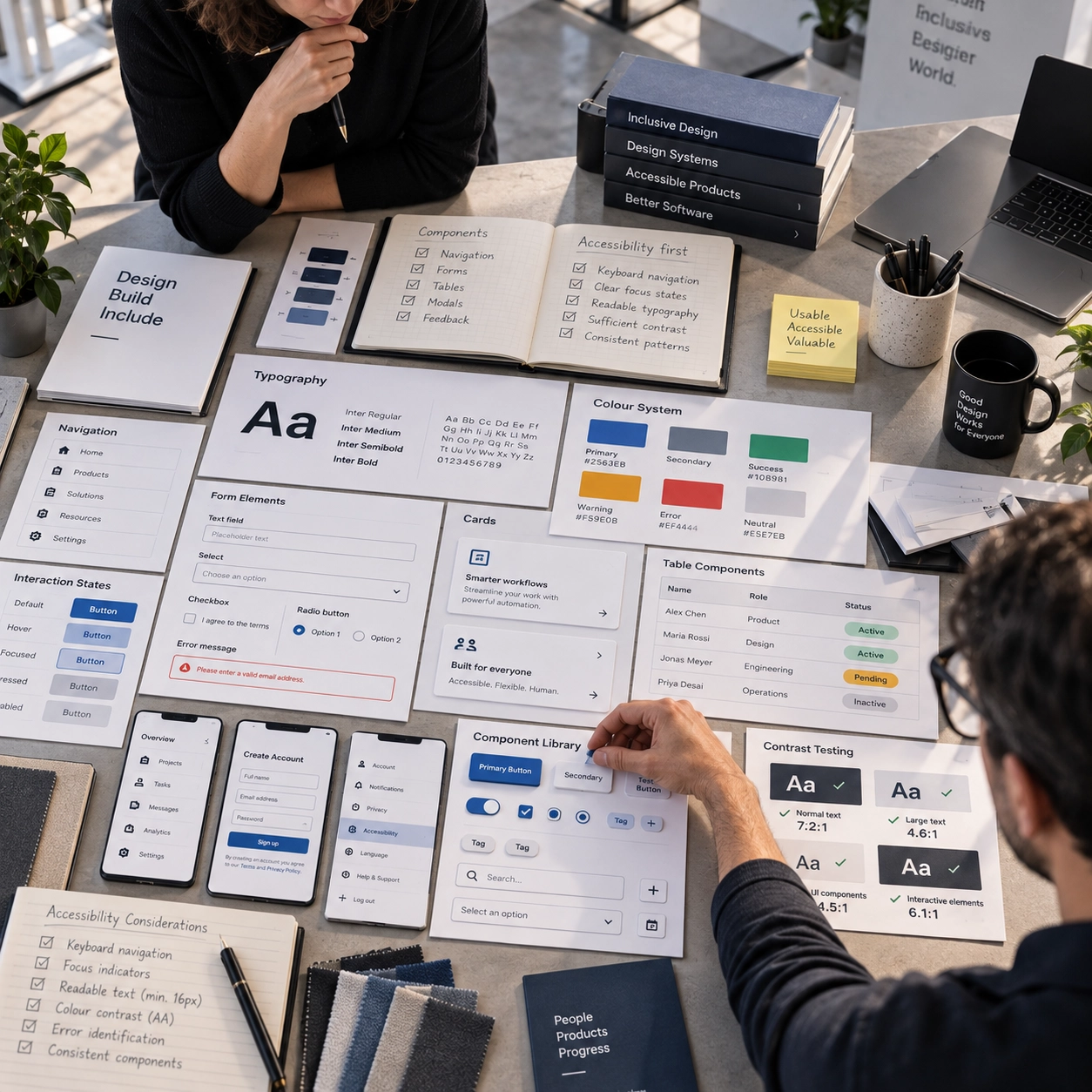
These examples demonstrate why accessibility needs to be considered at the architecture level. Component libraries, navigation structures, interaction patterns, form design, content hierarchy, error handling, and user feedback all influence whether the final product is genuinely usable.
For SaaS businesses, this becomes even more significant because accessibility is not confined to one page. It becomes part of the underlying design system that is repeated across dashboards, workflows, settings, forms, reports, and customer-facing experiences.
For software companies researching European accessibility, WCAG 2.2 is increasingly difficult to ignore. It introduces additional success criteria and reflects the direction in which accessibility standards are developing across the digital industry.
There is, however, an important distinction between technical best practice and the current legal reference standard in Europe.
In September 2026, EN 301 549 v4.1.1 was published with six new accessibility requirements from WCAG 2.2 and other updates. The new version adopts WCAG 2.2 as the accessibility benchmark for websites, software and digital documents. However, it has not yet been formally cited in the Official Journal as the harmonised standard for demonstrating EAA conformity. Until that happens, the current harmonised reference remains EN 301 549 v3.2.1, which is based on WCAG 2.1.
That distinction matters for companies planning their accessibility strategy. A business can use WCAG 2.2 as a forward-looking design target while still understanding which standard currently carries legal significance for conformity.
In other words, WCAG 2.2 can be part of the roadmap without incorrectly treating it as the current harmonised EAA requirement.
The strongest accessibility programmes do not rely on one final audit before release. They introduce accessibility throughout the product lifecycle.
During discovery, teams can identify users with different accessibility needs. During design, accessible interaction patterns can become part of the design system. During development, accessibility requirements can be incorporated into components and acceptance criteria. During testing, teams can combine automated checks with manual testing and assistive-technology testing.
After launch, the process continues.
New features can introduce new accessibility barriers. Product redesigns can unintentionally remove accessible behaviour that previously worked. Third-party integrations can change how information is presented. Content teams can upload inaccessible documents or media. Accessibility therefore needs to remain part of product governance rather than becoming a one-time certification exercise.
Modern accessibility tooling makes it easier for development teams to identify certain technical issues early. Automated testing can help detect problems involving colour contrast, missing labels, structural markup, and other measurable characteristics.
But accessibility is not entirely machine-verifiable.
Whether a product’s navigation makes sense, whether an error message is understandable, whether an interaction is predictable, or whether a workflow remains usable with assistive technology can require human evaluation. The most effective approach is therefore not automation versus manual testing, but automation combined with human testing throughout development.
For software companies, that also means accessibility should become part of the definition of “done”. A feature should not be considered complete simply because it functions technically; the intended interaction should also be usable by the people the product is designed to serve.

There is a broader business argument behind the regulatory shift.
A product that is easier to navigate, clearer to understand, more predictable in its interactions and more resilient across different devices and input methods can create a better experience for a much wider group of users. Accessibility improvements can also benefit people who do not identify as having a disability but who interact with products in different environments, devices, or circumstances.
The European Commission describes common accessibility standards as a way to remove barriers while also supporting a “Design for All” approach. These standards can improve accessibility for people with disabilities as well as others, including older people.
For software companies, that creates an opportunity to move the conversation beyond compliance. Accessibility can become part of product quality, usability and design maturity.
The first step is to establish visibility across the product. Companies should identify which products, services, interfaces, documents, and customer journeys may fall within the EAA or other applicable accessibility requirements, rather than assuming that accessibility is limited to the public website.
The second step is to assess the experience rather than simply the code. Automated testing, manual testing, keyboard navigation, screen-reader testing, and user testing can reveal different classes of barriers. Teams should document findings in a way that allows product, engineering and design teams to address them systematically rather than treating each issue as an isolated defect.
The third step is to make accessibility part of future development. Design systems, component libraries, product requirements, development standards, and release processes should all incorporate accessibility considerations so that new features do not repeatedly recreate the same problems.
Finally, companies should establish ownership. Accessibility can easily become everyone’s responsibility and therefore nobody’s responsibility. Clear ownership across product, design, engineering, QA, content, and compliance makes it more likely that accessibility remains part of the product after the initial audit is complete.
The most significant change may not be the introduction of another compliance requirement. It is the shift in how accessibility is understood.
For years, many digital teams treated accessibility as something to verify after the product had already been designed. Europe’s evolving accessibility framework is pushing the conversation in the opposite direction: accessibility needs to influence the product from the beginning.
The EAA has already changed the regulatory landscape for covered products and services. The publication of EN 301 549 v4.1.1 in September 2026, with WCAG 2.2 incorporated into the updated standard, also gives software companies a clearer indication of where technical accessibility standards are heading, even though the new version is not yet the harmonised legal reference for EAA conformity.
For software businesses selling across Europe, this creates a practical opportunity. Instead of treating accessibility as a final compliance exercise, companies can build it into product strategy, design systems, engineering processes and ongoing product governance.
For organisations managing complex business operations, accessibility is not only about the customer-facing interface. It can also extend into documents, employee information, workflows, approvals, internal systems and the wider digital environment through which people interact with the organisation.
Möbius provides an integrated business management environment connecting areas such as Document Management, Human Resources, Professional Services Management and wider business operations through its integrated Moebius platform.
This connected approach provides organisations with a structured environment in which information, documents, workflows and business processes can be managed together. While accessibility compliance remains dependent on the specific product, service and legal requirements involved, having a structured digital environment makes it easier for organisations to establish consistent processes, responsibilities and governance around how information and workflows are managed.
The broader lesson is important: accessibility should not sit separately from digital transformation. As organisations digitise more of their operations, the quality of those digital environments increasingly depends on whether they work for the people who need to use them.
Europe’s accessibility landscape is moving toward a simple but significant idea: accessibility should be designed into digital products rather than repaired at the end of the process.
For software companies, that means accessibility needs to enter the conversation much earlier — during product strategy, research, architecture and design — and remain present through development, testing, launch and continuous improvement.
The businesses that approach accessibility as part of product quality will be better positioned to respond as European standards continue to evolve. The question is no longer simply whether a digital product can technically meet an accessibility requirement.
The more important question is whether accessibility has been designed into the product from the beginning.
Provide us with a bit of information about your business needs and we will be in touch to arrange a no commitment demonstration.


"*" indicates required fields