Legal expertise remains the foundation of every successful law firm. Clients still choose firms for the quality of their advice, the experience of their lawyers, and their ability to navigate complex legal matters.
But expertise alone is no longer enough to determine how well a practice performs.
Across Europe, law firms face growing pressure to improve efficiency, respond faster to clients, manage knowledge more effectively, and protect profitability while continuing to deliver high-quality legal work. The pressure is also being shaped by rapid technological change. The Council of Bars and Law Societies of Europe’s work on digitalisation and artificial intelligence highlights how technology is increasingly affecting justice systems and the legal profession, while the 2026 State of the UK Legal Market shows that corporate legal teams increasingly expect outside counsel to use AI to improve efficiency, workflows and the quality of legal work.
This creates a question that sits outside traditional legal practice:
Can a law firm scale its legal expertise without allowing the operational complexity around that expertise to scale at the same rate?
The answer increasingly depends on how the firm manages the work surrounding the law.

A legal matter rarely consists of legal analysis alone.
Behind every piece of advice sits a network of activities: client communication, document preparation, research, internal reviews, meetings, approvals, deadlines, billing, time recording, and collaboration between lawyers and support teams.
As the number of matters increases, these activities create an operational layer around the firm’s legal expertise.
For a small practice, much of this coordination can happen informally. Lawyers know their clients, remember where information sits, and communicate directly with colleagues when something needs to move forward.
As a firm grows, informal coordination becomes harder to maintain.
More lawyers mean more matters. More matters mean more documents, communications, deadlines, and dependencies. Multiple offices or practice areas introduce another layer of complexity. The firm may still have excellent lawyers, but the systems surrounding those lawyers can become increasingly difficult to manage.
The operational question therefore becomes just as important as the legal one: how efficiently can the firm turn expertise into client service?
Most law firms already use technology. The problem is rarely the complete absence of software.
Instead, firms often accumulate systems around individual functions.
Documents may be stored in one environment. Client information may sit in another. Time and billing may be managed separately. Matter information can exist across emails, spreadsheets, shared drives, and individual workspaces.
Each system may perform its intended function reasonably well.
The difficulty appears when a lawyer or matter manager needs to understand the complete picture.
A partner preparing for a client meeting may need to find previous correspondence, review the status of an active matter, identify who within the firm is working on it, locate relevant documents, and understand outstanding activities. If those pieces of information are spread across multiple systems, the firm is effectively asking its professionals to become the integration layer. That may be manageable at a small scale.
It becomes expensive at scale.
Technology discussions in legal services often focus on automating legal work itself.
There is certainly potential for technology to support research, drafting, document review, and other parts of legal practice. But there is another opportunity that can deliver immediate operational value: making everything around the lawyer more efficient.
The 2025 Thomson Reuters Generative AI research found that legal professionals are increasingly adopting GenAI to enhance productivity, streamline workflows, and improve client services, with time savings and productivity among the leading reasons for adoption. The direction of travel is clear: technology is increasingly being evaluated not simply as a new tool, but according to how effectively it changes the economics of professional work.
A lawyer should not have to spend unnecessary time searching for information, checking the status of routine activities, or reconstructing a client’s history before taking action.
If technology can organise those activities, the professional can spend more time on work that actually requires legal expertise.
This is an important distinction.
The goal is not to automate the lawyer.
The goal is to remove operational friction so the lawyer can practise law more effectively.
Legal practices accumulate enormous amounts of knowledge over time.
Previous matters contain research, precedents, correspondence, documents, client history and lessons that can be valuable in future work. Yet knowledge has limited commercial value if it cannot be found and understood when it is needed.
This becomes particularly challenging when information is closely associated with individual lawyers.
An experienced partner may know which previous matter contains the relevant precedent. A senior associate may remember why a particular approach was taken. Another team member may know the history of a long-standing client relationship.
When that knowledge remains largely personal, the firm becomes dependent on individuals to access its own institutional memory.
A stronger approach is to create an environment where documents, matters, clients, contacts, and activities remain connected to their underlying context.
Knowledge then becomes something the firm owns and can reuse, rather than something individual professionals happen to remember.
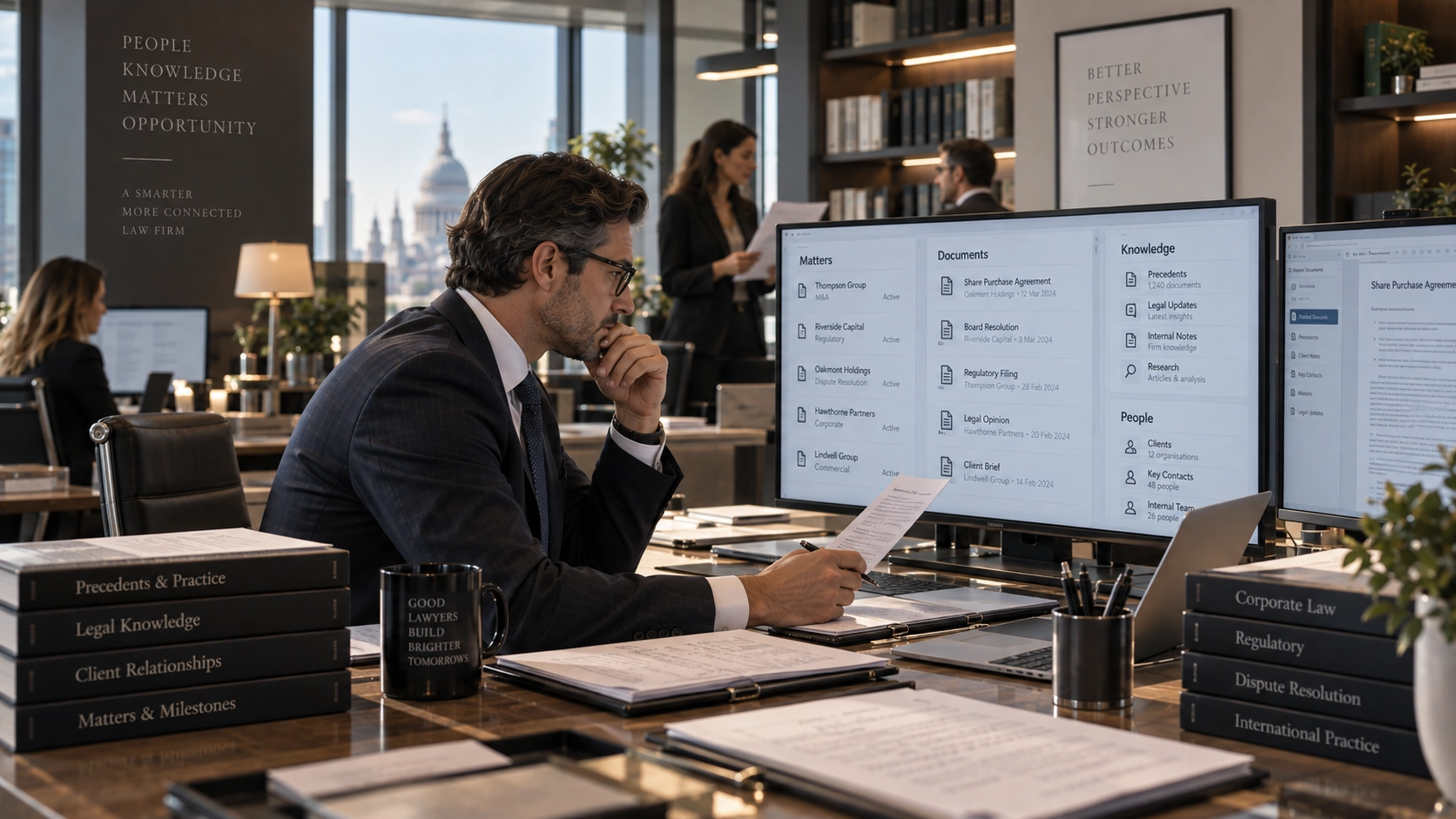
Clients do not experience a law firm’s internal systems directly.
They experience whether the firm responds quickly, understands their history, communicates clearly, meets deadlines, and provides visibility into the progress of their matters.
This makes operational efficiency part of the client experience.
A firm may provide technically excellent advice but still frustrate clients if information has to be repeatedly requested, updates are slow, or different teams have inconsistent visibility into the relationship.
Connected systems can improve that experience by giving professionals better access to the information surrounding each matter.
When a lawyer can immediately understand the client’s relationship with the firm, the status of ongoing work, relevant documents, and outstanding activities, conversations become more informed and responsive.
Technology therefore does not replace the client relationship.
It can give lawyers more context in which to manage it.
Law-firm profitability is often associated with utilisation, billing rates and matter volumes.
Those metrics matter, but they do not tell the whole story.
Every matter also carries an operational cost. Time spent searching for documents, coordinating internal teams, following up on administrative tasks, reconstructing client histories or correcting duplicated work reduces the amount of professional capacity available for higher-value activity.
The impact can be particularly significant as firms grow.
If operational inefficiency increases alongside matter volume, additional revenue can come with additional friction. The firm may generate more work without achieving the level of productivity or margin that growth should provide.
This is why modern legal operations increasingly need to be viewed as a profitability lever, not simply an administrative function.
Legal work contains countless dependencies.
A matter may begin with a client request, move through research and document preparation, require internal review, involve external advisers, and conclude with final documents and billing. Different people may be responsible for different stages.
When those activities are managed independently, progress can depend heavily on emails, meetings and individual follow-up.
Connected workflows provide a different model.
Tasks can be assigned to the appropriate people. Activities can be linked to matters and clients. Documents can remain associated with the work they support. Deadlines and responsibilities can be visible to the relevant team.
The objective is not to create bureaucracy around legal work.
It is to make the movement of legal work through the firm more predictable and transparent.
There is no universal technology architecture for every law firm. A specialist boutique, a multi-office commercial practice and a large international firm will have very different requirements.
But the underlying principle remains consistent: systems should reflect the way legal work is actually delivered.
Clients and contacts should provide context around the people and organisations the firm serves.
Matters and projects should connect the work being performed to the relevant client relationship.
Documents should remain associated with the matters, people and entities they support.
Activities and workflows should make responsibilities, deadlines and progress visible.
Financial information should provide a clearer understanding of the commercial performance of the firm’s work.
The objective is not necessarily to replace every existing application.
It is to reduce the number of times professionals have to move between disconnected systems to understand what is happening.
For legal practices, Moebius Professional Services Management provides a structured environment for managing the operational side of professional legal work.
Projects can be organised by client or business group, with administrators, participants, activities, deadlines, documents and financial information connected to the work being performed. This gives firms greater visibility into the operational lifecycle surrounding a matter rather than leaving coordination across emails, spreadsheets and individual workspaces.
The capability becomes even more valuable when combined with Moebius Document Management, which provides centralised document storage, retrieval, version control, access management, workflows and approvals.
Contact Management adds another layer by keeping client, partner, adviser and stakeholder information organised and connected.
For practices working with corporate clients and complex structures, Moebius Corporate Management can also provide structured information around companies, ownership, officers, beneficial owners and related corporate records.
Together, these capabilities support a broader objective: giving legal professionals a connected operational environment around the legal work itself.
There is a tendency to describe legal technology in terms of replacing manual work.
That is only one part of the opportunity.
The more strategic question is how technology can allow lawyers to spend a greater proportion of their time on work where professional expertise creates the most value.
If a lawyer spends less time locating information, coordinating routine activities, and managing administrative dependencies, more capacity becomes available for analysis, negotiation, strategy, and client interaction.
That changes the economics of technology investment.
The return is not simply fewer administrative tasks.
It is more productive professional capacity, better client responsiveness and greater scalability without proportionally increasing operational overhead.

Legal expertise will remain the defining asset of a law firm.
But the ability to deliver that expertise efficiently, consistently, and at scale is becoming an equally important part of the business.
The strongest practices will therefore look beyond legal technology as a collection of tools for lawyers. They will consider the entire operating environment around legal work: how matters move through the firm, how knowledge is retained, how client relationships are managed, how documents are connected to context and how professional capacity is converted into profitable client service.
That is where legal operations becomes strategic.
A modern law firm does not need technology to make it less human or less professional. It needs technology that allows its professionals to spend less time managing the mechanics of work and more time applying the expertise clients are actually paying for.
Provide us with a bit of information about your business needs and we will be in touch to arrange a no commitment demonstration.


"*" indicates required fields