
The audit team was not looking for anything unusual.
The reviewers had requested supporting documentation relating to a routine client engagement completed nearly two years earlier. Leadership expected the exercise to be straightforward. The organization had managed the engagement successfully, the client relationship remained active, and everyone believed the necessary records existed.
They were correct.
The records did exist.
Finding them proved to be another matter entirely.
Some documents were stored within shared drives. Key approvals existed only in email correspondence. Supporting evidence had been archived locally by former employees. Several important versions of the same document existed across different repositories, each containing slightly different information.
What should have taken minutes required several weeks.
The audit did not expose missing information.
It exposed an organization that could no longer reliably locate its own knowledge.
Across Europe, this situation is becoming increasingly common. Auditors, regulators, and governance reviewers are frequently discovering that organizations possess extensive information assets, yet struggle to retrieve, validate, and defend that information when scrutiny arrives.
What initially appears to be an information management issue often evolves into a much broader governance concern.
Most organizations begin with relatively simple information environments.
Documents are created, stored, and shared within designated locations. Teams understand where important information resides. Finding records is generally straightforward because the volume of information remains manageable and organizational complexity is limited.
Growth changes this dynamic.
Organizations expand into new jurisdictions. New business units emerge. Additional technology platforms are introduced. Teams adopt their own methods for storing documents, correspondence, approvals, and working files.
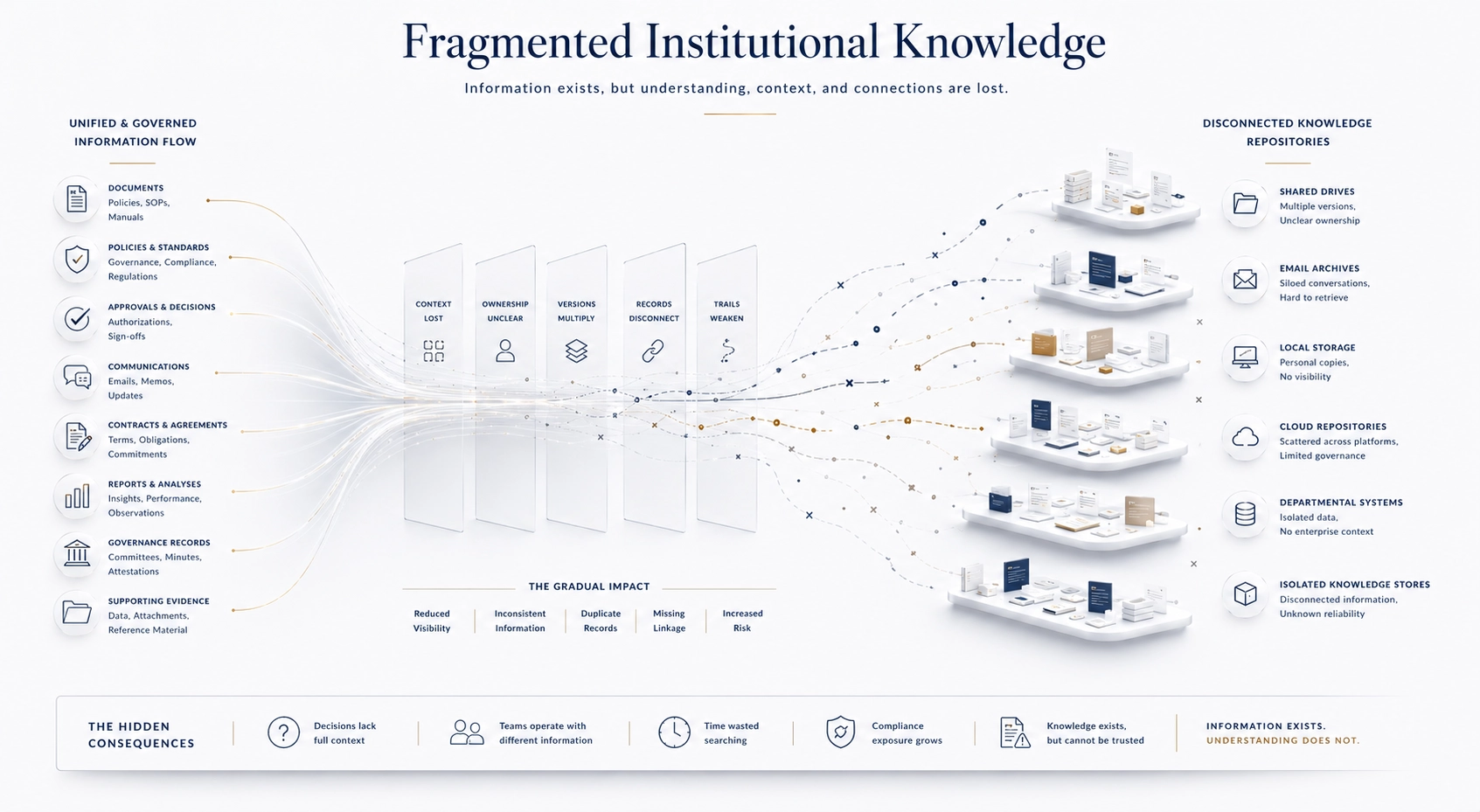
Over time, information becomes distributed across shared drives, email systems, cloud storage environments, local devices, collaboration platforms, and departmental repositories.
Each repository may function effectively in isolation.
Collectively, they create fragmented institutional knowledge.
The organization still possesses the information.
It gradually loses the ability to find it.
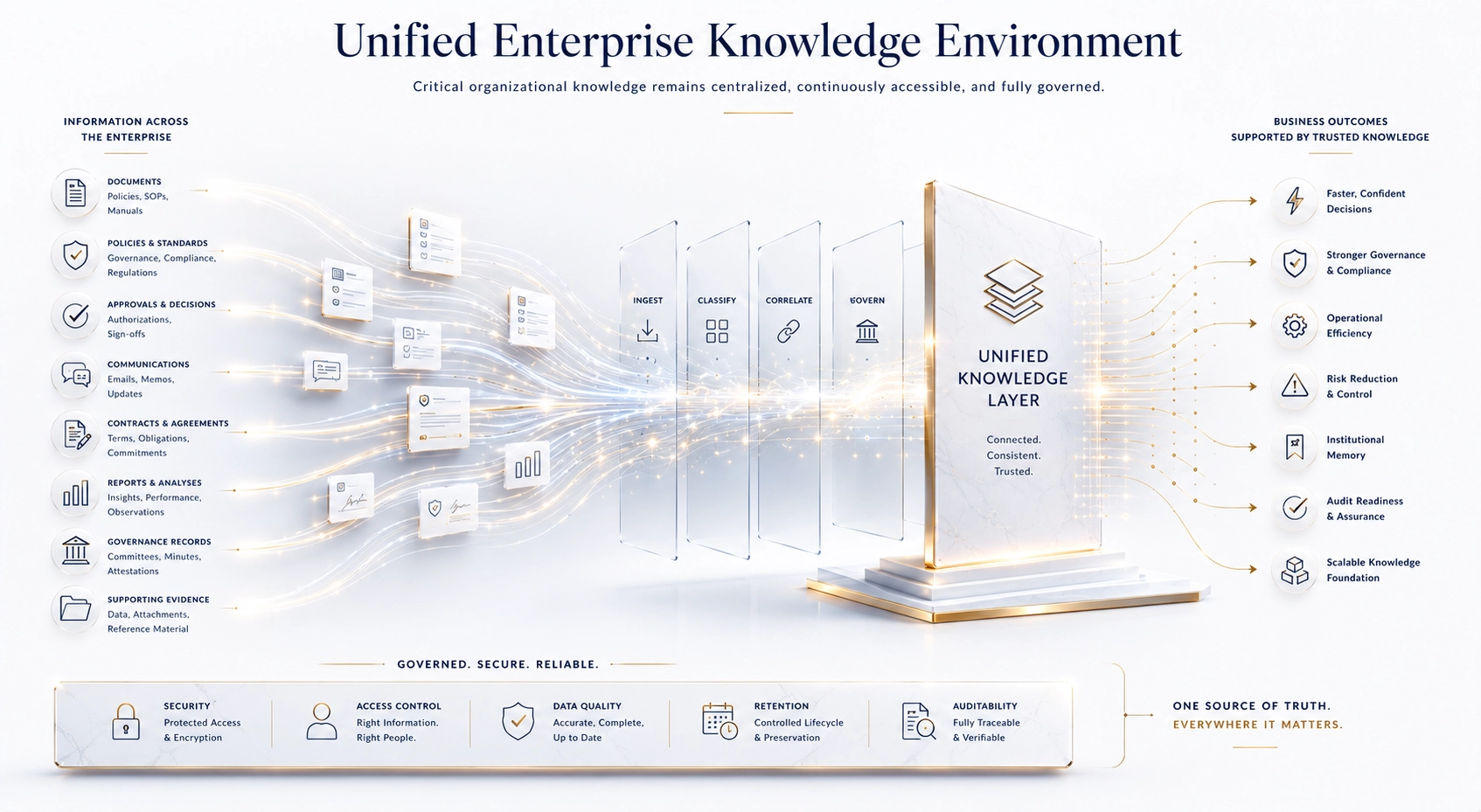
Information scattering is frequently viewed as an operational inconvenience.
In reality, its implications extend significantly further.
When critical knowledge becomes fragmented across disconnected repositories, organizations struggle to establish a reliable single source of truth. Different teams may rely on different document versions. Historical decisions become difficult to reconstruct. Supporting evidence may no longer align with formal records.
Decision-making quality often deteriorates as confidence in information declines.
Operational inefficiencies also increase substantially. Employees spend considerable time searching for information, validating document versions, confirming approvals, or reconstructing historical context before important decisions can be made.
More importantly, governance visibility weakens.
Organizations cannot effectively govern information they cannot reliably locate.
Modern enterprises increasingly require structured document governance environments capable of centralizing records, preserving version histories, managing approvals, maintaining audit trails, and ensuring that institutional knowledge remains continuously accessible regardless of organizational complexity.
According to the European Commission’s Digital Strategy, organizations across Europe are expected to strengthen digital governance, information accessibility, and trust in digital records as part of broader digital transformation initiatives.
Similarly, the European Securities and Markets Authority (ESMA) continues to emphasize the importance of effective record-keeping, information accessibility, and defensible documentation across regulated entities.
Information silos rarely emerge intentionally.
They evolve gradually.
A legal team stores contracts within its own repository. Compliance maintains separate regulatory documentation. Operations preserves process records elsewhere. Commercial teams rely on email correspondence and locally maintained files.
Initially, these arrangements appear practical.
Over time, however, information becomes increasingly disconnected from the processes, decisions, and governance activities that created it.
Organizations frequently discover that while documents exist, the relationships between those documents have disappeared.
Approvals become separated from policies. Supporting evidence becomes detached from decisions. Correspondence no longer aligns with final documentation.
The result is fragmented organizational memory.
Information remains available.
Context does not.
A large European professional services organization operating across multiple jurisdictions initiated an internal governance review following repeated delays during audit preparation.
The review revealed that critical engagement information was dispersed across shared drives, personal folders, email archives, and departmental repositories. Teams frequently maintained local copies of important documents because they lacked confidence in finding the latest approved versions.
The issue remained manageable until external auditors requested historical evidence supporting a significant client engagement completed three years earlier.
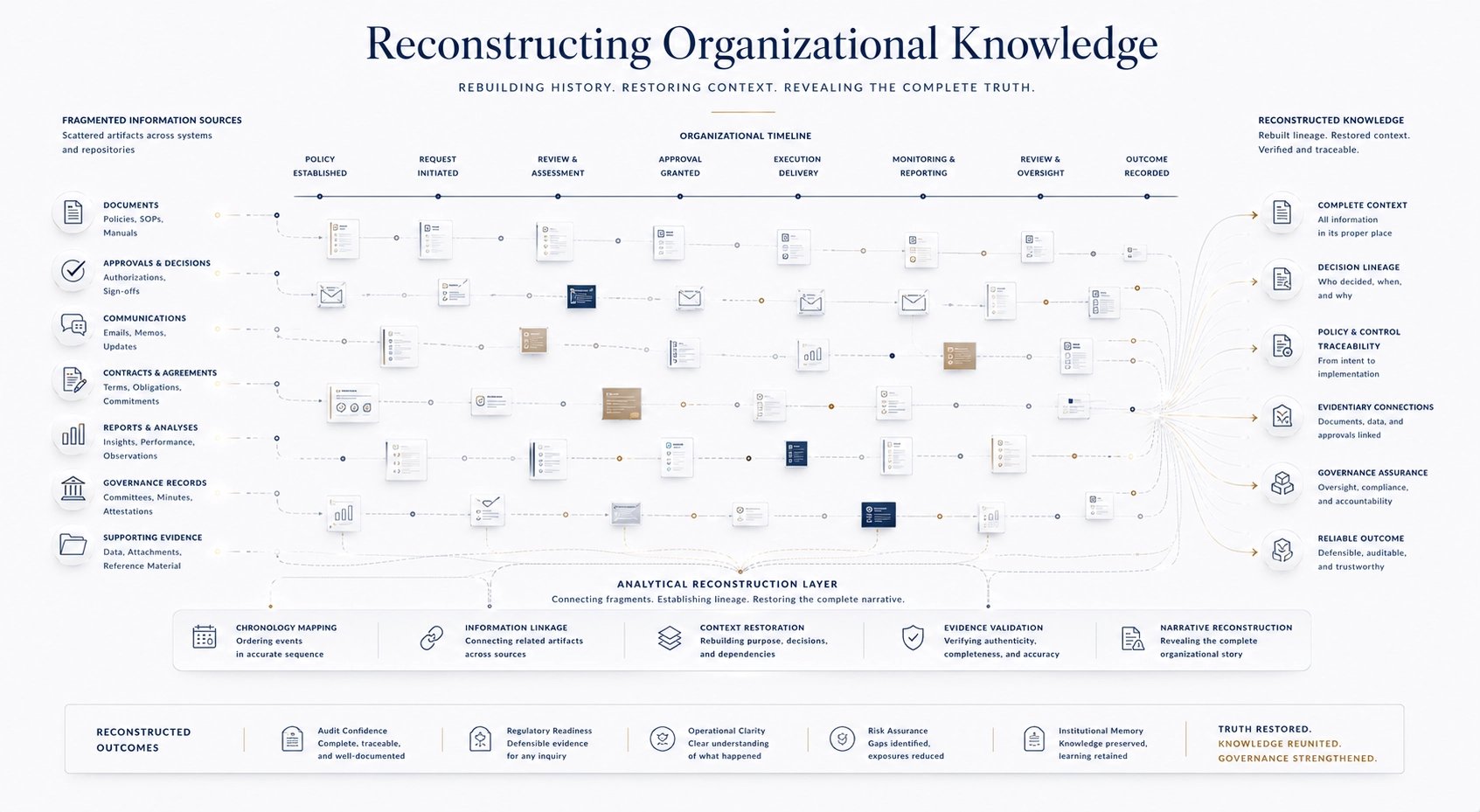
Reconstructing the complete documentation history required contributions from multiple departments, former employees, and archived storage systems.
Following the review, the organization implemented centralized document management, workflow-driven approval processes, enterprise search capabilities, and structured records governance policies.
The organization did not simply improve document retrieval.
It restored confidence in its institutional knowledge.
Reviewers increasingly distinguish between possessing information and governing information.
Organizations may maintain extensive documentation while still struggling to demonstrate information integrity, document lineage, approval history, and evidentiary reliability.
The ability to locate, validate, and defend critical information is increasingly viewed as an important indicator of governance maturity.
Information scattering often becomes visible during audits, regulatory inspections, litigation, due diligence exercises, or governance reviews.
Reviewers frequently request information that appears straightforward:
Organizations generally know that the information exists.
The challenge emerges when retrieval begins.
Critical records may reside across several repositories. Approval evidence may exist only within email correspondence. Historical versions may conflict with one another. Key context may depend entirely upon employee recollection.
At this stage, the discussion moves beyond records administration.
It becomes an assessment of governance defensibility.
What initially appeared to be an information management issue frequently expands into broader questions regarding accountability, control effectiveness, and organizational resilience.
Auditors rarely evaluate missing or difficult-to-locate documents in isolation.
Instead, they examine what these weaknesses reveal about broader governance arrangements.
Missing approvals may trigger questions regarding authorization controls. Inconsistent document versions may prompt scrutiny of document governance processes. Inability to locate supporting evidence may lead reviewers to assess records management practices and management oversight.
What initially appears to be a documentation issue can therefore escalate into a much broader evaluation of governance effectiveness.
This escalation pathway is becoming increasingly common across European regulatory environments.
Organizations that cannot confidently explain where critical knowledge resides often face increased scrutiny regarding governance maturity, information integrity, and operational resilience.
Many organizations continue to view document management primarily as a storage challenge.
Increasingly, that assumption is being challenged.
Enterprise information environments must do far more than retain files. Organizations require the ability to preserve document lineage, maintain version control, automate approvals, connect information to business processes, and ensure that institutional knowledge remains continuously accessible and defensible.
Achieving this level of visibility through shared drives, email archives, and disconnected repositories becomes increasingly difficult as organizations grow.
Organizations therefore require more than document storage systems.
They require integrated information governance environments.
This is where Moebius supports organizations.
Through its integrated Document Management, Workflow Automation, Task Management, and governance capabilities, Moebius enables organizations to centralize institutional knowledge, maintain complete document histories, automate approval workflows, and preserve a continuously accessible and defensible information environment.
The organizations that respond most confidently during audits are rarely those with the largest repositories.
They are the organizations that can immediately locate, validate, and explain the information that matters.
Provide us with a bit of information about your business needs and we will be in touch to arrange a no commitment demonstration.


"*" indicates required fields