
Regulated firms across the GCC rely heavily on client information to support compliance processes, operational decision making, and regulatory reporting. Contact data in particular forms part of the foundation for onboarding, customer due diligence, transaction monitoring, and ongoing client communication. Within many organizations, this information is treated primarily as an operational requirement rather than a control mechanism.
Supervisory reviews are increasingly approaching the issue differently.
Across inspections in jurisdictions such as the UAE and Saudi Arabia, regulators are placing greater attention on the quality, consistency, and governance of client records. What may appear internally as an administrative issue is increasingly being interpreted as an indicator of broader weaknesses within the control environment.
Outdated contact details, inconsistent client records, and incomplete data are no longer viewed in isolation. Supervisors are beginning to treat these issues as early warning signs of wider AML, KYC, and reporting failures.
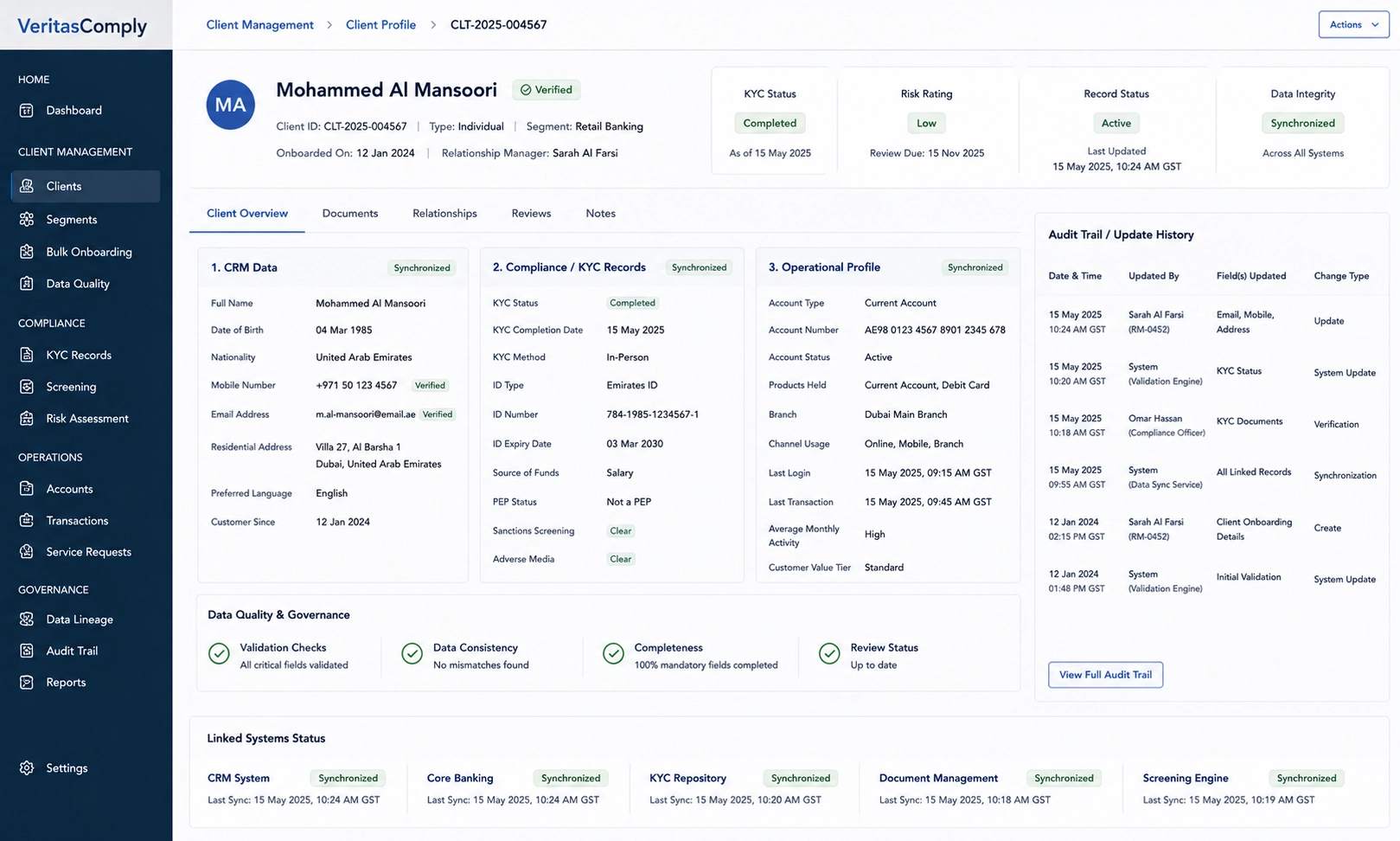
Regulatory frameworks across the GCC place significant emphasis on maintaining accurate and current customer information. This expectation extends beyond onboarding and applies throughout the lifecycle of the client relationship.
Authorities operating under supervisory frameworks such as the Central Bank of the UAE and Saudi Central Bank (SAMA) are increasingly examining whether firms maintain effective control over the quality of client data used across compliance and operational processes.
This includes assessing:
Whether contact records are consistently updated
Whether client information remains aligned across systems
Whether changes to client data are validated and traceable
Whether outdated records continue to be used within compliance workflows
In UAE based inspections, firms have been asked to demonstrate how customer information is reviewed and refreshed over time rather than simply captured during onboarding. In Saudi supervisory reviews, regulators have focused on whether inconsistent client records across systems create gaps in monitoring and reporting processes.
The underlying concern is becoming more visible.
If firms cannot maintain accurate client data, supervisors begin to question the reliability of the controls that depend on it.
Client contact data often feeds directly into multiple operational and regulatory processes. Risk assessments, transaction monitoring alerts, reporting obligations, and escalation procedures may all rely on the same underlying information.
Where records become outdated or inconsistent, the impact extends beyond administration.
Communication with clients may fail. Monitoring activities may rely on incomplete information. Escalations may not reach the appropriate individuals. In some cases, duplicate or conflicting client records may result in fragmented oversight across systems.
These issues are particularly significant within AML and KYC environments, where supervisory expectations rely on firms maintaining an accurate and continuously updated understanding of their customers.
From a regulatory perspective, inaccurate client data raises a broader concern.
If the underlying information is unreliable, the effectiveness of surrounding controls becomes difficult to defend.
These gaps frequently become visible during supervisory inspections.
A review may begin with a sample of client records linked to onboarding, monitoring, or reporting activities. Firms provide customer profiles, supporting documentation, and evidence of due diligence procedures.
The pressure point emerges when supervisors begin comparing data across systems and timelines.
They may identify outdated contact details still being used in active workflows. Client records may differ between operational systems, compliance platforms, and reporting environments. Changes to customer information may lack evidence of validation or approval.
In several UAE inspections, firms have been asked to explain why inactive or outdated contact information remained connected to compliance monitoring processes. In Saudi supervisory reviews, regulators have questioned whether inconsistencies across client records affect the firm’s ability to perform effective ongoing due diligence.
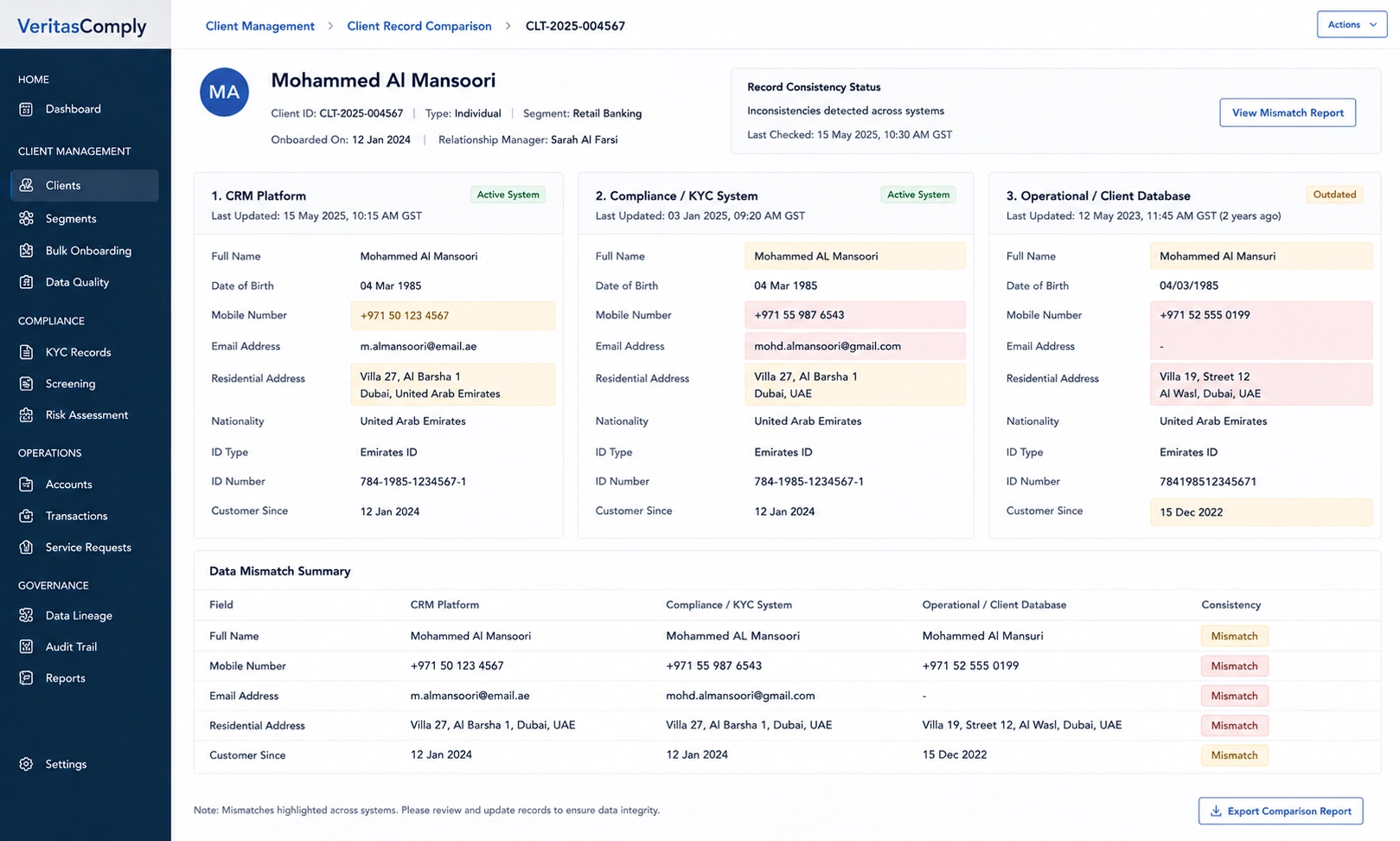
Where these inconsistencies are identified, the issue is no longer viewed as poor data maintenance.
It becomes a question of whether the firm can rely on its own client information to support regulatory obligations.
Once weaknesses in client data integrity are identified, supervisory interpretation typically broadens beyond the specific records under review.
Regulators assess whether the issue reflects isolated administrative gaps or a wider failure in data governance and oversight.
Where firms are unable to demonstrate structured controls around maintaining and validating client records, supervisors may conclude that:
Data governance frameworks are ineffective
Compliance controls are operating on unreliable information
Monitoring and reporting processes may be compromised
In GCC supervisory contexts, findings linked to poor client data quality have increasingly led to broader examination of onboarding controls, ongoing due diligence processes, and operational governance structures.
What may initially appear as a data management issue is often interpreted as a control reliability concern.
Supervisory expectations across the GCC are evolving toward treating client data integrity as an ongoing governance responsibility rather than a periodic administrative exercise.
This requires firms to demonstrate that:
Client information is reviewed and updated continuously
Changes to records are validated and traceable
Data remains consistent across systems and workflows
Outdated or conflicting records are identified and resolved promptly
Where these controls are weak or inconsistently applied, supervisors may question whether firms maintain an accurate understanding of their customer base.
Control effectiveness is increasingly tied to data reliability.
In many organizations, client information exists across multiple operational environments. Customer details may be stored separately within onboarding platforms, CRM systems, compliance tools, and reporting systems.
Over time, this fragmentation creates inconsistencies.
Updates applied in one environment may not be reflected elsewhere. Different teams may rely on separate versions of the same client record. Validation processes may vary between systems.
During supervisory inspections, firms are often required to demonstrate a consistent and accurate view of customer information across these environments. This can become difficult where records are fragmented or maintained independently.
In the UAE inspections, firms have been challenged where discrepancies between operational and compliance systems could not be clearly reconciled. In Saudi supervisory contexts, similar fragmentation has raised concerns around the reliability of customer due diligence information.
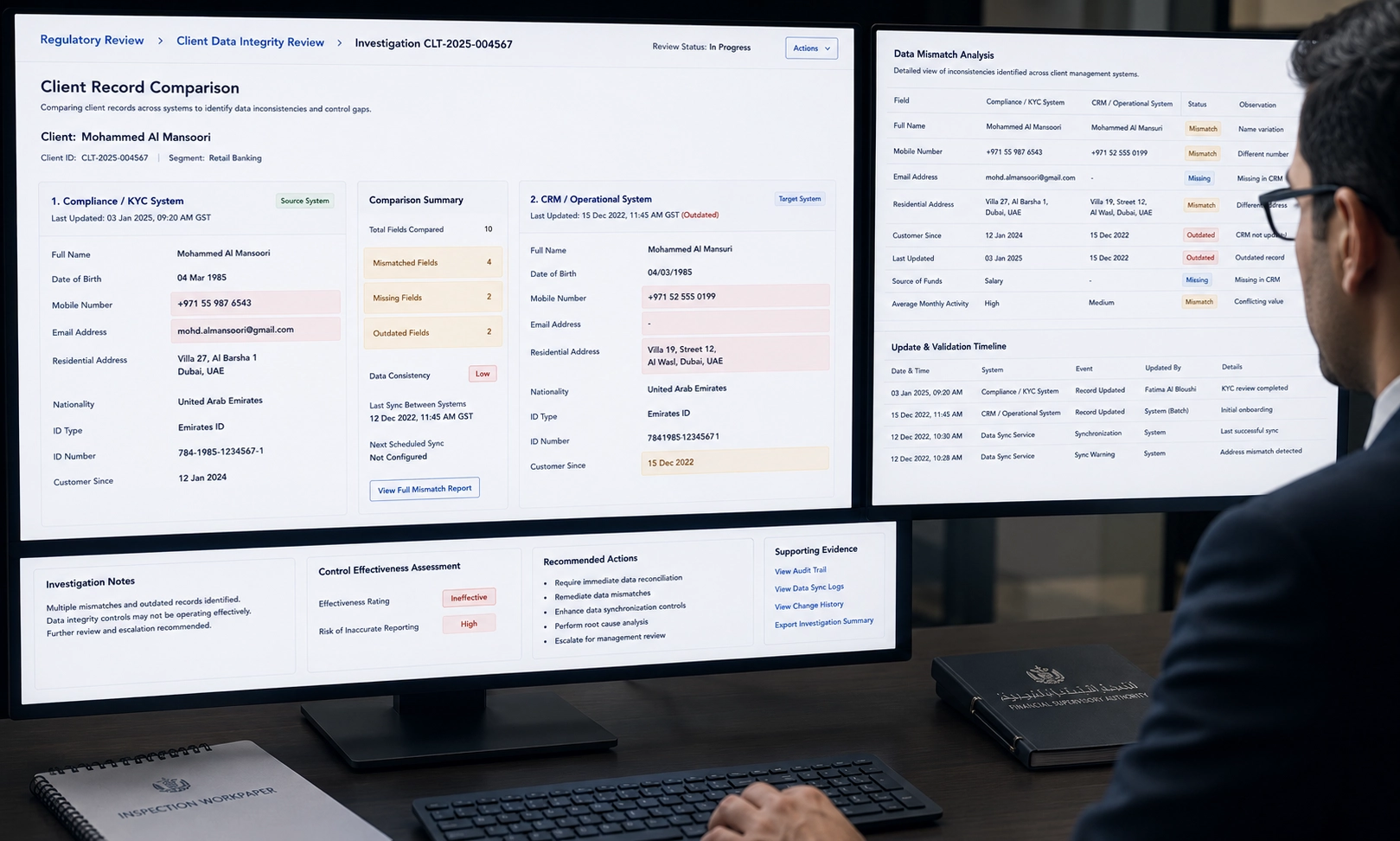
Where firms cannot clearly evidence data consistency, supervisors may question whether the organization maintains effective control over customer information.
To address these risks, firms are increasingly focusing on ensuring that client information is maintained within structured and controlled environments where updates, validation, and usage remain visible across workflows.
This involves treating contact data as a core component of the control framework rather than simply an operational record.
In practice, this means:
Client information is maintained consistently across systems
Changes to records are validated and tracked
Monitoring and reporting processes rely on synchronized data sources
Data quality issues are identified and escalated in real time
When these conditions are met, firms are better positioned to demonstrate that compliance controls operate on accurate and reliable information.
Provide us with a bit of information about your business needs and we will be in touch to arrange a no commitment demonstration.


"*" indicates required fields