
Regulated firms across Europe operate within environments where risk identification is only one part of the control framework. Once a risk is identified, it is expected to trigger timely action, escalation, or remediation depending on its nature and severity. In principle, this sequence is well understood and embedded within most compliance processes.
Supervisory reviews are increasingly focused on what happens between these two points. The interval between identifying a risk and acting on it is no longer treated as an operational detail. It is being assessed as a control in its own right. Where delays occur, regulators are examining whether those delays reflect capacity constraints or a deeper weakness in how controls are applied.
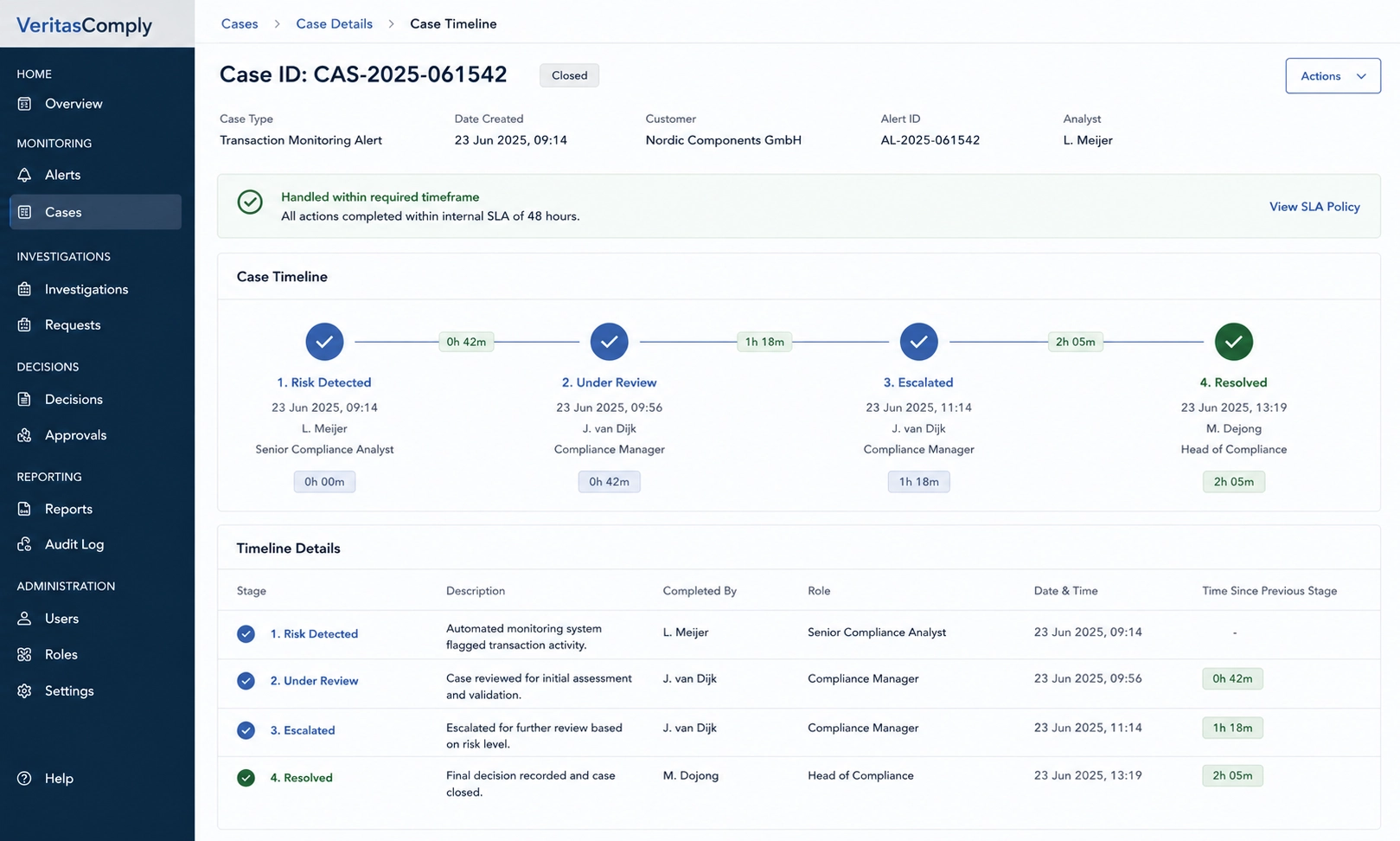
European regulators are placing greater emphasis on how quickly firms respond once a risk has been identified. The expectation is not limited to whether action eventually occurs, but whether it happens within a timeframe that reflects the level of risk involved.
Authorities influenced by supervisory approaches from the European Banking Authority are increasingly examining response timelines as part of control assessments. Reviews often include analysing how long it takes for alerts to be reviewed, escalations to be triggered, and decisions to be implemented.
In several European inspections, firms have been asked to justify delays between alert generation and investigation, or between identification of an issue and escalation to senior management. Where response times are inconsistent or extended without clear justification, supervisors are less likely to accept operational backlog as an explanation.
From an internal perspective, delays are often attributed to workload, prioritisation challenges, or resource constraints. In complex environments, it is not unusual for certain actions to take longer than intended.
Supervisory interpretation is more direct.
Where a risk has been identified, but action is delayed, the control is considered incomplete. The existence of the alert or detection mechanism is not sufficient if it does not lead to timely intervention. In this context, delay is not treated as a secondary issue. It is treated as evidence that the control framework is not functioning effectively.
This distinction is critical. A firm may be able to demonstrate that risks are detected, but if those risks are not acted upon within an appropriate timeframe, the effectiveness of the control is called into question.
This issue typically becomes visible during supervisory inspections, where regulators examine the lifecycle of specific events rather than relying on summary reporting.
A review may begin with a sample of transaction alerts, suspicious activity indicators, or compliance breaches. Firms provide system records showing when the issue was identified, along with documentation of subsequent actions taken.
The pressure point emerges when supervisors analyse the sequence and timing of those actions.
They may examine how long it took for an alert to be reviewed, when escalation occurred, and when a final decision was made. In European inspections, firms have been asked to explain why high risk alerts remained unreviewed for extended periods or why escalation occurred significantly after initial detection.
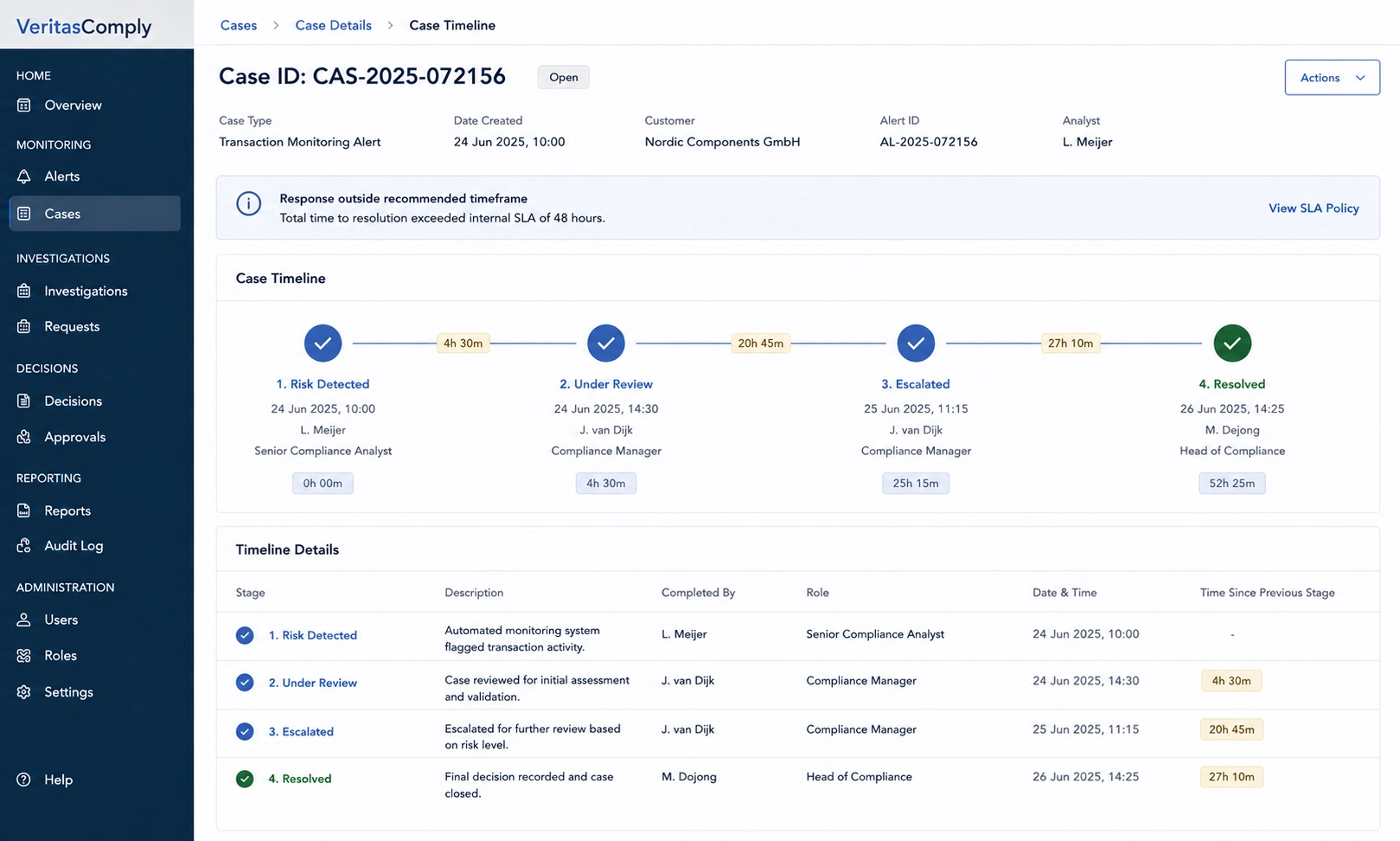
Where these gaps are identified, the issue is no longer viewed as operational delay. It becomes a question of whether the control is capable of responding to risk in a timely manner.
Once timing gaps are identified, supervisory interpretation tends to extend beyond the specific cases under review. Regulators assess whether delays are isolated or indicative of a broader pattern across processes and teams.
Where delays are recurring, the interpretation shifts.
What begins as a timing issue is reclassified as a control weakness. If response times are inconsistent, poorly monitored, or not aligned with risk severity, supervisors may conclude that the firm lacks effective mechanisms to ensure timely action.
In European supervisory contexts, such findings have led to broader reviews of escalation frameworks, resource allocation, and governance oversight. Delays that appear operational at a micro level are often treated as structural at a supervisory level.
Supervisory expectations increasingly require firms to treat response time as a measurable component of control effectiveness. This involves defining clear timelines for different types of actions and ensuring that these timelines are consistently met.
Effective governance frameworks typically include defined thresholds for review, escalation, and resolution, along with mechanisms to monitor adherence to those thresholds. Where delays occur, they are expected to be identified, explained, and addressed.
Where such structures are absent, or where adherence is inconsistent, supervisors may view this as a lack of control over how risks are managed in practice.
In many organizations, the stages of risk management are captured across different systems. Detection may occur in one platform, review in another, and escalation or resolution in a separate environment. Communication and decision making may take place outside these systems.
This fragmentation makes it difficult to establish a clear and consistent timeline of events.
During supervisory reviews, firms may need to reconstruct when a risk was identified, when it was reviewed, and when action was taken. This often requires pulling data from multiple sources and aligning them into a single sequence.
In European inspections, firms have been challenged where these timelines could not be clearly demonstrated. Where evidence is incomplete or inconsistent, supervisors may question whether response processes are effectively controlled.
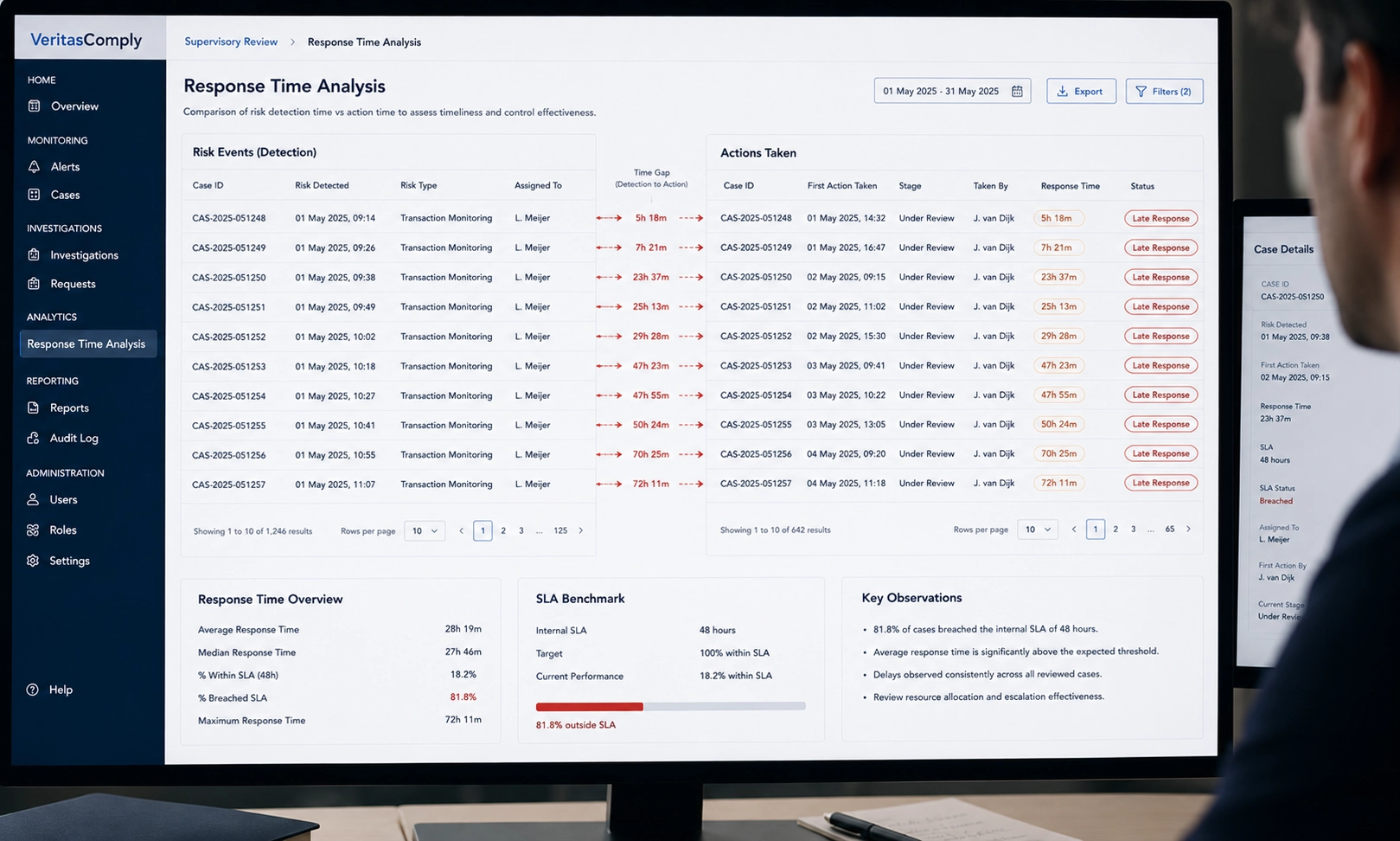
To address these risks, firms are increasingly focusing on ensuring that response processes operate within structured environments where timing is visible, measurable, and controlled.
This involves embedding response timelines within workflows so that actions are triggered and tracked in real time. It also requires ensuring that delays are immediately visible and subject to escalation.
In practice, this means that detection, review, and escalation are connected within a single process, with clear time based expectations applied at each stage. Where these conditions are met, firms are better positioned to demonstrate that risks are not only identified but also acted upon within appropriate timeframes.
Provide us with a bit of information about your business needs and we will be in touch to arrange a no commitment demonstration.


"*" indicates required fields