
For many regulated firms across Europe, annual filings and compliance reviews are still treated as routine administrative obligations. Financial statements are finalized, regulatory forms are submitted, audit schedules are managed, and compliance reports are compiled.
On the surface, this process appears orderly.
In practice, annual filings and regulatory reviews have become one of the most revealing stress tests of a firm’s compliance infrastructure.
Across law firms, fiduciaries, corporate service providers, fintech firms, banks, and Designated Non-Financial Businesses and Professions (DNFBPs), the same pattern repeats year after year. The filing itself is completed, but the process of assembling the required data exposes inconsistencies, missing records, conflicting client information, and undocumented compliance decisions that were invisible during daily operations.
What emerges is not a documentation problem. It is a structural data problem.
In European regulatory environments shaped by tightening obligations under the Anti-Money Laundering Directive (AMLD), the General Data Protection Regulation (GDPR), and growing supervisory pressure driven by the Financial Action Task Force (FATF), these inconsistencies increasingly translate into regulatory risk rather than administrative inconvenience.

Annual filings and compliance reviews force a firm’s entire data environment to converge into a single regulatory narrative.
Client records, beneficial ownership details, transaction histories, risk classifications, billing data, audit trails, and compliance decisions all have to align.
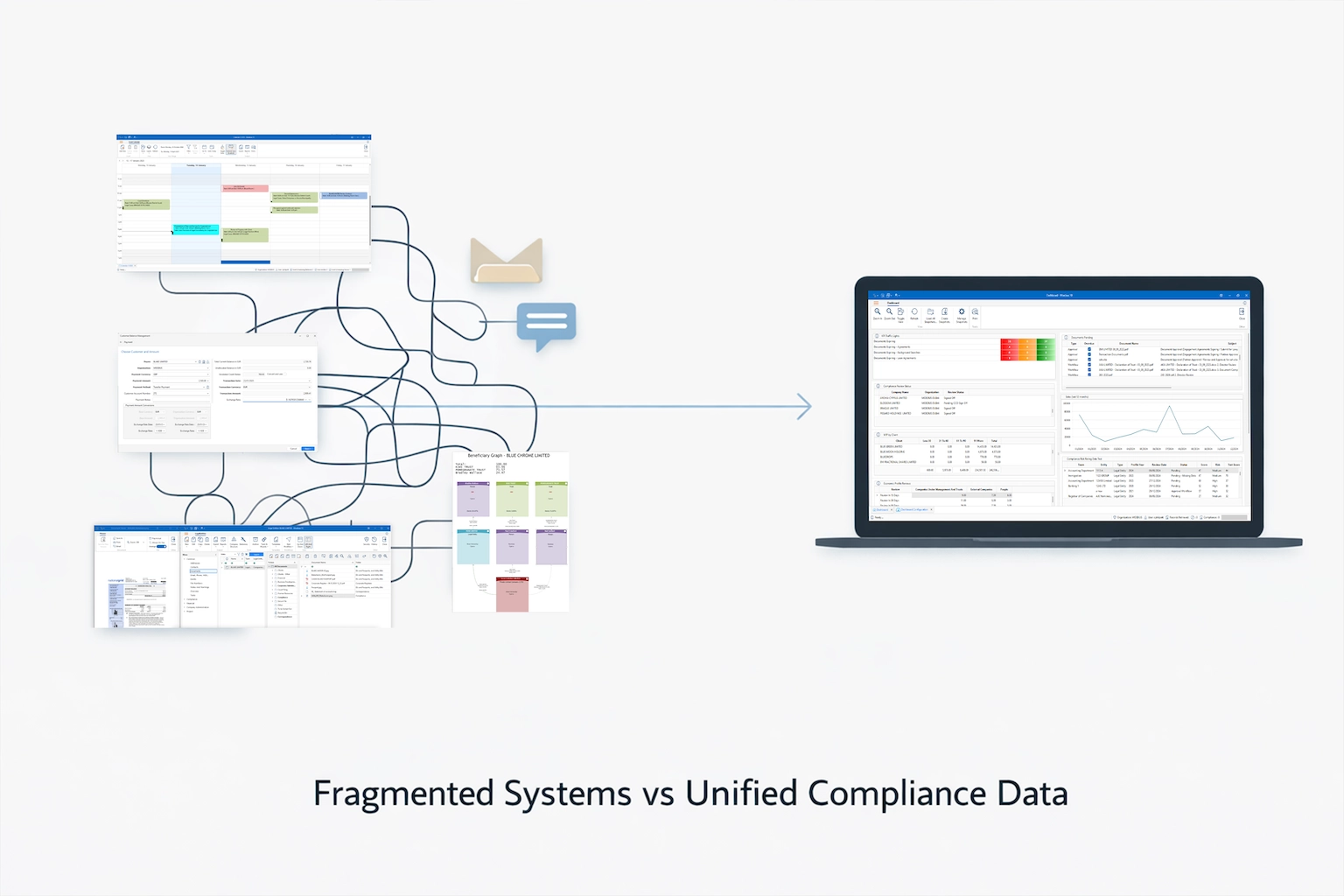
When those elements sit across spreadsheets, email chains, onboarding tools, document repositories, accounting platforms, and standalone compliance systems, the convergence process becomes fragile.
During routine operations, fragmented data environments function tolerably. Teams work around inconsistencies. Minor mismatches go unnoticed. Manual corrections become habitual.
During filings and audits, those same inconsistencies surface simultaneously.
Regulators do not only review whether a filing is complete. They assess whether the data supporting that filing is coherent, traceable, and defensible across systems and time periods.
In European jurisdictions such as Cyprus, where firms operate under the supervision of the Cyprus Securities and Exchange Commission (CySEC), the Institute of Certified Public Accountants of Cyprus (ICPAC), and the Cyprus Bar Association, annual filings and regulatory reviews increasingly extend beyond finance into compliance and governance.
A filing that reconciles financially but collapses under compliance questioning is no longer considered acceptable.
In fragmented compliance environments, three recurring failure points appear during annual filings and audits.
First, inconsistent client records.
Client onboarding data stored in one system often does not match what appears in accounting platforms, compliance logs, or legal matter files. Beneficial ownership details may differ between corporate registers, internal compliance tools, and audit documentation. Risk classifications applied during onboarding are not always reflected in how clients are treated operationally.
Second, broken audit trails.
Compliance decisions taken months earlier, such as why a client was classified as low risk, why enhanced due diligence was not triggered, or why a suspicious transaction alert was closed, cannot be reconstructed confidently. Supporting context sits across emails, spreadsheets, and disconnected platforms, making regulatory explanation difficult.
Third, follow-up fragility.
After an initial filing is submitted, regulators frequently request clarification, updated ownership records, historical transaction summaries, or justification for prior compliance decisions. Each follow-up reopens the reconciliation problem. Each manual assembly increases the risk of introducing new inconsistencies.
These are not isolated documentation failures. They are symptoms of system design weaknesses.
In 2026, European regulators no longer interpret filing inconsistencies as clerical issues.
They interpret them as internal control weaknesses.
Under FATF-aligned supervisory approaches, regulators increasingly infer governance quality from how smoothly firms can:
When firms struggle during filings, they are not viewed as administratively disorganized.
They are viewed as structurally under-controlled.
In jurisdictions influenced by Cyprus-style regulatory supervision, this inference is particularly strong. CySEC inspections, ICPAC audit reviews, and professional-body oversight now regularly cross-reference filings with compliance practices, beneficial ownership registers, and AML documentation.
Filing inconsistencies have become compliance signals.
Although regulatory expectations are converging across Europe, filing-driven gaps manifest differently by sector.
For law firms, annual reviews increasingly surface inconsistencies between client onboarding records, conflict-check logs, billing data, and matter documentation. When client risk classifications do not align with transactional behavior or billing history, regulators question whether compliance oversight is operationally embedded or merely procedural.
For corporate service providers and fiduciaries, filings frequently expose outdated beneficial ownership records and incomplete economic substance documentation. Ownership structures that have changed during the year are not always reflected consistently across compliance systems, legal files, and accounting platforms.
For fintech firms and virtual asset service providers, annual reporting highlights mismatches between transaction monitoring outputs, alert-handling records, and risk-scoring frameworks. Regulators increasingly expect defensible consistency between how clients are monitored and how they are reported.
For DNFBPs, filings often surface documentation gaps around source-of-funds verification, ongoing monitoring decisions, and escalation logic applied to higher-risk clients.
For banks, filing discrepancies are treated as immediate governance issues, not administrative errors. Even minor data mismatches can escalate into supervisory findings.
Across sectors, the pattern is consistent.
Annual filings expose the fault lines created by fragmented systems.

A supervisory authority requests confirmation of all high-risk clients reported during the previous financial year. The request includes:
The regulator expects coherent, reconciled data within days.
In firms operating on spreadsheets and siloed systems, this request triggers a manual assembly exercise across compliance, finance, legal, and operations teams.
Client records do not align across tools. Ownership details differ between registers and internal files. Risk classifications applied during onboarding do not match those reflected in transaction monitoring systems. Closed-alert reasoning sits in email threads rather than structured audit logs.
Time is lost reconciling versions.
Each reconciliation increases the risk of introducing new inconsistencies.
In firms operating on unified compliance environments, the same request is procedural. Data is already structured, traceable, and regulator-ready.
In 2026, this difference increasingly determines whether a filing review remains routine or escalates into a supervisory finding.
Many regulated firms believe they have solved their data problems because some systems are connected.
In reality, partial integration rarely survives regulatory scrutiny.
When onboarding tools, accounting platforms, compliance systems, and document repositories operate independently, even with light integration, inconsistencies still emerge during filings.
Data synchronization delays create version mismatches.
Manual overrides introduce undocumented changes.
Updates made in one system do not propagate reliably to others.
During routine operations, these weaknesses remain hidden.
During annual filings and audits, they surface immediately.
Regulators interpret this not as a technical limitation, but as a governance risk.
Firms that perform consistently during audits and regulatory reviews share one defining characteristic.
They operate on a unified compliance data environment.
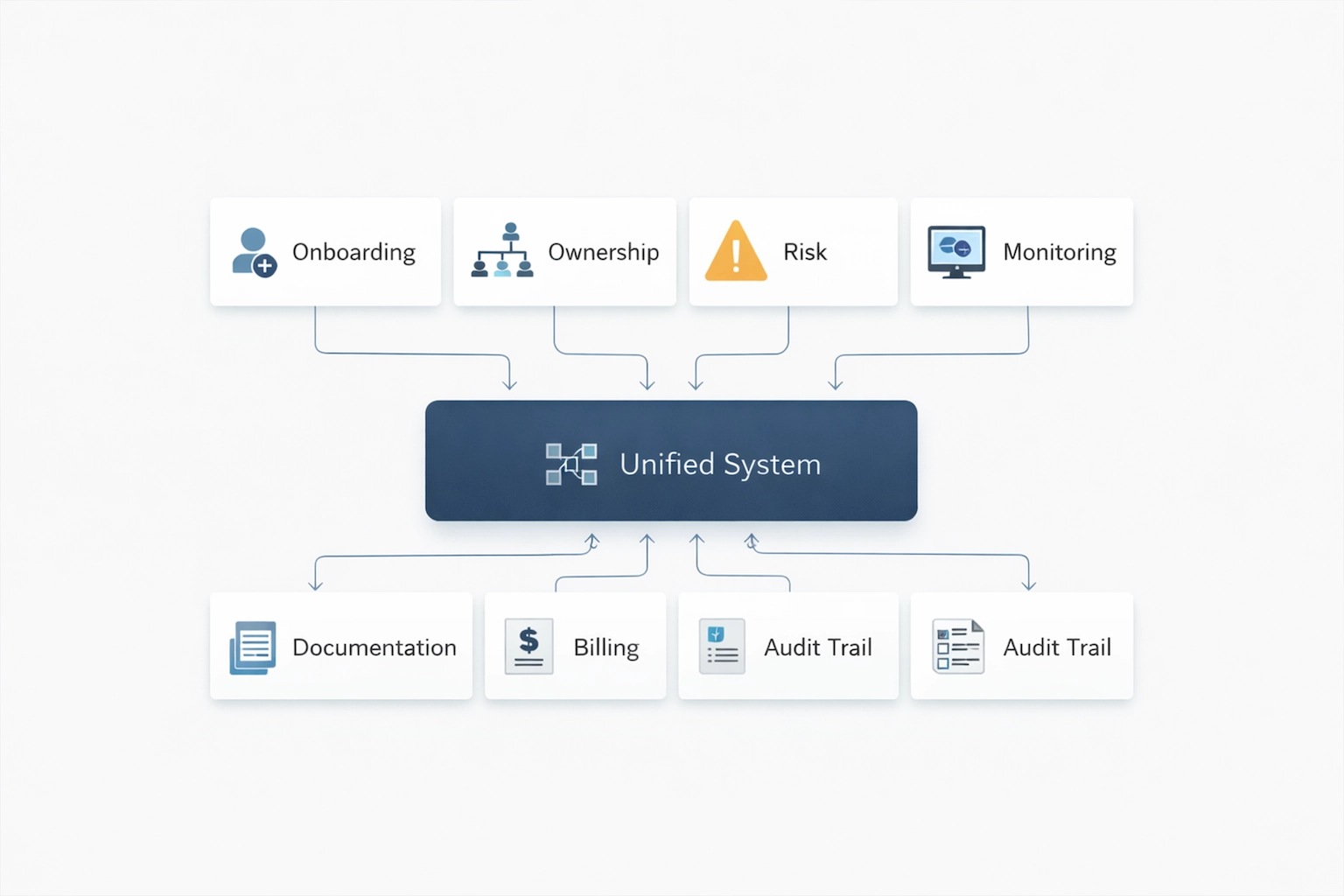
Client onboarding, beneficial ownership records, risk assessments, transaction monitoring, compliance actions, documentation, billing visibility, and audit trails all exist within one operational framework.
This structural coherence delivers three critical outcomes during filings.
First, data consistency.
The same client record supports legal, financial, and compliance reporting.
Second, traceability.
Every compliance decision can be reconstructed months later, with supporting context intact.
Third, inspection resilience.
Follow-up requests from regulators become procedural rather than disruptive because the information already exists in a structured, regulator-ready form.
This is not about faster reporting. It is about defensible reporting.
For many firms, annual filings still sit within finance or legal departments.
In practice, filings are now compliance events.
They test:
Treating filings as a narrow reporting obligation is no longer defensible in modern regulatory environments.
Filing readiness is now a compliance strategy.
Moebius is designed for this exact regulatory stress point.
By unifying client data, beneficial ownership records, risk classifications, compliance actions, documentation, billing visibility, and audit trails into a single operational environment, Moebius enables firms to maintain filing-ready compliance data continuously, not just at year-end.
This means that annual filings no longer pose a high risk.
They become routine confirmations of data integrity.
Moebius turns regulatory reporting from a reconciliation exercise into a controlled, inspection-ready process.
Provide us with a bit of information about your business needs and we will be in touch to arrange a no commitment demonstration.


"*" indicates required fields